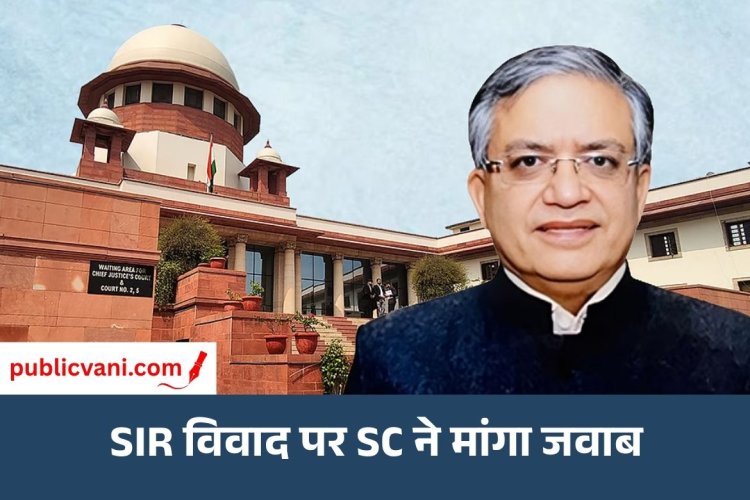
Supreme Court on SIR Controversy: The Supreme Court has sought a reply from the Election Commission. The court said that after looking at the replies, if earlier decisions were found to be without consent, then they can be withdrawn.
Supreme Court on SIR Controversy: New Delhi. The Supreme Court on Monday refused to give an interim order to suspend Chief Election Commissioner Gyanesh Kumar. CEC Gyanesh is accused of taking about 14 decisions related to SIR without the consent of two other election commissioners. The court has sought a reply from the Election Commission on these allegations. After looking at the replies, if the decisions are found to be without consensus then they can be withdrawn.
Notice issued to Central Government and Election Commission
A bench of CJI Surya Kant, Justice Joymalya Bagchi and Justice V. Mohana issued notice to the Central Government, Election Commission, CEC Gyanesh Kumar, Election Commissioners Dr. Sukhbir Singh Sandhu and Dr. Vivek Joshi, Deputy Election Commissioner Manish Garg and DG (IT) Seema Khanna on the petition.
Hearing was held on petitions filed against the Chief Election Commissioner taking decisions on SIR by ignoring both the Election Commissioners. The court said that no order can be given on the basis of news report because it may be completely true, partially or false.
Next hearing will be held next week
During the hearing, the court said that nothing like this would happen in 10 days. It can always be canceled if something goes wrong. The lawyer demanded to keep the records safe but the court did not say anything on this.
The next hearing of the case will be held next week. The three-member bench heard three petitions of Shailendra Mani Tripathi, Rakesh Kumar Singh and Sudhakar Singh. Lawyer Vikas Singh said that the Election Commission will take decisions by majority or consensus. No decision can be taken alone.
Process to remove election commissioner
-
- To initiate the process against the CEC, a notice signed by at least 100 MPs in the Lok Sabha or 50 MPs in the Rajya Sabha is given.
-
- After the notice is approved, investigation is conducted under two prescribed legal procedures to investigate the allegations. In this, CEC gets a chance to present its side.
-
- If the allegations are proved in the investigation, a proposal for his removal is brought in the Parliament.
-
- It is necessary to pass the proposal by special majority in both Lok Sabha and Rajya Sabha. That is, a majority of the total membership of the House and at least two-thirds votes of the members present and voting are required.
-
- The President can remove the CEC from the post after the proposal is passed by both the Houses.
Gyanesh Kumar is the 26th Chief Election Commissioner of India.
-
- Gyanesh assumed office on 19 February 2025. He is the first CEC to be appointed under the new law of 2023.
-
- He is a 1988 batch IAS officer of Kerala cadre. Retirement on 31 January 2024.
-
- B.Sc. in Civil Engineering from IIT Kanpur. Tech, studied Business Finance from ICFAI, Environmental Economics from Harbord University.
-
- He was Joint Secretary in the Ministry of Defence, played an important role in the modernization of Defense Shipyard.
-
- Worked as Secretary in the Ministry of Parliamentary Affairs and Ministry of Cooperation.
-
- Became District Collector of Ernakulam in Kerala, Kochi Municipal Corporation Commissioner, MD of Kerala State Cooperative Bank.
-
- Joint Secretary, as Additional Secretary, played a major role in the state reorganization process, abrogation of Article 370 in Jammu and Kashmir.
-
- Appointed Election Commissioner on 15 March 2024, he conducted the 2024 Lok Sabha elections and assembly elections of various states.