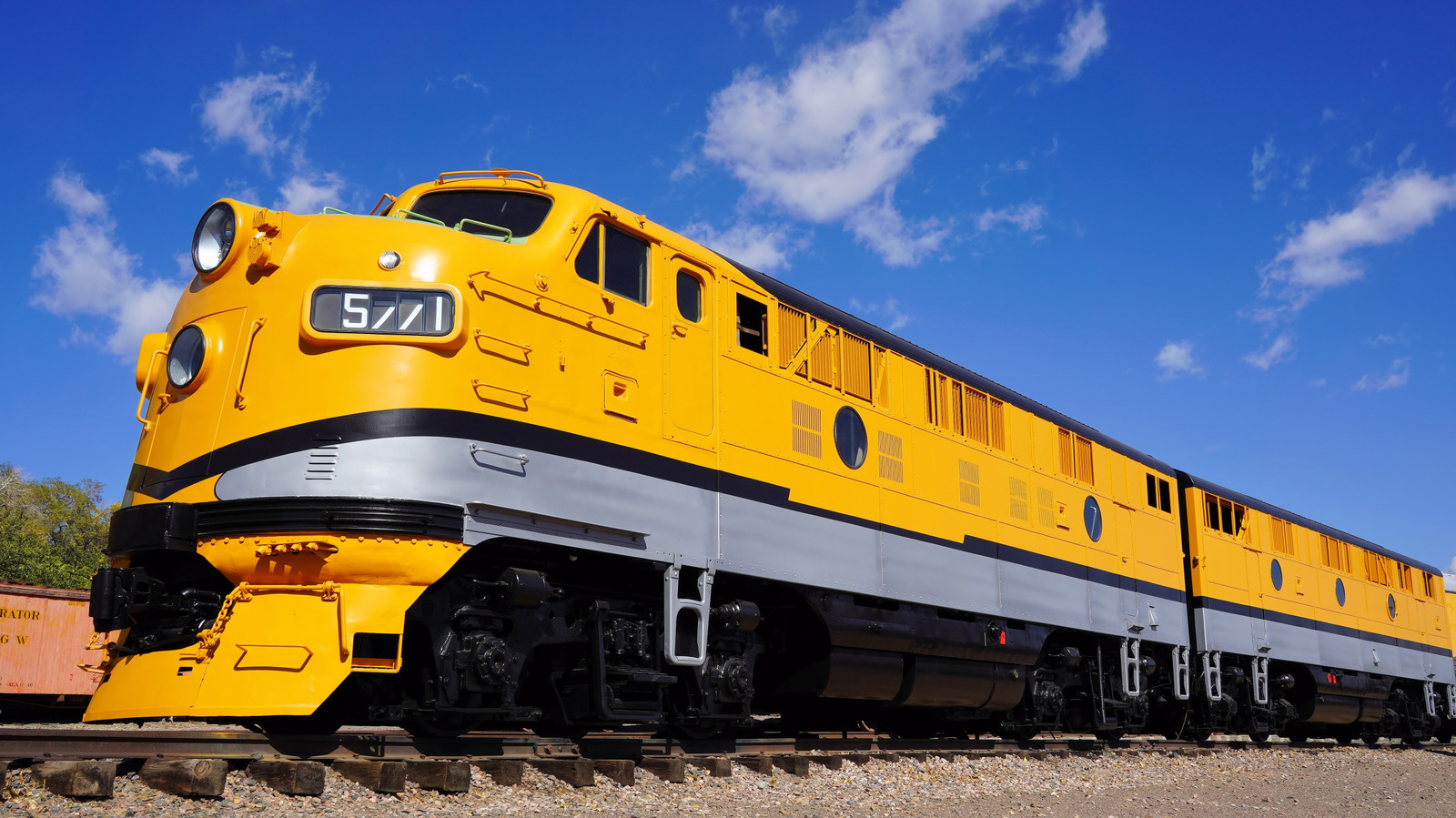
The train that earned the title of “The Diesel That Did It” was the Electro-Motive “F-unit.” Its primary mission was to haul freight, which is what the “F” stood for — even though it was also well-suited for pulling passengers. From the fall of 1939 through more than 20 years of production, until 1960, over 7,500 Electro-Motive F-units were manufactured. And believe it or not, the Electro-Motive Division was owned by General Motors, which acquired the company in 1930, building a total of eight models of this extremely influential diesel-electric locomotive, which had an engine type about which there are things you might not know.
The actual engine that powered the Electro-Motive F-unit was Electro-Motive’s 567-series V-16 diesel engine, which initially produced 1,350 horsepower and was steadily upgraded until it put out 1,750 horsepower in its final form, the F9, in 1954. The F-unit’s primary accomplishment was to show railroads that diesel-electric locomotives could compete with long-running steam locomotives for hauling freight long distances on challenging routes at greatly reduced cost.
The title “The Diesel That Did It” was awarded to a specific F-unit locomotive set, the FT demonstrator 103, which went on a demonstration tour that ran from November of 1939 until October of 1940. This tour put a total of 83,764 miles on FT 103, hauling the heaviest freight and people for 20 different railroads on some of the most difficult routes with the steepest inclines. FT 103 accomplished its mission, ending the steam age and opening the diesel era.
What else should you know about ‘The Diesel That Did It?’
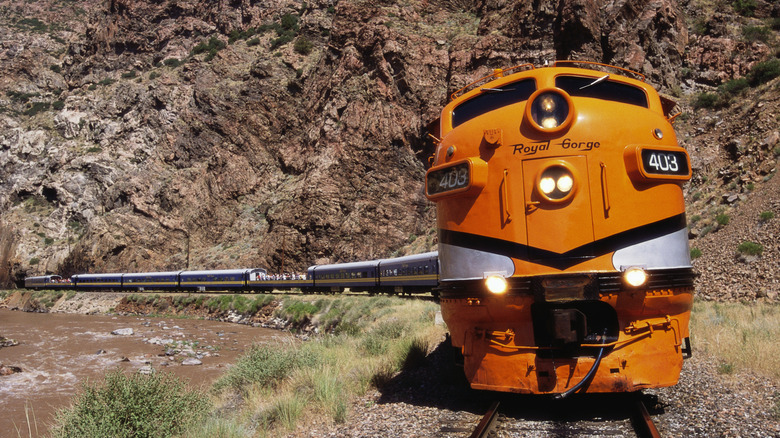
Electro-Motive’s F-unit was not its first diesel-electric locomotive. The company spent many years prior to 1939 developing its line of switching engines and other diesel-electric trains, which still haven’t become fully electric. In addition, its diesel engine was extremely reliable, and Electro-Motive provided high levels of customer service. This was a winning combination. General Motors also calculated the financial benefits of converting the railroad industry to diesel. It amounted to a $4 billion jackpot for the company that did it. General Motors had two factories to produce these locomotives: La Grange, Illinois, and London, Ontario, Canada.
The Electro-Motive demonstrator set FT 103 was not one diesel-electric locomotive; it was actually a set of four. These were configured as an A-B-B-A set, which looks like the top photo, with two identical units added in reverse order. Altogether, this set produced 5,400 horsepower, more than enough to handle the heaviest freight loads. Speaking of weight, the entire demonstrator set weighed 923,600 pounds and carried 1,200 gallons of diesel fuel. The 80,000+-mile demonstration tour to the many U.S. railroads likely included some of the longest train lines in the world.
Half of the original FT 103 demonstrator set has survived to the present day, with one A unit at the National Museum of Transportation in St. Louis, Missouri, and one B unit at the Virginia Museum of Transportation in Roanoke, Virginia. The F-unit represents the rise of diesel-electric power and the decline of steam as a means of propulsion.