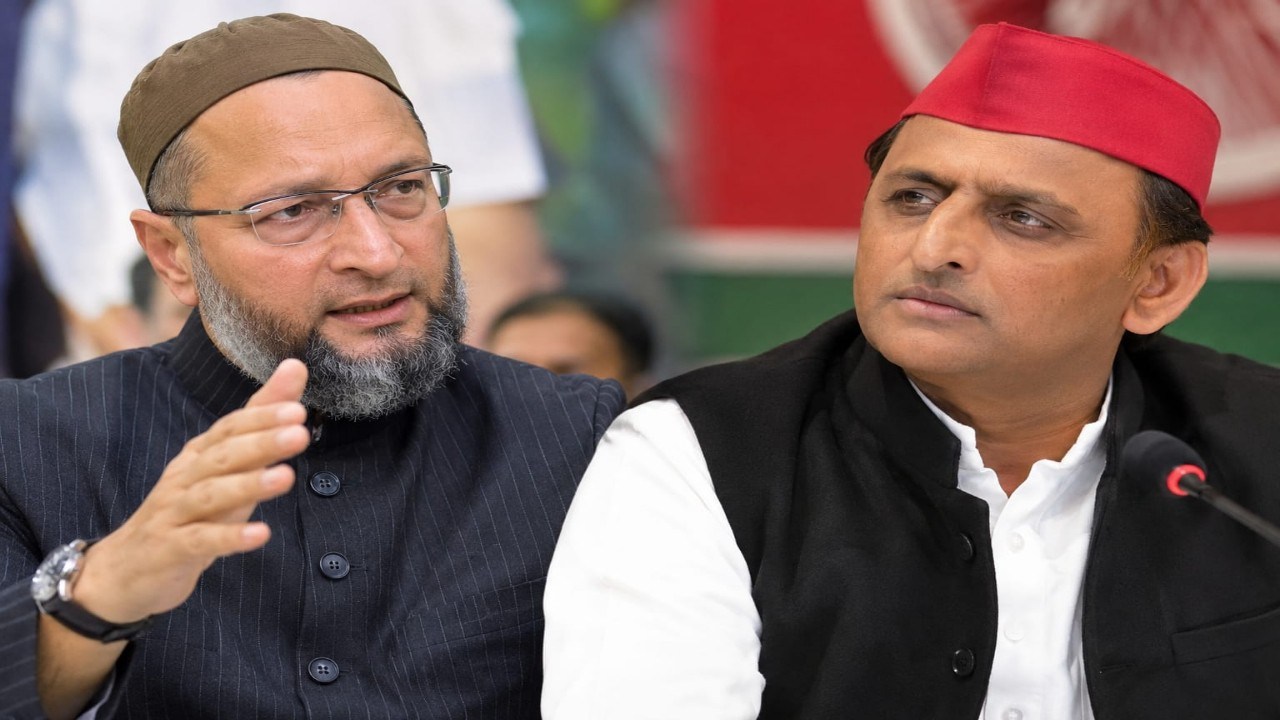
Before the Uttar Pradesh Assembly elections 2027, political efforts to woo Muslim and Dalit voters are intensifying. While Samajwadi Party (SP) President Akhilesh Yadav is preparing to return to power with the help of PDA i.e. Backward, Dalit and Minority equation, Asaduddin Owaisi's Muslim-Dalit (MD) formula can become a new challenge. There are political discussions regarding a possible alliance between Owaisi's AIMIM and Nagina MP Chandrashekhar Azad's Azad Samaj Party (Kanshi Ram). If both the parties come together and succeed in uniting their supporters, then the mathematics of the contest may change on many seats from Western UP to Rohilkhand.
Owaisi's MD formula is being seen as a possible strategy to bring together Muslim and Dalit voters. AIMIM talks about Muslim political representation, while the main basis of Chandrashekhar Azad's politics has been Dalit rights and social justice. If there is an alliance between the two parties, the challenge for SP to save its traditional support may increase.
SP's problems may be greater in those seats where Muslim voters play an important role in its victory and the contest is decided by small margins. If AIMIM fields a strong candidate there, there may be a possibility of BJP getting benefit from the division of opposition votes. At the same time, if Chandrashekhar Azad's party strengthens its hold among the Dalit voters, then Akhilesh Yadav's PDA equation will also be tested.
Why are the results of 2022 important?
In the 2022 assembly elections, BJP had won 255 seats, while SP had won 111 seats. BSP could win only one seat, although its vote percentage was around 12.9 percent. This made it clear that despite the presence of a party's vote base, it is not easy to convert it into seats. In 2027, SP will face the challenge of maintaining its Muslim-Yadav base and increasing support among backward classes and Dalit voters. On the other hand, BJP may try to take advantage of the division of votes among the opposition parties. If Muslim and Dalit voters unite in any area and support one candidate, then the contest can be challenging for BJP as well.
Also read: Defamation case: Relief or shock for Rahul Gandhi? Decision on 26 October
Eye on 50 seats from Western UP to Ruhilkhand
In the context of Owaisi's MD formula and the possible alliance of Chandrashekhar Azad, Behat, Nakur, Saharanpur Nagar, Saharanpur, Deoband, Rampur Maniharan and Gangoh seats of Saharanpur division may remain under discussion. In the Shamli-Muzaffarnagar area, Kairana, Shamli, Thana Bhawan, Budhana, Charthawal, Purkaji, Muzaffarnagar, Khatauli and Meerapur will also be monitored.
The equation of votes of Muslims, Dalits and other communities may be important in Nagina, Dhampur, Nahtaur, Bijnor, Chandpur and Noorpur seats of Bijnor region. The impact of the possible alliance will also be visible in Kanth, Thakurdwara, Moradabad Rural, Moradabad Nagar, Kundarki and Bilari of Moradabad region. The trends of Muslim and Dalit voters in Sambhal, Asmoli, Chandausi, Gunnaur and Bisauli can affect the electoral contest.
Local social equations will also be important in Swar, Rampur, Chamraua, Milak and Bilaspur seats of Rampur region. The support of different communities in Amroha, Naugawan Sadat, Hasanpur and Dhanaura can decide the direction of the results. Sardhana, Meerut South, Meerut Cantt, Hapur, Garhmukteshwar, Dhaulana, Loni and Muradnagar seats of Meerut-Hapur region will also be monitored for possible Muslim-Dalit equation. However, it is too early to assume that the alliance will have the same impact on all these seats. The popularity of the candidate, local issues and support from other communities can also play a decisive role.
How much benefit to Owaisi and Chandrashekhar?
The challenge for Owaisi will be to establish AIMIM as a strong political alternative and garner sufficient support in favor of its candidates. Chandrashekhar Azad will face the challenge of strengthening the Dalit base and increasing acceptance among other communities as well. If both the parties form an alliance, then the distribution of seats, selection of candidates and transfer of votes of supporters in favor of each other will decide its success. The alliance will be beneficial only if both the parties are not limited to just bringing their supporters together on one platform, but can also keep them united till the day of voting.
Also read: 5 Pasi MPs of SP, BJP weak, how will politics improve in UP?
Will BJP get benefit?
If a part of Muslim votes goes towards AIMIM and Dalit voters divide among different parties, then BJP's position may get strengthened in some seats. But if the potential alliance enters the electoral fray with strong candidates and gathers support at the local level, then the contest could also be triangular. That is why the challenge for Akhilesh Yadav will not only be related to Owaisi's candidates but also to maintaining his hold among the Dalit voters. On the other hand, BJP will also have to counter the opposition's strategy by keeping its supporters united.
At present, the alliance of Owaisi and Chandrashekhar Azad should be seen only as a possible political equation. If both come together, then PDA may face a challenge to the MD formula in the 2027 elections. Which seats will have its actual impact will be clear only from the formal announcement of the alliance, candidates and grassroots support.