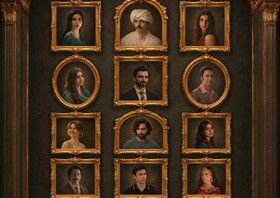
Long before Indian audiences began waxing eloquent about Korean and Chinese dramas, Pakistani series had already found a loyal following in India and continue to be a favourite binge-watch.
Now, all eyes were trained on Netflix’s first Pakistani original, the much-awaited Jo Bacchae Hain Sang Samait Lo, which brings together not one but two of Pakistani television’s favourite on-screen pairs — Fawad Khan reunites with Mahira Khan, 15 years after the hit melodrama Humsafar, which had fans in an emotional chokehold when it was released in 2011. The series also reunites Fawad with Sanam Saeed, his co-star in the slow-burn, grounded romantic drama Zindagi Gulzar Hai, released in 2012, which went on to achieve a cult following among viewers on both sides of the border. The trailer of Jo Bacchae Hain Sang Samait Lo, which released on November 24, introduces six interconnected love stories spanning three generations and was met with considerable excitement.
For fans in India, however, the December 4 watch party, the day the show is scheduled to stream globally, has encountered a major glitch. The All India Cine Workers Association (AICWA) wrote to Prime Minister Narendra Modi earlier in the week, demanding that the series not be released in India and called for a permanent ban on Pakistani entertainment content on Indian screens. On November 26, the Ministry of Information and Broadcasting asked Netflix not to showcase Pakistani content in India, reiterating the mandate issued on May 8, 2025, following last year’s Pahalgam terror attack, asking digital platforms not to release content originating from Pakistan in India.
The past two days have also seen calls for the cancellation of two private screenings of Pakistan’s ARY TV’s Dar E Nijaat, a current favourite among fans in India. Released in August, the drama has racked up 1.7 billion social media views, spawning a craze around the character of Abu Bakr, played by popular actor Shehryar Munawar. Watch parties and screenings have been organised across cities, including Hyderabad and Bengaluru.
A millennial love affair
Viewers of Pakistani content in India recall that the romance with shows from across the border began in the 1980s. With access to little more than the state-run Doordarshan at home back then, content from Pakistan was a novelty. Yet, at the same time, it felt incredibly familiar. The characters, their relationships and everyday stories seemed much like our own. The shows had a warmth and a wholesomeness about them that made these dramas all the more endearing, recall viewers.
Also read: Why Ayushmann Khurrana is the perfect fit for Sooraj Barjatya’s new ‘woke’ Prem
Case in point, the slice-of-life drama Dhoop Kinare (1987), which became a rite of passage for many. Video cassettes were rented, with young viewers putting their names on waiting lists for its episodes at video parlours which stocked Pakistani dramas alongside the latest Bollywood blockbusters. The story of vivacious medical resident Zoya (Marina Khan), who falls for her strict, reserved, middle-aged mentor and senior surgeon Dr Ahmer Ansari (Rahat Kazmi), kept families invested with its witty and realistic storytelling. Its spirited female lead remains as memorable as her wavy bob-cut hair, popularly known as the Zoya hairstyle and sported by many young girls at the time.
Dhoop Kinare’s enduring appeal is one for the books, with generations of viewers returning to the show not just once but several times over.
Tanhaiyan (1985), another hit among Indian viewers, told the story of two sisters orphaned in an accident and determined to reclaim their home. Viewers cheered and cried along with Zara (Shahnaz Sheikh) and Sanya (Marina Khan) as they put up a brave front in the face of the tragedy that had befallen them. Other hits of the time included Waris, Sona Chandi and Ankahi, as well as stage comedies such as Bakra Qiston Pay.
Fawad Khan and Sanam Saeed in the romance Zindagi Gulzar Hai. Photo: Wikipedia
“Growing up in the ‘80s, my romance education came from Pakistani serials: Dhoop Kinare, Tanhaiyan. They had no budget for spectacle, so they didn’t bother. No bursting into song, no rain, no chiffon saris. Just restraint, pauses and unsaid things. It was frugal: the most feeling from the least material. I’ve been chasing that efficiency in my work ever since,” says Swati Bhattacharya, a creative consultant based in Delhi.
Writer and journalist Mohar Basu recalls that, like many others, Dhoop Kinare was her introduction to Pakistani dramas. “I have to say that it was primarily the soundtrack of Dhoop Kinare, which is by Faiz Ahmed Faiz. Being Bengali, we are very inclined towards music, and everyone’s a huge fan of Nusrat Fateh Ali Khan. My father was a huge fan of Manto and Faiz, so I suppose that soundtrack was how I got into the show, which was fabulous. I wanted to be like Zoya; she was a cool girl.”
Basu adds: “But more than that, what drew me to them (Pakistani series) was the simplicity of their stories and how intimate they were. They focused on human relationships, which is such a contradiction to how India saw films. Indian films are all about spectacle. It’s all about the big-screen experience. But with these dramas, they’re focusing on what you feel, and that’s just something I really found myself drawn to.”
The cable TV boom in India in the ‘90s saw many Pakistani dramas, such as Marvi and Dhuwan, find a loyal following. However, access was soon curtailed after broadcast regulations pushed them out of the radar following the Kargil war in 1999.
The ones that came after
The digital wave saw viewers migrating towards the internet in 2010, with greater access to content on YouTube. The launch of Zee’s Zindagi, which syndicated and broadcast Pakistani serials nationwide from 2014 to 2016, further whetted the appetite for and demand for Pakistani dramas and films among Indian fans.
Shailaja Kejriwal, executive producer and writer who pioneered cross-border digital originals during this wave, says, “People assumed this was about nostalgia, or Partition, or curiosity about ‘the other side’. It wasn’t. Indian audiences didn’t love these dramas because they were Pakistani. They loved them because they were good, and because they recognised themselves in them. The grammar of the family, the silences, the way longing is expressed, the texture of a joint household — it’s a shared language. The border is political. The storytelling was never foreign. That’s what Zindagi proved — that an audience, given something true, doesn’t check its passport first.”
In the ‘90s and early 2000s, when Indian television was catering to saas-bahu sagas (think Ektaa Kapoor’s ‘K’ serials) spanning 500 episodes and endless seasons of convoluted plots caught between conniving women and sacrificial ones, Pakistani dramas offered wholesome family entertainment. They packed in a bit of everything, from love, betrayal and heartbreak to redemption and humour.
The popular Humsafar, starring Fawad Khan and Mahira Khan. Photo: Wikipedia
“What drew Indian audiences was the restraint. These dramas trusted silence. A look did the work of three pages of dialogue, a scene was allowed to breathe, and nobody felt the need to explain the emotion they’d just shown. The stories ended when they were meant to end. The writing was literary, and the women were actual people, not stereotypes. But the real difference isn’t taste; it’s structure. It’s still a writer’s industry. Nobody — not the platform, not the star, not the director — changes a single line without the writer saying yes. So the word is protected. What you’re watching was authored, not engineered to hold a distracted viewer. I don’t think we were importing stories so much as a certain way of respecting the audience,” says Kejriwal.
Also read: Why backlash against ‘warrior Sita’ is telling of India’s discomfort with strong, independent women
For Sadhvi Sabherwal, a communications professional working in Dubai, it has always been the emotional intensity of these dramas that stood out. Their stories do not necessarily adhere to a set template or format, she says, pointing also to the dialogues, which she describes as the hero of the stories. The background scores also worked in their favour. “From a very macrocosmic world they narrow in slowly to the microcosm of emotional intensity. There is no rush. Yet, ironically, the episodes are limited, and they are able to close the story beautifully within that number of episodes, and yet there is no sense of urgency. I think the dialogues and the way they are delivered bring the main character energy. The pauses within the dialogues give you time to absorb the emotions. The musical score comes without the trappings of the loud crescendos and octaves which accompany our shows,” says Sabherwal.
Adds Mohar: “People don’t realise how culturally close we are (India-Pakistan). Some of the shows we saw have gone beyond the captive fan base of, say, a Fawad Khan, and given us some great viewing content. They offer us insightful stories which are human, articulating what’s in one’s heart and what you are feeling. I just think that is such a beautiful aspect of telling stories, and movies should also be about that. Of course, I’m all for the big Ramayan; who doesn’t like great VFX? And I’m all for Shah Rukh Khan’s King because, of course, Shah Rukh Khan’s the GOAT (Greatest of All Time). But I’m also for the small, cute, intimate stories that are all about the human heart, and the complexities of the human heart,” says Mohar.
Then there were the films
Pakistani films often found their way across the border too.
In 2007, Shoaib Mansoor’s Khuda Ke Liye, which premiered at the International Film Festival of India in Goa, addressed terrorism and religious fundamentalism in the aftermath of the 9/11 attacks. It highlighted how ordinary Muslims were caught between hardline extremism and Western suspicion, striking a chord across both sides of the border.
The director’s 2011 film Bol, the story of a religious patriarch refusing to accept his transgender son, won acclaim for questioning religious and societal hypocrisy. The film also had a mainstream release in India.
Films such as Behad reflected on parent-child dynamics, while Cake, a family drama centred on two strong-willed female protagonists, won praise for its portrayal of women and its treatment of family relationships. The 2022 film Joyland, which amplified the LGBTQIA+ voice, made history at Cannes, winning the Un Certain Regard Jury Prize and the Queer Palm.
In a society often defined by deeply patriarchal attitudes and restrictive expectations of women, Pakistani dramas continued to push storytelling boundaries. Their storylines challenged rigid gender roles, colourism and social taboos in shows such as Cheekh, Baaghi, Dobara, Kuch Ankahi and Yakeen Ka Safar. The feminist thriller Churails was another example of this evolving storytelling, alongside family dramas such as Diyar-e-Dil, Suno Chanda, Chupke and Aunn Zara.
These progressive narratives often came with a strong female gaze. They offered viewers a remarkable breadth of storytelling within the boundaries of social and cultural restraint.
For Sabherwal, female agency continues to be a strong focal point of these shows. “For all the elements of the family that are woven in, the societal and social aspects, even if you are charmed by the looks of the male actor, in most of them the female actor holds the floor. You know, she is the one. The characterisation is so strong that there is a face, and behind the face, the neck, which guides the entire premise. Naqab, which had societal politics, you have Ali Ansari in the front, but at the back of it, what weaves the story from one high to the next high is the female lead.”
According to Kejriwal, these dramas carry a quiet moral order — a sense that goodness holds, that restraint isn’t weakness, that the world has a floor under it. “It’s never preached. It’s just in the air; even a simple ‘Khuda hafiz’ tells you a spiritual texture is woven into ordinary life, so it flows into the writing without anyone deciding to put it there. And that’s what gives the viewer such comfort — inconspicuously, almost without your noticing — the feeling of being held by a world that still believes in something. I don’t mean religion, which is a different thing altogether. Religion is iconography. This is spiritual — a moral grammar the audience feels in its bones. And I think that register has quietly drained out of most popular television now, ours included, which is perhaps why, when we find it, it stays with us,” she says.
Now, while some applaud the decision to restrict Pakistani content and others lament missing out on the first Netflix original from the neighbouring country. The thing to consider, perhaps, is whether borders can work for art and storytelling.