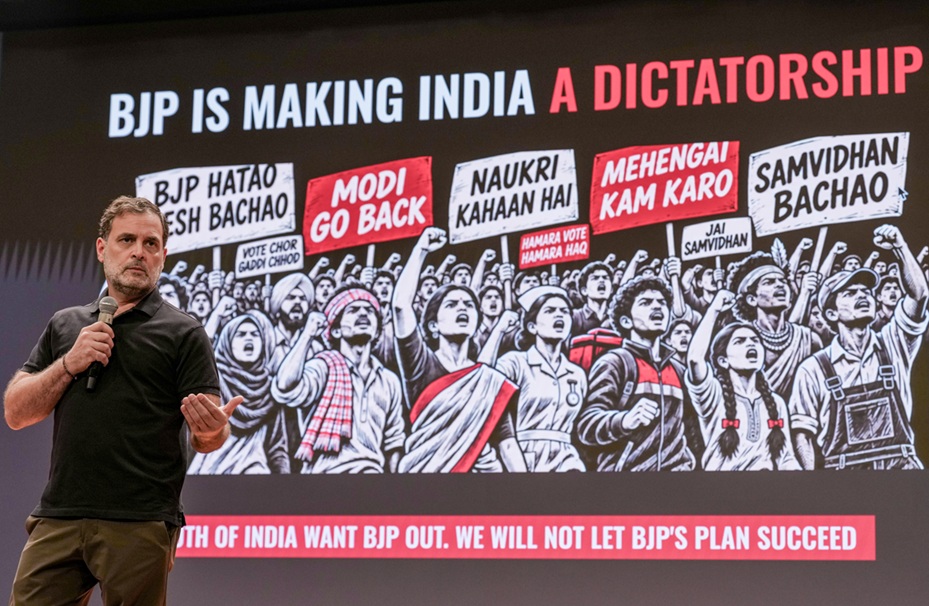
Congress leader Rahul Gandhi on Saturday (November 28) accused the Bharatiya Janata Party (BJP) of pushing India towards “dictatorship”, alleging that the government’s proposal to expand the Lok Sabha to 850 seats represents the “murder of Indian democracy”.
Addressing a press conference following a two-hour meeting with floor leaders of INDIA bloc parties, the Leader of the Opposition claimed the move was designed to give Prime Minister Narendra Modi, Home Minister Amit Shah and Chief Election Commissioner Gyanesh Kumar a “blank canvas” to redraw the country’s electoral map.
Also read: Delimitation: ‘Only BJP gaining; it may target smaller parties’
“Why 850 seats? The answer lies in Assam and Jammu and Kashmir. If they have 850 seats to play with, they can redraw the map to suit themselves, weaken the representation of communities opposed to them and allow them to target specific opposition leaders,” Rahul said, arguing that the proposal would hand the ruling party a massive advantage before a single vote is cast.
Allegations over delimitation panel
Rahul alleged that the government was attempting to capture the delimitation commission in the same manner it had allegedly captured the Election Commission. He claimed the delimitation process would be controlled by Kumar, alongside a former Supreme Court judge selected by Modi and Shah, and a third member chosen by Kumar.
Also read: Delimitation: Why Bengal is more worried about political boundaries, than numbers
“Gen Z, please remember, this number 850 represents the murder of Indian democracy. The idea is to give Modi, Shah and Gyanesh Kumar a blank canvas to redraw India’s electoral map,” the former Congress president said.
He further alleged that the 2024 general election was “illegal” and claimed the government was seeking a “new escape route” through delimitation. “We have trapped Modi, Shah and Gyanesh Kumar, and the three musketeers have come out with a new idea. The idea is to open a new space,” he said, adding that the opposition would not allow the BJP to reshape the foundation of Indian democracy.
Social justice and demands
Raising concerns over social justice, Rahul said the government had sidelined the caste census because the upcoming 2027 census would reveal “uncomfortable facts” for the BJP. He warned that Scheduled Castes (SCs), Scheduled Tribes (STs) and minorities would be disempowered for the next 40 years if their populations grew without a corresponding increase in reserved seats.
Also read: DMK backs Centre’s delimitation Bill, slams Congress
Outlining the Congress party’s demands, Rahul insisted that the current Lok Sabha strength of 543 seats be maintained without altering the existing seat share of any state. He called for a bipartisan delimitation commission to conduct the exercise using data from the 2027 census alongside a nationwide caste census.
He also urged that women’s reservation be implemented within the existing 543-seat framework with a dedicated sub-quota for Other Backward Classes (OBCs).
“The issue is not about state share; it is about giving the BJP a blank slate to reshape the foundation of Indian democracy, to destroy democracy and steal from the people of India,” Rahul said.
Opposition united before sitting
Rahul’s remarks came after INDIA bloc constituents resolved on Saturday to jointly oppose the Constitution amendment bill in Parliament. Congress president Mallikarjun Kharge alleged that the legislation was aimed at denying SCs and STs an increased share of Lok Sabha seats proportional to their latest population figures, terming it a bid by the BJP-RSS to permanently capture power.
Also read: CJP urges Opposition to block delimitation bill, warns of ‘gerrymandering’
The Centre is set to introduce the Constitution (132nd Amendment) Bill, 2026, in the Lok Sabha on Monday during a special parliamentary sitting convened from November 30 to December 3. While the Lok Sabha reconvenes on Monday, the Rajya Sabha will meet on December 2.
The proposed legislation seeks to implement one-third reservation for women by raising the Lok Sabha’s maximum strength to 850 — comprising up to 815 members from states and 35 from Union territories — and increasing each state and Union territory’s seat allocation and assembly strength by 50 per cent. It also proposes raising the ceiling on state legislative assemblies from 500 to 650 seats, while freezing the revised allocations and boundaries until 2051.