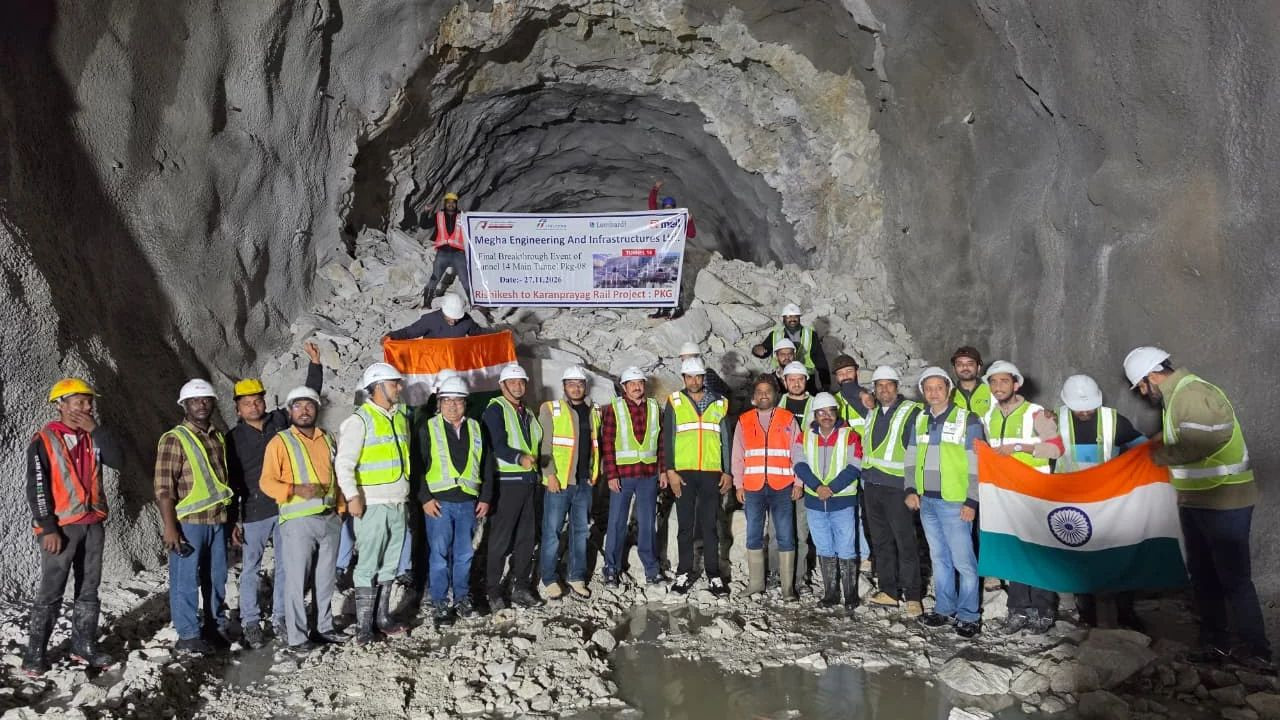
New Delhi: A new story of development is being written by breaking the chest of mountains. Where once inaccessible mountains, deep slopes and difficult geographical conditions used to test human courage, now a new path of railways is being prepared on the basis of modern technology and engineering. The day of 27 November 2026 was recorded as a historic achievement in the Rishikesh-Karnprayag rail project. Rail Vikas Nigam Limited (RVNL) achieved breakthrough in main excavation of 6.59 km long Tunnel No. 14 in Rudraprayag district. That is, the construction work going on from both ends of the tunnel finally met each other and the path across the mountain was opened.
Behind this achievement lies the long struggle of engineers, technical experts and the construction team. 4.7 kilometers were excavated from the first end of the tunnel, Sumerpur, and 1.79 kilometers from the other end, Marora. The machines and construction teams advancing from both directions defied the difficult conditions and finally achieved the target.
Weak ground, population above and tunnel war below.
The biggest challenge at the first end of the tunnel was the loose soil and the safety of the residential areas above. Here, under the upper layer of soil of only 20 to 30 meters, the tunnel being built for three railway tracks of about 110 meters length was excavated very carefully. For this, a special technique of strengthening the ground before excavation and phased construction through many small tunnels was adopted. At the same time, the slope of the mountain towards Marora and the problem of land subsidence had made the path of construction difficult. Here the ground was strengthened with a structure of 30 to 35 meter deep micro pillars, 15 to 20 meter long rock bolts and special grouting technique. After this, excavation of the main tunnel could start in March 2024. Challenges related to land subsidence and acquisition of land and houses were also resolved.
There was no compromise with the safety of the population.
The safety of surrounding villages and houses remained the top priority during construction. At the other end, about 100 meter portion was excavated with machines. Controlled explosions around both portals were carried out only during day time, so as to cause minimum disturbance to the local population. A special ventilation system was also installed to provide fresh air and proper temperature to the workers during the 4.7 km long excavation from the first end. This breakthrough is not just an achievement of completing the construction of a tunnel, but a major victory of modern engineering, technology and human determination in the inaccessible Himalayan region. Now the dream of providing rail from Rishikesh to Karnaprayag has crossed another important milestone.