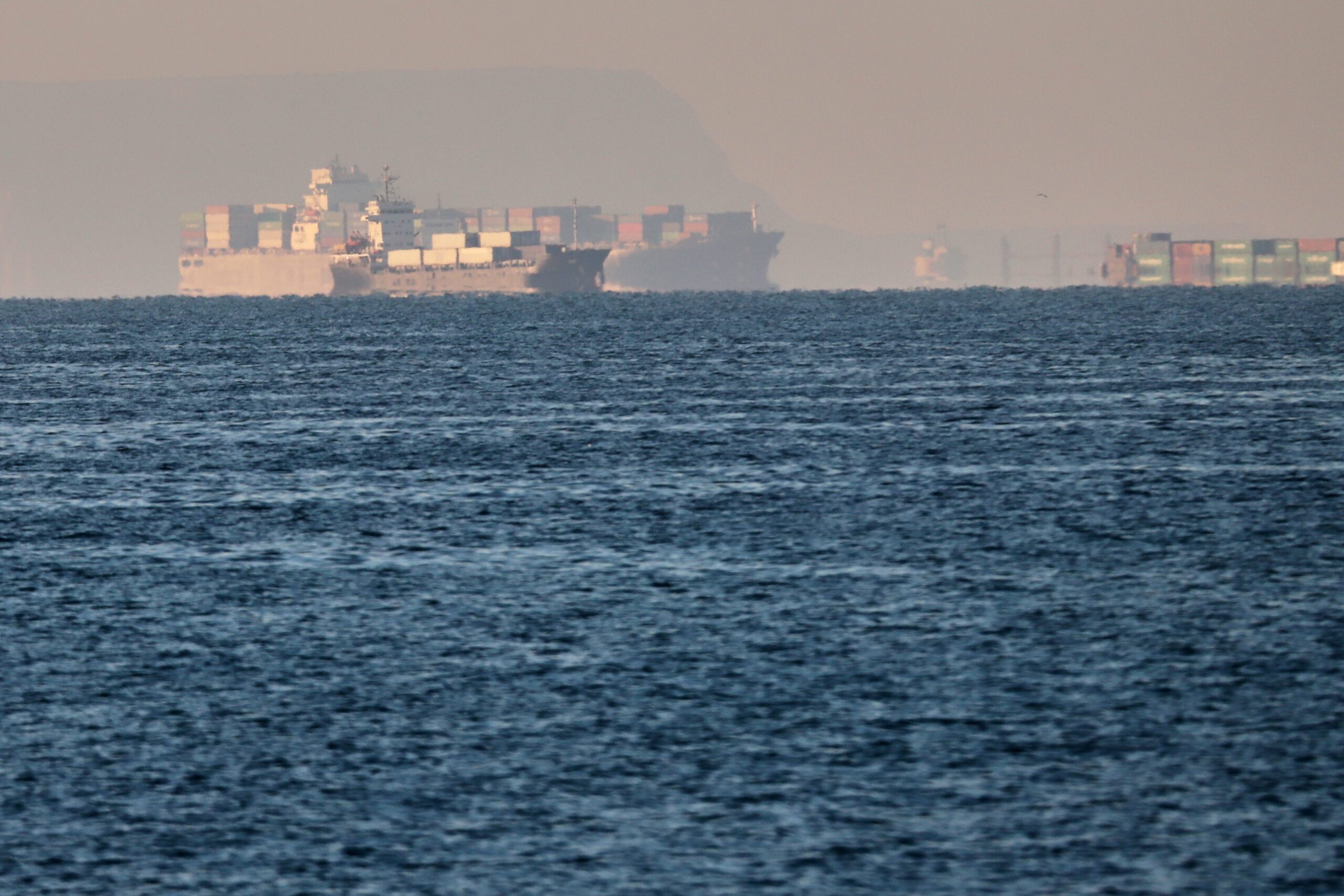
U.S. Says It Disabled Ship Breaching Iran Blockade as Israeli Strikes Kill 5 in Gaza/ NEWSLOOKS/ WASHINGTON/ Jehan Mansour/ The U.S. military said it disabled a merchant ship attempting to breach its blockade of Iranian ports, leaving the civilian crew unharmed. Houthi authorities reported at least 11 deaths in a Yemen airstrike, while Gaza hospitals reported five people killed in Israeli strikes. The developments came amid disrupted shipping, regional diplomatic efforts and defense talks involving Pakistan, Saudi Arabia and Turkey.
Iran Blockade and Middle East Developments: Quick Look
- Ship disabled: U.S. Central Command said an aircraft struck the Palau-flagged M/V Pacific Archer in the Gulf of Oman.
- Crew status: The military said the ship’s propulsion was disabled and its civilian crew was unharmed.
- Blockade enforcement: U.S. forces say they have redirected 158 merchant ships since the blockade resumed in July.
- Yemen casualties: Houthi authorities reported at least 11 people killed, including children; their account was not independently verified.
- Gaza casualties: Hospital officials reported five deaths in three Israeli strikes Friday.
- Hormuz tensions: Iran’s Revolutionary Guard issued additional claims about tankers using unauthorized routes.
- Oil flows: Rystad Energy reported an approximately 20% decline in early November compared with October.
- Defense diplomacy: Pakistan, Saudi Arabia and Turkey held talks under their collective defense agreement.
U.S. Says It Disabled Merchant Ship Attempting to Breach Iran Blockade
WASHINGTON — The U.S. military said Friday that it disabled a merchant ship in the Gulf of Oman after the vessel attempted to breach the American blockade of Iranian ports.
A military aircraft fired “precision munitions” at the stern of the Palau-flagged M/V Pacific Archer on Thursday, U.S. Central Command said.
The “ship’s propulsion was ultimately disabled and the civilian crew was unharmed,” the command said in a statement.
According to the military, the vessel had departed Iran’s Bandar Abbas port before attempting to cross the blockade. Ship-tracking websites listed Singapore as its destination.
The incident came as the Trump administration considered its next steps in the war with Iran, while regional governments pursued diplomacy to prevent renewed large-scale fighting.
Pacific Archer Is at Least 15th Vessel Disabled
The United States began blockading Iranian ports in April, temporarily lifted the restrictions during summer negotiations and resumed enforcement in July.
Since the resumption, U.S. forces say they have redirected 158 merchant ships and disabled vessels that refused to comply.
The Pacific Archer is at least the 15th publicly disclosed ship disabled since the blockade began and the sixth since its summer resumption. The previous disclosed incident occurred Nov. 7.
Central Command has consistently said American forces issue multiple warnings before firing on merchant vessels.
The practice drew international condemnation in June after a strike on a tanker attempting to evade the blockade killed three Indian sailors, according to Indian officials. The head of the International Maritime Organization condemned that attack.
Regional Governments Seek to Prevent Renewed Iran Escalation
The war, which began in late Februaryhas settled into a prolonged stalemate in recent months.
Regional officials told The Associated Press earlier in November that Israeli Prime Minister Benjamin Netanyahu was pressing Washington to resume major military operations or permit Israeli strikes on Iran’s nuclear facilities and missile capabilities.
Officials from Persian Gulf countries, Pakistan and Turkey have pursued diplomatic contacts, including calls with senior U.S. officials, to prevent another escalation.
President Donald Trump has alternated between threatening additional large-scale strikes and declaring that the war “militarily is effectively over.”
The United States maintains a substantial naval deployment in the region, including two aircraft carriers and accompanying warships.
Iran Issues New Claims About Tankers in Strait of Hormuz
Iran’s Revolutionary Guard said Friday that two tankers attempted to transit the Strait of Hormuz through an “unauthorized” route.
It claimed one struck a naval mine while the other was forced to turn back. Those accounts could not be independently verified.
The Guard also said attempts to use unauthorized routes had declined sharply in recent days.
Iran continues to warn ships against passing through the strategic waterway without Tehran’s approval.
Shipping Disruptions Reduce Oil Flows and Raise Costs
Oil flows during the first two weeks of November fell approximately 20% from October to around 13 million barrels per dayaccording to Rystad Energy.
October exports had roughly matched prewar levels of 15 million to 16 million barrels daily.
Factors behind the decline include Iranian attacks deterring tanker crossings and reduced flows through a Saudi pipeline to the Red Sea port of Yanbu, which has also faced repeated attacks.
A U.N. Trade and Development report found that disruptions in the Strait of Hormuz, Red Sea, Black Sea and Panama Canal are extending voyages, increasing fuel expenses and worsening port congestion.
Alternative ports and inland transport routes have helped sustain trade, but at greater cost.
Houthis Report 11 Killed in Yemen Airstrike
Yemen’s Houthi-run health ministry said an airstrike killed at least 11 people, including children, in Turbah city in southwestern Taiz province early Friday.
Ministry spokesperson Anees al-Asbahi said a cinema building was struck in a densely populated area. He said some victims sold ice cream nearby and had been living in part of the building.
The death toll was preliminary as rescuers searched the rubble, he said.
Al-Asbahi blamed Saudi Arabia. The AP could not independently verify the account, and the Saudi coalition made no public comment.
Houthi-run al-Masirah television broadcast footage showing a destroyed building and people recovering children’s bodies. The footage also could not be independently verified.
Israeli Strikes Kill Five in Gaza, Hospitals Say
Hospital officials said three Israeli strikes killed five people across Gaza Friday.
A strike on a car in Gaza City killed one person, according to Shifa Hospital. Another strike killed three people in Muwasi in southern Gaza, Nasser Hospital said.
The Israeli military said those strikes targeted militants but did not provide further details.
A separate strike on a street in Jabaliya killed one person, according to Shifa Hospital. Israel’s military did not immediately comment on that incident.
Although the heaviest fighting subsided after the October 2025 ceasefire, Israeli fire has killed more than 1,700 Palestinians since the agreement, according to Gaza’s Health Ministry.
U.N. agencies and independent experts consider the ministry’s figures generally reliable. Its totals do not distinguish between civilians and militants.
Hamas Says Negotiator’s Son Survived Separate Strike
Hamas political bureau member Bassem Naim said the only surviving son of the group’s chief negotiator, Khalil al-Hayya, escaped a targeted Israeli strike Friday.
Naim said the son was targeted alongside his family and the family of a brother killed earlier this year.
Health officials at Shifa Hospital said a strike on a residential apartment in Gaza City wounded six people, including one critically.
Hamas accused Israel of repeatedly violating the ceasefire. The Israeli military did not immediately respond to a request for comment on the allegation.
Pakistan, Saudi Arabia and Turkey Hold Defense Talks
Senior diplomatic and military officials from Pakistan, Saudi Arabia and Turkey met in Islamabad to discuss regional developments, including Houthi attacks on Saudi Arabia.
The talks took place under the Joint Mecca Defense Agreement, which treats an attack on one member as an attack on all three.
Saudi Crown Prince Mohammed bin Salman, Turkish President Recep Tayyip Erdogan and Pakistani Prime Minister Shehbaz Sharif signed the agreement in August.
Erdogan formally approved the pact, completing Turkey’s ratification process after parliamentary approval earlier this month.
Turkish opposition parties had warned that the agreement could draw the country into regional wars and endanger its soldiers.
More on US News
For more world news