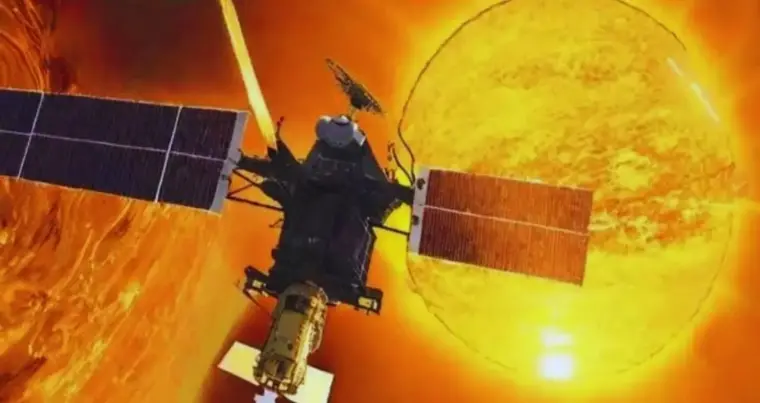
Scientists from India’s Aditya-L1 mission have detected small flashes in the Sun’s atmosphere before solar flares. These signals were seen a few hours before the flare in the same area where the subsequent eruption occurred.
Take: Sun-Earth L1 Point: Observations received from Aditya-L1 have given new information in understanding the activity that occurs before the formation of solar flares. Scientists recorded small, short-lived transient events using UV and X-ray data that appeared in active regions before major flares and clustered around the flare site afterward.
Aditya-L1 caught small flash before flare
In the analysis of data received from Aditya-L1, scientists observed many small and short-lived brightening events in the active regions of the Sun. These are called transient events. These events appeared before major solar flares began and were later concentrated around the location where the flare occurred.
X-ray signatures were also recorded along with some of these transient events. This indicates that these events may involve the release of magnetic energy. According to researchers, repeated small-scale energy releases can gradually destabilize the magnetic field of an active region and may eventually lead to a larger solar flare.
Important information obtained from UV and X-ray observations
In this study, simultaneous observations from three payloads of Aditya-L1 were used. The Solar Ultraviolet Imaging Telescope (SUIT) observed the Sun through 11 near-ultraviolet filters, while the SoLEXS and HEL1OS instruments recorded X-ray emissions coming from the solar corona.
Aditya-L1’s vantage point around the Sun-Earth Lagrange Point 1 (L1) helps it continuously observe the Sun’s activity. The near-ultraviolet information provided by SUIT is particularly important because Earth’s atmosphere absorbs most ultraviolet radiation, making such wavelengths difficult to obtain from ground-based observations.
Hope for better solar flare forecasting
Solar flares are sudden intense electromagnetic radiation bursts associated with the release of magnetic energy. Large flares can affect radio communications and navigation systems, damage satellites, and increase radiation risks to astronauts and spacecraft.
According to scientists, understanding pre-flare activity could help in developing reliable flare forecasting and better space weather predictions in the future. This can improve preparations to protect satellites, communication systems, astronauts and other critical technologies from the possible effects of solar activity.
This research has been done by researchers from Manipal Center for Natural Sciences and Manipal Academy of Higher Education in collaboration with scientists from ISRO/Department of Space and other academic institutions. The findings of the study have been published in Monthly Notices of the Royal Astronomical Society.