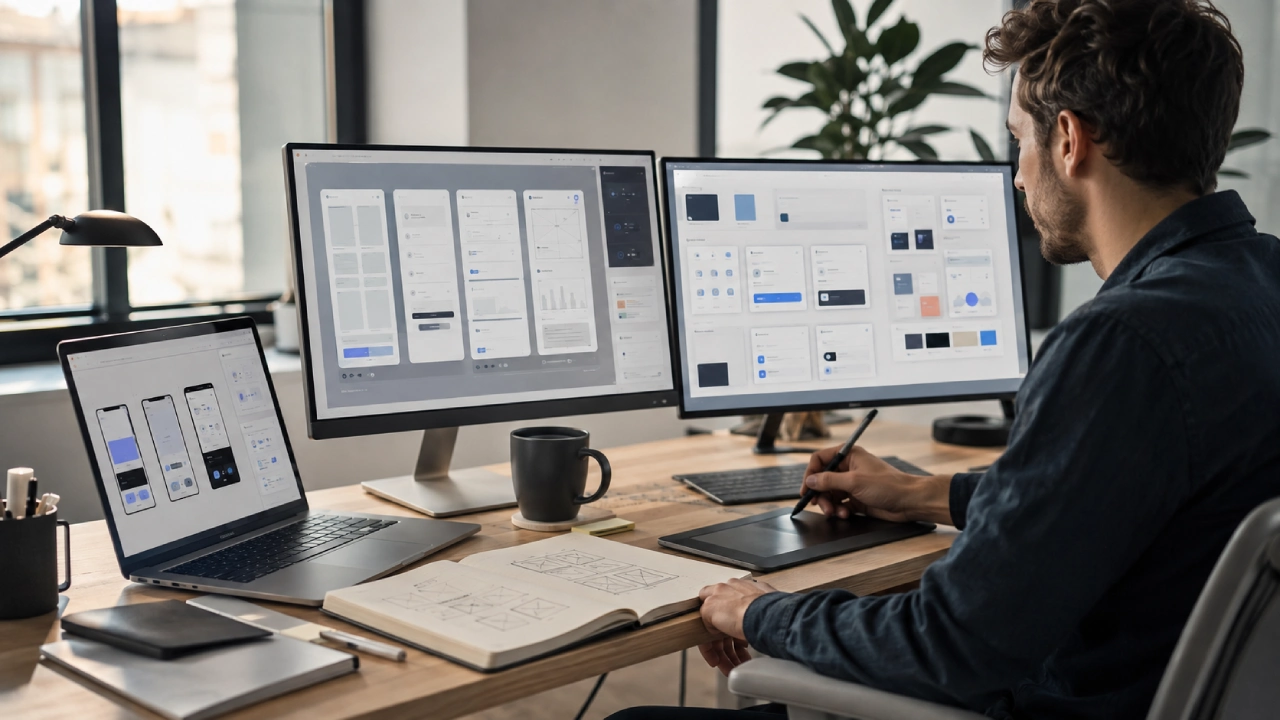
While user interface design has always been a very human job, the sudden emergence of AI UI generators means a designer no longer has to start with a completely blank screen. Traditionally, the real work begins as buttons are placed, menus are arranged, colors are tested, and spacing is adjusted again and again.
Sometimes a small change in layout can take hours. That slow process has been normal for years in the tech world. But now something new is entering this space. AI tools are starting to design interfaces on their own.
The system creates a basic layout for you to describe your application’s functionality in an instant when you type in a brief description of the application. By using the AI UI generator, which takes seconds to process, an individual can create their own home screen layout, menu, card, and navigation components without needing to hire or talk with a professional user interface designer.
From this standpoint, the entire design community now finds itself asking the same question: “What happens to me when an artificial intelligence can create a functional and acceptable user interface layout significantly quicker than I can?”
The answer is not as simple as “AI will replace them.” The reality looks more like a partnership between humans and machines.
What AI UI Generators and Automated Design Workflows Actually Mean
AI-generated UI design simply means using artificial intelligence to create interface layouts automatically. Instead of developing each screen as a separate task, you would provide the system with a short description of how to create each screen.
For example: “Create an app for grocery delivery with the following screens: product list, cart, order tracking”. It is then possible for you to receive several screens in less than ten seconds by using the AI. They often include buttons, image sections, product cards, and navigation bars.
These systems work because they learn from large collections of existing app designs. Over time, they recognize common patterns. They understand where menus usually sit, where action buttons appear, and how screens are normally arranged. Because of that training, the layouts they create often look familiar and usable.
Why Tech Companies Are Interested in This
Speed is the biggest reason. Designing an interface from scratch takes time. A designer may spend hours building the first layout and then days refining it.
AI can produce the starting point instantly. For product teams, this can save a lot of early work. Instead of beginning with a blank screen, they start with a rough design created by AI. This helps teams test ideas faster.
Startups see a big benefit here. Many early startups do not have a dedicated design team. Founders and developers often build prototypes themselves. AI tools give them a way to create decent layouts without deep design knowledge. That does not mean the design is perfect, but it is often good enough to test an idea.
Tools That Are Already Doing This
Several AI design tools have started gaining attention in the past couple of years. Some tools focus completely on UI generation. A user types a prompt and receives a ready layout. These systems can generate things like login screens, dashboards, product pages, and profile pages.
Other tools work inside design software that many teams already use. Instead of replacing the design tool, AI becomes an assistant inside it.

A designer can ask the system to generate a layout, suggest components, or create multiple versions of the same screen. This makes the early stage of design much faster than before.
Where AI Is Actually Helpful
The early stage of product design is often messy. Teams explore ideas, move sections around, and test different layouts. This part of the process can take a lot of time.
AI is very good at helping here. It can quickly generate different layout ideas for the same product. A team might see five or six design directions in a few minutes.
Wireframes are another area where AI helps. Wireframes are simple screen structures that show where elements will appear. They are important for planning an interface, but they are not very creative work.
AI can generate these structures almost instantly. This allows designers to focus more on improving the experience instead of building basic layouts.
Where AI Still Feels Limited
Even though AI can generate clean-looking screens, design is more than placing elements on a page. Good design requires understanding people. A designer thinks about what the user wants to do, what might confuse them, and what information should appear first.
AI does not truly understand those things. It only recognizes patterns from existing designs. Because of this, some AI-generated interfaces look fine but feel awkward when someone tries to use them.
Navigation may not feel natural. Important actions may not be clear. Another issue is that many generated designs look similar. AI models are trained on large collections of popular apps. As a result, the layouts they produce often follow the same patterns. That can make different apps start to look alike.
Companies that want a strong brand style usually need human designers to shape the final look.
Designers Are Not Disappearing
Whenever a creative industry is introduced to a new technology, there is often concern about what will happen to jobs. However, in general, over time, the opposite has occurred.
The introduction of new tools into the workplace has had a profound effect on the way in which that work is performed, but it has not resulted in a situation where skilled workers are no longer needed. For example, when smartphones began to feature higher-quality cameras and image processing technology, it was thought by some that the profession of photography would come to an end. This did not occur.
Instead, photography became more common, and professionals focused on higher-quality work. UI design may follow a similar path. AI can handle repetitive tasks like basic layout generation. Designers will still guide the product experience and make decisions that require human judgment.
The Role of Designers May Shift
The daily work of designers may change a little. Instead of spending hours building the first layout, they might start with something generated by AI. Then they review it carefully.
Usability issues are fixed, screen flow is adjusted, and simplified experiences are created by designers who also consider a user’s entire journey regarding how to move between screens and how the product can provide a solution to a real-life problem. This is human-level thinking, which has not yet been replicated by AI in its entirety.
Designers take an AI-generated starting point to create the end-user’s experience.
New Skills That May Become Important
As AI tools become more common, designers may develop a few new habits. One of them is learning how to guide AI systems with clear instructions. A well-written prompt can lead to better-generated layouts.
Another skill is editing AI output. Typically, the first version of an AI-generated design is not ideal. An individual must then refine and correct it before it can be used. User research becomes even more important at this stage.
Understanding the needs and issues of actual customers is something AI struggles with on many occasions. Designers who are particularly concerned with understanding how to meet the needs of their users will always have an important role to play.
What This Means for Product Development
AI-generated UI design may make early product development much faster. Small teams could build prototypes in a few hours instead of several days.
Developers might create simple interface drafts themselves before a designer becomes involved. But complex products will still rely heavily on experienced designers.
Apps used for banking, healthcare, or large business systems require careful planning and testing. These products cannot depend only on automated layouts. In many cases, AI will simply remove some of the slow setup work from the design process.
The Direction Things Seem to Be Moving
Right now, AI design tools are still improving. Some results look impressive, while others still need a lot of fixing. But the direction is clear. AI is becoming a normal part of digital product creation.
For designers, this does not mean their work disappears. It means the tools around them are changing.
Design may become a little faster and a little more automated at the beginning. But the core of the work remains the same. Someone still needs to understand the user, shape the experience, and decide how the product should feel. That part of the design still belongs to humans.