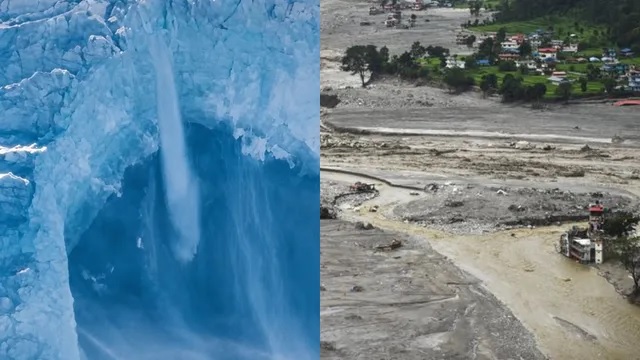
Kathmandu. The devastating flash flood caused by the breaking of the glacier in the hilly areas of Nepal has caused huge devastation. According to the latest data, so far 1,127 people have been confirmed dead in this horrific natural disaster, while more than 4,800 people are still missing. A large-scale search and rescue operation is being carried out to rescue people trapped in the affected areas and tunnels of several damaged hydropower projects. Meanwhile, it has also come to light that an alert was sent 38 minutes after the glacier broke.
38 minutes delay, failure of 'early warning system'
After this entire tragedy, Nepal's emergency alert system is under question. This alert, issued 38 minutes after the glacier collapsed, exposed the disaster management of the Balen government. When the glacier broke near the Nepal-Tibet border at 8:37 am on August 26, the government machinery was also unaware. After the disaster management department received the first official alert, text messages were sent to the mobile phones of people in the affected areas, Rasuwa, Nuwakot, Dhading and Chitwan at 9:15 am.
These alert messages were sent a full 38 minutes after the glacier collapsed. This 38-minute delay in warning in the face of flash floods flowing at great speed in the hilly areas proved to be a disaster for people living in low-lying areas, due to which they did not get enough time to move to safer higher places.
Negligence of sensors and communication networks
Nepal's Mines and Geology Department had recorded seismic data of 4.4 magnitude at 8:37 am, but instead of considering it as a seismic shock, it was kept in the normal category and no alert was issued. At the same time, at 8:50 am, the gauge of Bhotekoshi river in Rasuwa was washed away by the strong current. According to the Kathmandu Post, officials of the National Disaster Risk Reduction and Management Authority (NDRRMA) say that in many areas, telecom towers were destroyed by the initial surge of floods. Although some people were evacuated to safe places after a text alert sent at 9:15 pm, the deluge had wreaked havoc even before the information reached the remote villages.
timely warning
Experts say that due to climate change, glaciers in the Hindu Kush Himalayan region are melting twice as fast. Despite this, Nepal's warning system still relies only on simple water level gauges, which are unable to detect such severe disasters. At present, the rescue and search operation for the missing people is going on after this severe flood. Rescue workers and security forces are continuously searching the flood affected areas and lower parts of the river.