
Jeep will launch the next-generation Compass in India in the first half of 2028, and the SUV will borrow its underlying platform(s) from the Tata Sierra. More specifically, Tata Motors has licensed the ARGOS platform to Stellantis while retaining its ownership.
Internally codenamed J1J, the upcoming SUV is being developed under an expanded partnership between Tata Motors Passenger Vehicles (TMPV) and Stellantis. It will likely have petrol and electric powertrains sourced from the Sierra and a design that is unmistakably Jeep. Four-wheel drive (4×4) capability is also expected. The partnership will help Jeep develop new products for global markets at a lower cost.
An official press release states that TMPV and Stellantis are formalising plans for a ‘new Jeep SUV’ based on the Tata Sierra’s platform. A formal agreement for the same has been signed between the two companies. We have now learnt that this ‘new Jeep’ will be the next generation Compass.
The Sierra now has both internal combustion engine-powered (ICE) and all-electric versions on sale here. These products are based on two different platforms. The ICE version uses the ARGOS (All-Terrain Ready, Omni-Energy and Geometry Scalable) platform whereas the EV is based on the Acti.EV+ architecture. We now know that the next-generation Compass will have both petrol-powered and electric versions. This could possibly mean the ICE version using the ARGOS and the other being based on the Acti.EV+.
Another possibility is Jeep using the ARGOS for the electric Compass as well. Since it is a multi-energy platform, the ARGOS will fully support electric vehicles. Time remains before we learn more about the actual gameplan.
Stellantis and Tata Motors have had long-standing partnerships with each other. The platform-sharing is the latest step in this journey. For Jeep, the takeaway is straightforward- it gets a new, capable platform for the new Compass without having to build one entirely from scratch. This will bring down development costs. Tata Motors will also benefit from this sharing deal. It will be able to spread the cost of developing ARGOS across more vehicles.
Jeep’s project will also benefit from the Sierra’s (Tata’s) strong supplier base for shared parts. Model-specific parts will require separate sourcing and tooling.
The next-generation Compass is also expected to share some of its internals with the Sierra. The design of the body and cabin will, however, stick to Jeep’s stylebook. The driving character and dynamics will also be very Jeep-like.
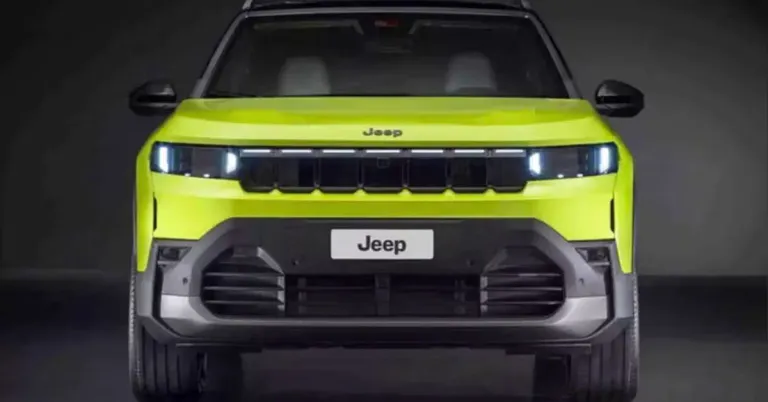
With the upcoming model, the Compass will enter its third generation. It will have fresh styling. The vehicle had originally been revealed in May 2025. More recently, Stellantis filed a design patent for the same in India, possibly indicating launch plans. The filings indicate that the India-spec Compass will retain most design cues of the global third generation.
The design is a fair departure from the outgoing model. The front gets a fresh appearance- LED Matrix headlamps with DRLs positioned towards the outer edges, seven-slot signature Jeep grille, chunky bumper and a muscular bonnet.The side has a new window line and the rear gas chunky body cladding, illuminated Jeep logo, and new tail lamps with a connecting light bar. The production model may also come with an active grille shutter and air ducts for improved aerodynamic efficiency.
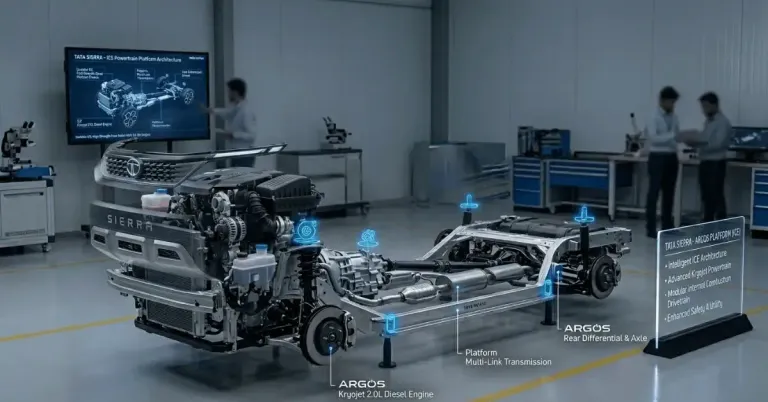
The ARGOS will prove to be an ideal base for the new Compass. The outgoing model has a wheelbase of 2,636 mm. The Sierra’s ARGOS platform has a wheelbase of 2730mm. The move to it will thus make the next-generation Compass larger and roomier than the outgoing model.
The platform will likely retain much of its existing structure, with changes and reinforcements wherever required. These modifications will help accommodate Jeep’s body and meet crash-test and regulatory requirements in overseas markets.
Tata Technologies, the engineering services arm of the Tata group, is understood to be involved in the programme’s engineering work. Its role includes helping develop the Jeep-specific body and interior, adapting the vehicle for left-hand-drive markets and making changes needed to meet overseas regulations. A dedicated development team is based in Pune.
Now, let’s talk about powertrains. The internal combustion engine-powered version will use the 1.5-litre direct injection turbocharged petrol (Hyperion) of the Sierra. It had previously come to light that this powertrain will be used on future Jeep models. It remains unclear if the next-generation Compass will be offered with a diesel engine option.
The electric powertrain is also likely to be borrowed from the Sierra.EV. If so, expect it to be based on the Acti.EV platform and be made available with a 63kWh and 75 kWh battery options. Dual-motor based all wheel drive (AWD) will also be offered. These remain speculations for now, as Jeep hasn’t officially revealed the final engine and motor specifications.
It is also reported that the carmaker is evaluating a range-extender electric vehicle (REEV) version of the Compass. It will likely be based on the ARGOS platform as well. The internal combustion version will also be offered with the option of 4-wheel drive (4×4), in-line with Jeep’s off-road DNA.
While Tata Motors manufactures the Sierra at its Sanand plant in Gujarat, production of the new Jeep is expected to take place at the Fiat India Automobiles Ltd (FIAL) joint venture facility in Ranjangaon, Maharashtra. The manufacturing operations there are expected to be adapted forn the new programme over the next 18 months. The plant will also make left-hand-drive versions of the new Compass for exports.