
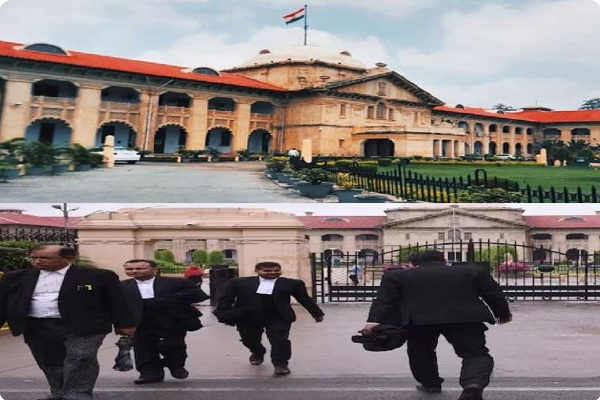

Prayagraj, 18 July. The Allahabad High Court has expressed deep concern over the increasing presence of alleged criminal elements and advocates holding fake degrees in the advocacy profession in Uttar Pradesh, saying that if this trend is not curbed in time, then public confidence in the justice system will weaken.
Advocate is not just the representative of the client but an integral part of the justice delivery system
The High Court also made it clear that advocates are not just representatives of their clients but are integral parts of the justice delivery system. In such a situation, it is the joint responsibility of both the Bar Council and the judiciary to maintain the purity of their conduct and profession.
Justice Vinod Diwakar, while hearing the petition of Mohammad Kafeel, conducted a comprehensive review on the criminal records of advocates, fake degrees and the disciplinary system of the Bar Council in Uttar Pradesh. The court sought detailed reports from the state DGP, DGP (Prosecution), Uttar Pradesh Bar Council and Registrar of Firms, Societies and Chits.
In the case, the petitioner had challenged the order of the Chief Judicial Magistrate of Etawah refusing to summon the police officers and the order of the Revision Court which had upheld the magistrate’s decision. The reports presented before the court during the hearing exposed many serious facts related to the advocate community in the state.
5056 cases against 4157 lawyers
According to the report presented before the court, there are more than 5.14 lakh active advocates registered with the Uttar Pradesh Bar Council. Of these, a total of 5,056 criminal cases are registered against 4,157 advocates. 418 advocates have three or more cases pending against them while some advocates are continuing their practice despite more than 40 criminal cases being registered against them. In the certificate verification campaign, law degrees of 105 advocates were found to be fake.
Bar Council is not able to take effective action
The High Court found that the disciplinary system of the Bar Council is not as effective as expected. Despite serious criminal cases being registered against a large number of advocates, disciplinary action against them remained negligible. The court also said that due to dissolution of disciplinary committees during Bar Council elections, disposal of pending cases gets affected for years, which is taken advantage of by people with criminal background and practicing law on the basis of fake documents.
Instructions to file case against 105 lawyers
The High Court directed the Uttar Pradesh Bar Council to register an FIR against 105 advocates with fake degrees under relevant sections including cheating, forgery and impersonation. Also, immediate disciplinary action should be initiated against the advocates against whom charge sheets have been filed in heinous crimes and their practice license should be suspended if necessary. The court also directed to develop a system of regular information exchange between the district judges, police officers and the Bar Council, so that time bound action can be ensured on such cases.
gangster in law, Concern expressed over entry of mafia
The High Court made a very strong comment at the end of its judgment saying that the facts available on record indicate not just administrative negligence but a deep institutional and ethical crisis in the legal profession. The infiltration of gangsters, mafia, habitual criminals and persons possessing fake educational qualifications into the advocacy profession in Uttar Pradesh is a serious threat to the credibility of the justice system.
The court said that if the Bar Council does not discharge its statutory responsibilities effectively, both the dignity of the legal profession and the confidence of the general public in the judiciary will be affected. Therefore, the need of the hour is to take strict, transparent and continuous corrective steps to maintain the sanctity of the profession, so that the reputation of the justice system and public trust remain intact.
Delhi High Court has expressed concern over the increasing number of fake journalists.
Interestingly, the Delhi High Court has already expressed serious concern over the increasing number of fake journalists a day earlier, saying that any report can be made with a mobile phone and a mike in hand. The High Court also said that it is very important to stop such trend.
Emphasis on creating a balanced and effective regulatory framework
Making an important comment on the changing picture of journalism and media, the Delhi High Court said that in today’s era, almost every person having a mobile phone and a microphone has started calling himself a reporter. The court acknowledged that freedom of the press is a basic requirement of democracy, but to prevent its misuse, the government should consider creating a balanced and effective regulatory framework.
A single bench of Justice Girish Kathpalia made this observation during the hearing of a case in which regular bail was granted to the accused in the alleged attack on two freelance journalists working for a YouTube channel. The High Court said that with the expansion of digital media and social media, the nature of journalism has changed rapidly. In such a situation, many people start reporting by calling themselves journalists without any professional training, ethical understanding or accountability.

Comments are closed.