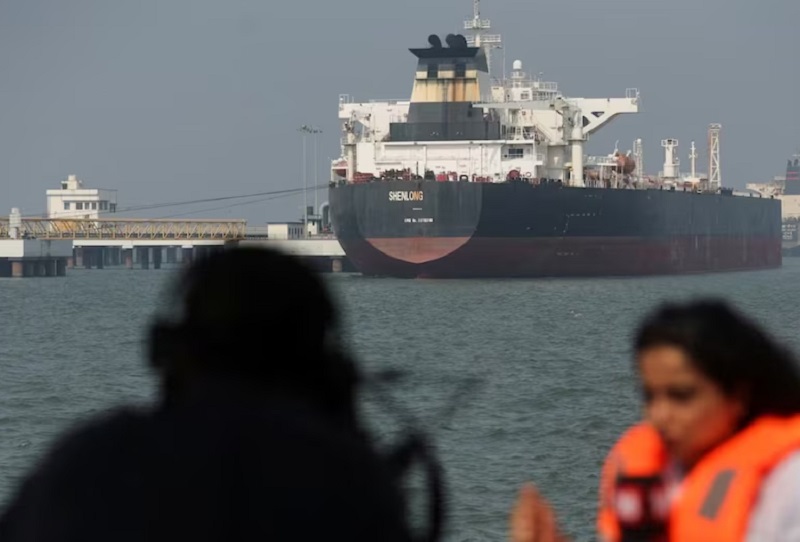
New Delhi. America and Iran kept fighting each other and India made a big play. In fact, in November, India received maximum crude oil supply from the Gulf countries through the Strait of Hormuz and this is the first time after the start of the Iran-US War. On the other hand, India's oil import from Russia has decreased. Let us tell you that due to the war, the Strait of Hormuz was badly disrupted amidst the deep Middle East tension and its impact was seen on all the oil import dependent countries of the world. These included Pakistan, Bangladesh, South Korea and India. However, India managed to mitigate the crisis by diversifying the destinations of its oil imports.
21 lakh barrels of oil arrived daily
Citing Kepler's data, Bloomberg has said that so far in November, India has received an average supply of 21 lakh barrels of crude oil daily through the Strait of Hormuz and this figure is almost close to the level before the start of the US-Iran war. In fact, after the Iran war intensified, the oil supply from the Strait of Hormuz was badly affected. In April, India was getting only 2.47 lakh barrels of oil per day through Hormuz, before the start of the war in February it was 28 lakh barrels per day, but since the war, due to attacks on ships, the movement of oil through this sea route had almost come to a standstill.
Why is Hormuz important for the world?
The impact of the disruption caused by the war in the Strait of Hormuz controlled by Iran was seen in many countries, where the oil and gas crisis had deepened. The impact was seen from Pakistan to Bangladesh and from South Korea to London. India was also not untouched by this and LPG shortage had increased significantly here too. But due to not being dependent only on Gulf countries, the impact was less visible in India, which is among the world's largest oil importers.
Let us tell you that this Strait of Hormuz is responsible for meeting 20% of the total oil requirement of the world, through which oil and gas are supplied to many countries. After the war, while Iran had closed this important sea route, America had imposed a blockade around it.
Bumper supply to India from these countries
Now the situation is changing. The movement of oil through Hormuz is gradually improving. Major oil producing countries like Saudi Arabia, United Arab Emirates (UAE), Iraq and Kuwait have also increased their oil exports. In October, the combined oil exports of these four countries increased to 15.53 million barrels per day, which is close to the level of the beginning of the year. Apart from this, the system of transferring oil through tankers to other ships outside Hormuz has also helped in normalizing the supply.
More imports from Gulf countries than from Russia
According to Kpler data, the oil received by India from Gulf countries is now about 3 lakh barrels per day more than that from Russia, because India's import from Russia has reduced to 18 lakh barrels per day. A major reason for this change in India's oil imports is price and transportation cost.
Producers in the Middle East are providing crude oil at competitive prices, while its cost has been affected by the long distances involved in sourcing oil from Russia and rising freight costs. Apart from this, the impact of Ukraine's continuous attacks on Russia's energy infrastructure has also been seen on Russian oil exports.
What is the impact on Indian economy?
It is noteworthy that India imports about 85 percent of its crude oil requirement. In such a situation, change in the sources of oil purchase becomes very important for the country's economy. Increasing supply from Gulf countries can help India strengthen its traditional oil supply system. Apart from this, due to purchasing a large part of its requirements from abroad, the direct impact of changes in the international market is seen on India's import bill.
Keep an eye on crude oil prices
Now let's talk about the prices of crude oil in the international market, the price of Brent crude is continuously falling and it is trading around $92 per barrel. Apart from this, the price of WTI Crude Oil has now fallen to around $85 per barrel. If we look at the Murban crude price, it is available at $93 per barrel.