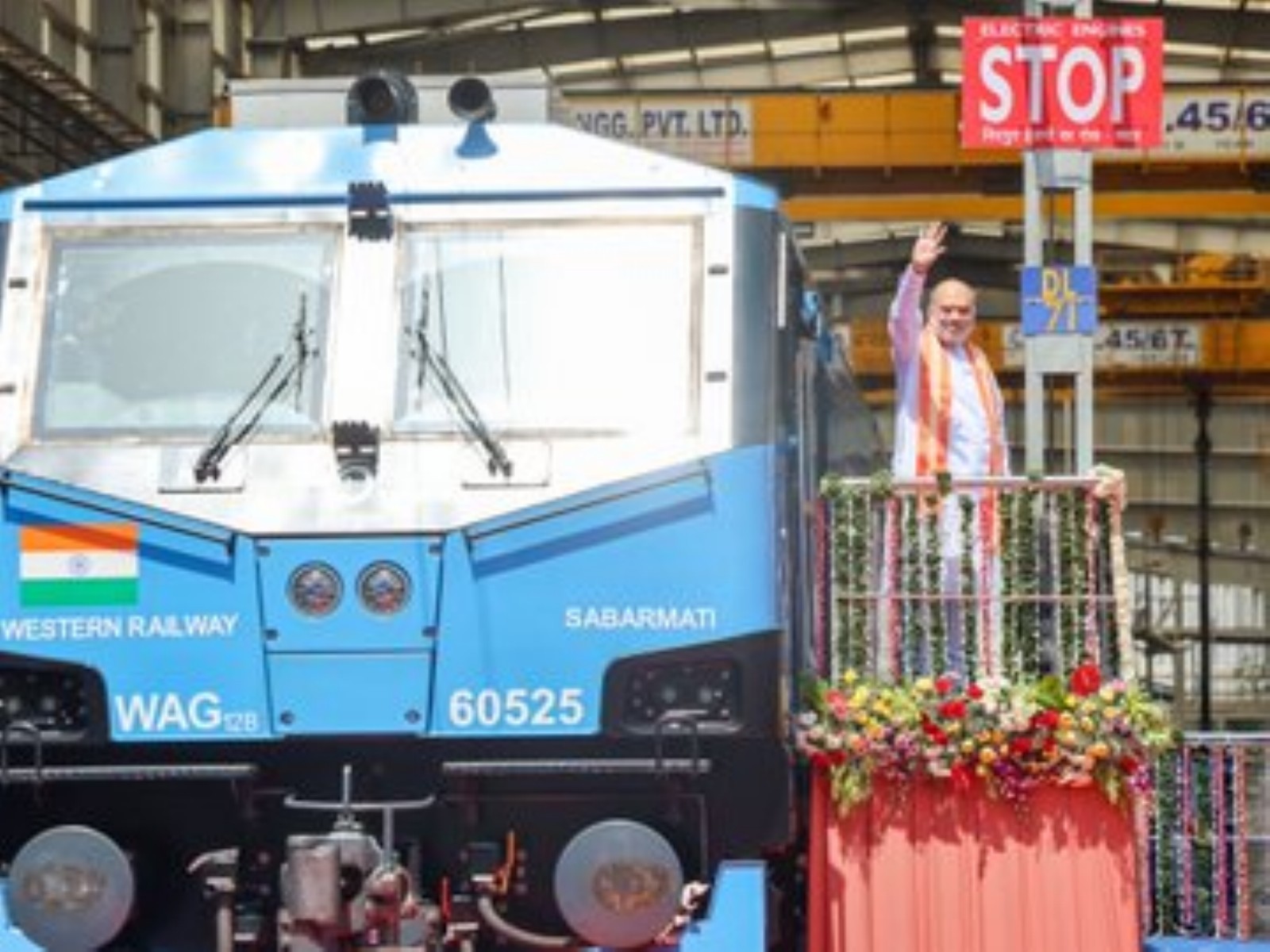
Union Home Minister Amit Shah inaugurated development projects valued at Rs 1,472 crore and flagged off India’s first liquefied natural gas (LNG) powered train from Sabarmati Railway Station in Ahmedabad, Gujarat, on September 28.
Shah also opened the WAG-12 Maintenance Shed, established for maintaining railway locomotive engines, reportedly constructed at a cost of Rs 700 crore. Gujarat Chief Minister Bhupendra Patel and other dignitaries were present at the event, according to the Ministry of Home Affairs.
During the programme, Shah outlined that multiple railway initiatives had commenced within the Sabarmati division, focusing on environmental sustainability, passenger amenities, and rail safety. He recalled that Sabarmati is historically significant as the starting point of experiments such as Satyagraha, simple living, rural development, and khadi.
Shah noted the transformation of Sabarmati Railway Station from the 1980s, when passengers had to walk nearly two kilometers to find rickshaws, into a station with markedly improved connectivity, facilities, and safety. He emphasized that the projects inaugurated and foundation stones laid with a budget of Rs 1,472 crore would significantly benefit the region.
He detailed that the WAG-12 Maintenance Shed supports maintenance for locomotives including the newly commissioned 12,000-horsepower twin-section WAG-12 engine, capable of hauling freight equivalent to 600 trucks alone, replacing the need for two locomotives previously required. Shah described this as a historic milestone for Indian Railways.
In addition, the ‘Kavach’ train protection system has been installed on the Sabarmati–Kalol–Sabarmati rail section at a cost of Rs 48 crore to enhance safety. Implementation of ‘Kavach’ is underway on Ahmedabad–Palanpur and Ahmedabad–Samakhiali rail sections, alongside the doubling of the Sabarmati–Sarkhej railway line.
Shah highlighted the launch of the LNG-powered train as a major step towards environmental conservation. He recalled that since Narendra Modi assumed office as Prime Minister in 2014, the railways have seen the introduction of new facilities and modernization of the network.
He mentioned the successful trial of India’s first double-stack long-haul container train connecting Jawaharlal Nehru Port Trust in Mumbai to Vadodara. Shah stated that the concept could nearly double freight-carrying capacity despite the limitation of existing tracks. He also referred to the ongoing conversion of an 11,000-kilometre corridor into a four-lane network to improve traffic flow towards Delhi–Howrah and Delhi–Guwahati.
Shah attributed key projects such as Dedicated Freight Corridors, the Rapid Rail System, and premium railway stations to Prime Minister Modi’s leadership. He recalled the recent inauguration of a hydrogen-powered train by Modi, placing India among four countries possessing the technology. He stated that 97 per cent of bio-toilets and 87 per cent of LHB coaches are produced domestically under Modi’s government, with railway electrification increasing from 30 per cent to near completion during this period.
He further stated that the railway safety budget increased by 67 per cent and locomotive production capacity by 66 per cent under Modi’s administration, crediting initiatives such as ‘Make in India’ and ‘Aatmanirbhar Bharat’ for advancements in domestic locomotive manufacturing.
Shah observed that diesel consumption by the railways decreased from 293 crore liters in 2015–16 to 108 crore liters in 2024–25, describing it as a major but underreported achievement. He noted that while railway electrification was only 75 kilometers per year in 2010–11, it expanded to 7,188 kilometers in 2023–24, with 99.6 per cent of the network electrified. The remaining 0.4 per cent is expected to be completed soon.
He compared India’s railway electrification to other countries: China at 92 per cent, Spain 68 per cent, France 60 per cent, and the United Kingdom 49 per cent, stating India would soon achieve 100 per cent electrification. Only Sweden has achieved full electrification, but it has significantly less railway track length than India.
Addressing the rail budget for Gujarat, Shah said it was Rs 589 crore between 2009 and 2014, whereas for 2026–27 it stands at Rs 17,366 crore, illustrating the increased pace of development. He urged the public to challenge opposition leaders who make unfounded statements with facts and figures.
Shah questioned the opposition about its record, alleging that during its tenure, the party was involved in scams, scandals, and corruption amounting to Rs 12 lakh crore over ten years and accomplished nothing else. He stated that for 12 years, no corruption allegations have been leveled against Prime Minister Modi.