
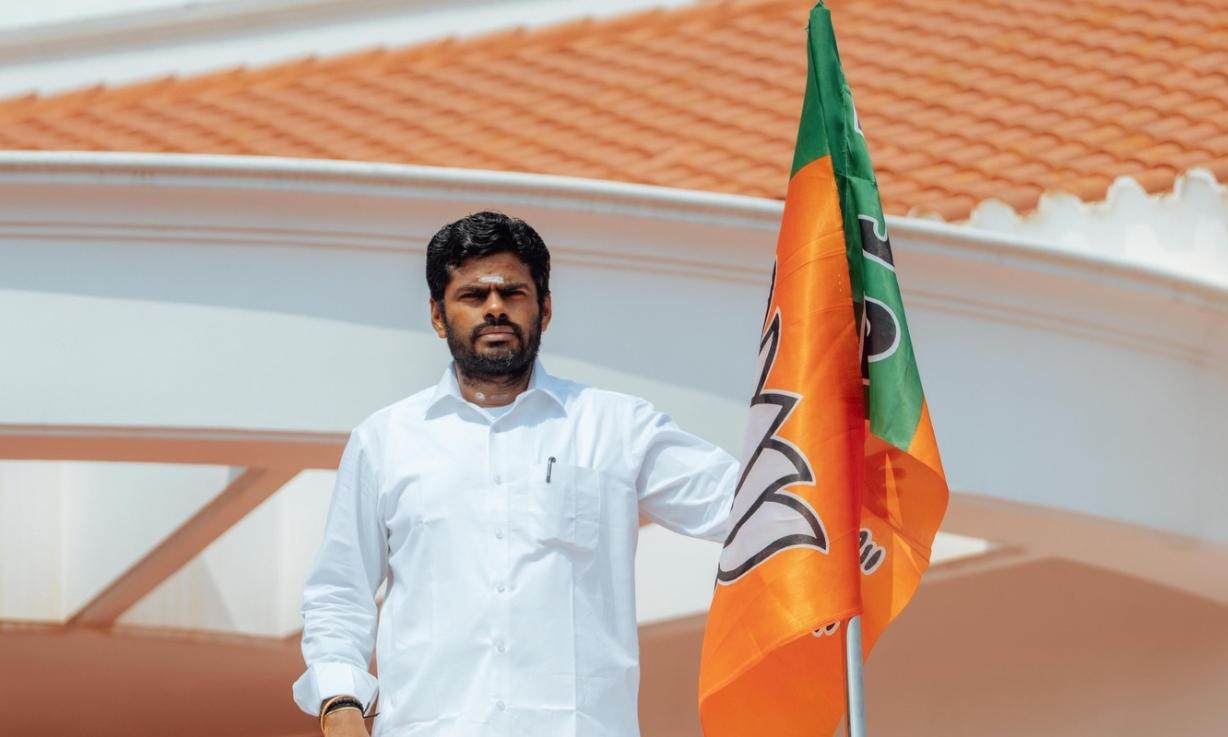

K Annamalai quit the BJP on June 5, a day after he turned 42. Within hours, his platform ‘We the Leaders’ had 8 lakh new volunteers. The same day, the BJP had moved on, too.
Nobody was angry. Nobody was bitter. That should tell you something.
Political resignations in India are usually ugly. They involve press conferences where people brandish old grudges, factions take sides, and parties spend weeks doing damage control. Annamalai’s exit had none of this.
The BJP formally “relieved” him, a term used for employees completing a tenure, not for rebels walking out. He had informed the leadership in December 2024. They asked him to finish election duties first. He did. The Tamil Nadu state BJP chief called the exit a non-event. Nobody slammed doors.
Helpers from outside
This is not how a party behaves when it loses someone important. This is how a party behaves when it has already figured out that the person is more useful from the outside than from within.
Watch/Read | Can Annamalai’s experiment succeed after Vijay’s rise?
Surely, the BJP tried very hard to crack Tamil Nadu for over a few decades. Sadly, it has almost no tangible results. The 2026 cut was the unkindest of all.
The problem is not effort. The real problem is identity. A party defined by Hindi and Hindutva has a structural ceiling in a state where both trigger real cultural resistance. Annamalai’s job inside the BJP was to lower that ceiling by projecting a Tamil face on a party that Tamil Nadu had decisively rejected. Of course, he was good at optics. But that was not good enough to win a seat.
What changes for BJP
So what changes when he leaves? Everything that was impossible inside the BJP becomes possible outside it.
A new party with no formal saffron affiliation can speak Tamil identity without apology. It can go after DMK voters without triggering the reflexive anti-BJP response that has limited the party’s growth for years. It can occupy the anti-establishment, anti-dynasty space that TVK’s Vijay has been building, and do so with someone who is younger than Vijay, more administratively credible, and rooted in OBC community networks that are the real prize in Tamil Nadu’s electoral math.
If Annamalai weakens TVK, fragments anti-DMK vote, and consolidates OBC communities that neither Dravidian party has fully captured, BJP benefits without spending a rupee or lending its name.
Here is the number that makes this calculation worth taking seriously: roughly 62 per cent of Tamil Nadu’s electorate is under 50. This is a young state politically, and young voters show little loyalty to the DMK machine or the AIADMK legacy.
Annamalai is 42. He is pitching cadre-based politics, leadership training, and a promise that his party will not become anyone’s personal property. That pitch lands differently with an 18-year-old first-time voter than with someone who grew up watching Karunanidhi and MGR define what politics looks like.
Skipping 2029 is telling
Now consider what Annamalai is deliberately not doing. He has declared he will contest only the 2031 Assembly elections, not the 2029 Lok Sabha polls. That choice is revealing.
Watch/Read | Real story behind Annamalai’s withdrawal from TN poll duties
Contesting Parliament in 2029 would force him to take clear positions on national issues, on Modi, on the BJP, on policies of a government he served under ideologically for five years. He would have to either defend them or attack them.
Neither is comfortable. Defending them keeps the BJP tag alive. Attacking them would burn bridges he may not want to burn. Skipping 2029 is the cleanest way to avoid that choice. Spend two years building the party, two more consolidating it, and arrive at 2031 without ever having publicly answered where he really stands on Delhi.
A second way to read it
Or read it another way entirely, and this reading also holds. Annamalai may have simply done the math on his own future and concluded that staying inside the BJP was a slow political death.
The AIADMK is a hollowed-out shell. The DMK is a family business with diminishing returns for anyone who does not carry the Stalin surname. Vijay demonstrated that new formations can attract volunteers faster than anyone expected. The OBC political space that is numerically enormous and institutionally under-represented, has no dedicated home.
Voters have short memories about many things. In Tamil Nadu, however, political identity is not one of them.
For an ambitious 42-year-old with a genuine following and five years of statewide visibility, the BJP was a ceiling, not a launchpad. Leaving was not betrayal. It was arithmetic.
Well, both readings can be true simultaneously. That is what makes the move genuinely difficult to pin down, and why Tamil Nadu’s political establishment is watching Annamalai with unease. If he weakens the TVK, fragments the anti-DMK vote, and consolidates OBC communities that neither Dravidian party has fully captured, the BJP still benefits without spending a rupee or lending its name. Political interests do not need formal agreements to run in parallel.
Baggage he cannot shed
But Annamalai has a problem that a new party name alone cannot solve: his past. Five years as the BJP’s most visible face in Tamil Nadu is not a neutral fact. He led the charge on issues that Tamil Nadu’s voters found alienating: the party’s positions on Hindi, state autonomy, and Dravidian cultural politics.
Watch/Read | Vijay’s suit sparks debate on politics, identity and symbolism
Voters have short memories about many things. In Tamil Nadu, however, political identity is not one of them.
So, the problem is the BJP baggage question, and Annamalai has not answered it clearly. You cannot spend five years being the face of something and then ask people to see you as its opposite. The rebranding has to be ideological, not merely structural.
Rajini recall
So far, Annamalai has offered no clear ideological distance from his BJP years. He has simply changed the vehicle while also keeping the destination vague.
In fact, Tamil Nadu politics has seen this kind of ambition before. Rajinikanth spent years talking about entering politics, finally did, and left before the first election.
Perhaps what Tamil Nadu may demand of Annamalai is clarity. He has an image, and of course, he has the energy. Probably, numbers, too.
What he does not yet have is an honest and convincing explanation of why his past should no longer matter. And that will decide his future.
(The Federal seeks to present views and opinions from all sides of the spectrum. The information, ideas, or opinions in the articles are of the author and do not necessarily reflect the views of The Federal.)

Comments are closed.