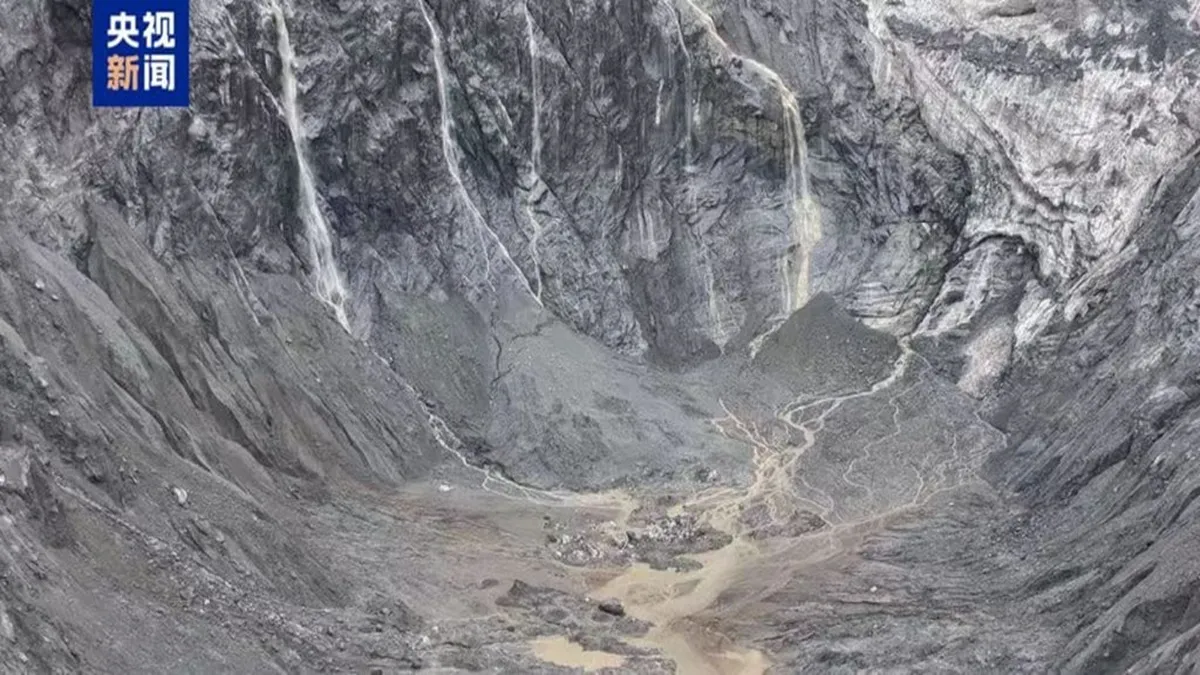
The devastating floods in Nepal on August 26 have caused widespread devastation. Meanwhile, another major threat has raised concerns. Ice cliffs surrounding the impact crater in Nepal’s Chochen River are still at risk of collapsing, potentially leading to a major disaster. The Chinese Embassy in Nepal has shared this information with Nepal.
Chinese state media CCTV News also published the report on Tuesday, citing China’s Ministry of Water Resources. According to CCTV, China’s Ministry of Water Resources is continuing consultations and monitoring to continuously assess all potential risks related to debris flooding in the Gariong (Kerung) County of Tibet Autonomous Region in southwest China. A comparative analysis of recent remote-sensing images revealed that the water levels of 14 previously identified glaciers in the Gairong Tsangpo River Basin have not changed significantly. All these lakes are currently in stagnant condition.
Based on drone images taken at 5:45 a.m. Nepali time on Tuesday morning, most of the water accumulated in the impact crater on the Chochen River in Nepal has flowed away. As a result, river flow is common in the lower coastal areas. However, the report said there is a risk of a glacier or large iceberg breaking off around the impact crater. Consequently, the sudden breakup of these glaciers poses a serious threat in the future. This report from the Ministry of Water Resources of China was shared by the Chinese Embassy with the Department of Meteorology and Flood Forecasting of the Government of Nepal.
Meanwhile, the death toll in Nepal’s devastating floods has risen to 1,003. Search operations are ongoing, and the death toll may rise. Families struggle to identify flood victims in Nepal There is a disagreement between the three families regarding the identity of body number 1003 located in the Pokhara government hospital. All three families claim that the body belongs to a family member who has been missing since the floods.