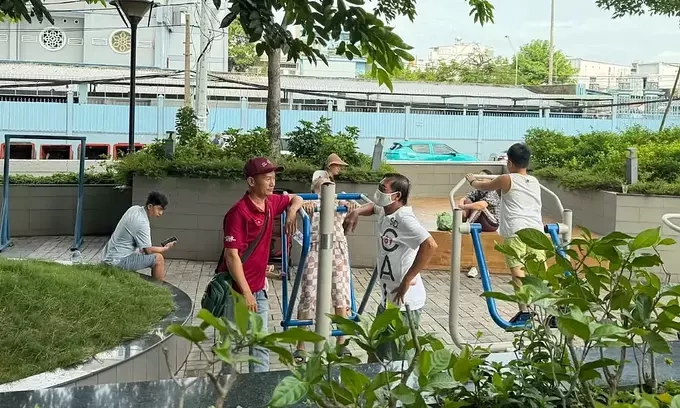
Quang Thai, 34, lives in a complex of over 1,100 apartments in Binh Dong Ward that lacks perimeter walls. Keycards are used there to prevent outsiders from gaining access to residential floors.
But the internal roads, outdoor exercise equipment, and other facilities remain accessible to outsiders. Every day around 6 p.m., outsiders come in to exercise and bring children or pets to play.
Because the entire complex has fewer than 10 exercise machines, many occupants head downstairs only to find themselves waiting in line or heading back home, despite paying a monthly management fee that covers all the facilities.
Thai says disputes have broken out between outsiders and residents waiting to use the equipment. Security guards, unable to resolve the problem, have had to call in the police on occasion to escort non-residents out.
With the property situated opposite a bustling local market, the ground-floor restrooms have become a convenient stop for shoppers.
Thai has seen vomit on the floor and unflushed toilets. Smells persist despite daily cleaning by the janitors. Though the management has posted warning signs and assigned extra guards in the lobby, the problem persists.
In August, a child living in the complex was chased and hit by a group of outside children. That evening, residents pulled security camera footage and posted it in their community group, demanding stronger security measures.
|
The common area in an apartment complex in Binh Dong Ward, HCMC. Photo courtesy of Thai |
Kim Anh, 32, who lives in an apartment complex in An Khanh Ward, says her child has been afraid to play downstairs since July after being threatened by outside kids.
Though she has reported the issue, the outside group continues to show up. “My family pays more than VND800,000 (US$31) in management fees every month, but my child is too scared to use the playground below our home,” she says.
Outsiders using playgrounds, exercise equipment, restrooms, and internal roads has become a hot topic on apartment forums in HCMC.
Read found a number of people living in apartments such as Akari City of An Lac Ward, Picity High Park of Thoi An Ward, and Green River of Binh Dong Ward making posts complaining about non-residents borrowing keycards to sneak into swimming pools, basketball courts, and gyms.
Each post attracts 200-300 comments expressing disapproval and demanding action from managements.
Residents say they pay monthly fees to maintain the infrastructure, but facilities are being overcrowded with non-paying outsiders.
An online survey by Read found 53% of readers wanting managements to prevent non-residents from using internal roads in apartment complexes.
Ha Lan, a real estate agent in An Khanh Ward, says this issue also exists in mid- and high-priced apartments.
Even though access is by keycard, security guards there struggle to distinguish between genuine visitors and people sneaking in to use amenities.
Kim Oanh, a manager at Green River Apartment Complex of Binh Dong Ward, says outsiders entering internal areas has been an ongoing problem for years due to the complex’s proximity to markets and schools.
Neighborhood kids frequently ride electric bicycles and play soccer on the grounds.
Since identification relies entirely on the memory of security guards, the management is considering fencing off the complex and having only a single entrance.
 |
|
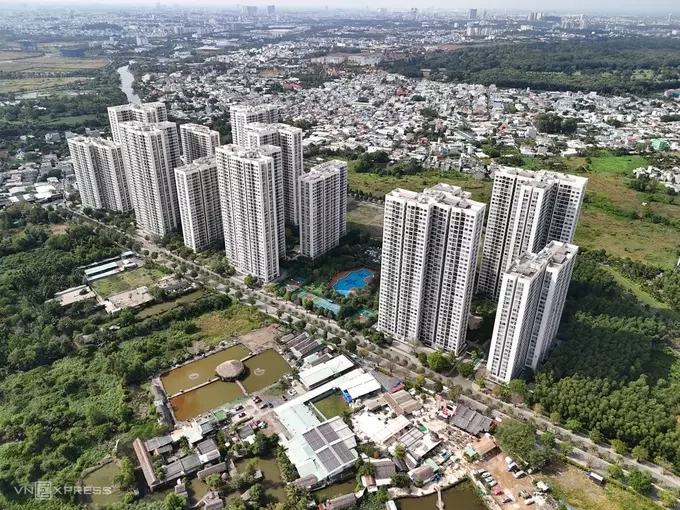
Real estate in the East of HCMC, December 2025. Photo by Quynh Tran |
Nguyen Duy Thanh, vice president of the HCMC Apartment Management Association, says managers must clearly distinguish between guests accompanied by owners and outsiders who regularly show up to exercise or hang out.
From a legal perspective, outsiders have no automatic right to use shared private property in an apartment complex.
The situation is also a reflection on the shortage of public spaces in urban areas, with HCMC’s population continuing to grow and public parks, playgrounds, and sports facilities failing to keep pace.
Enforcing control is especially tricky in complexes with multiple entry points, where non-residents can borrow cards, follow residents, or claim to be visiting guests.
During busy times, security staff cannot manually check every individual, while requiring strict registrations creates inconvenience for actual residents.
Thanh suggests that management boards should personalize resident keycards, issue QR codes for guests, and install facial recognition cameras at entrances.
Two years ago, Hoai Tam, 31, had an embarrassing experience when trying to use another building’s amenities. He was living at EHome 3 of An Lac Ward, which only had a small pool.
When he brought his family to City Gate Towers of Phu Dinh Ward and asked a friend to swipe their card for access to the third-floor swimming pool, he was stopped by security guards and his entire family was asked to leave.
“To be honest, I didn’t mean to steal access, and if the building sold day passes to non-residents, I would have happily paid the fee,” he says.