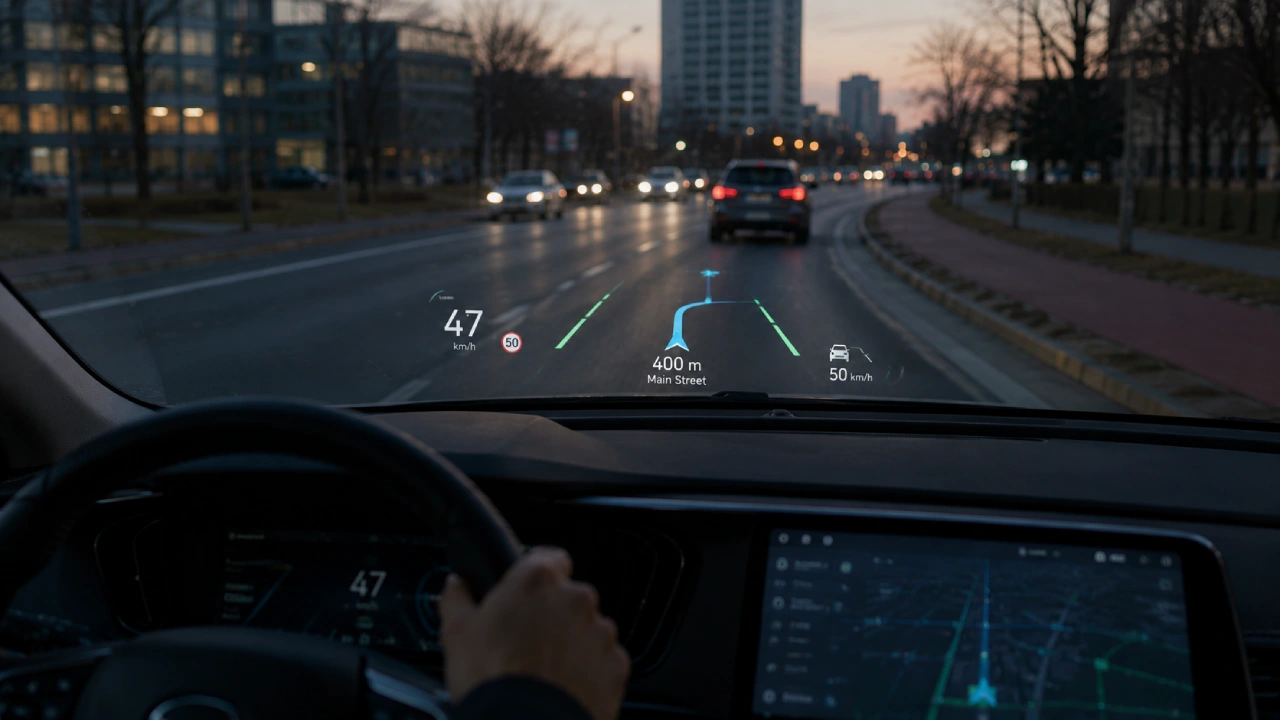
As modern cars evolve far beyond simple mechanical machines, AR windshields are rapidly transforming vehicles into smart digital spaces. For many years, when driving, you would have had to look at your dashboard or central control system to see your speed, what turns you would have to take, as well as any warning signals.
This is what the majority of drivers are used to doing; however, having to look down at your dashboard does require taking your eyes off the road for a small amount of time.
With the introduction of specialized display systems that use projected images to show important driving information (such as speed, turns, and warning signals) directly into the driver’s view, your eyes never need to leave the road, leading to a significantly safer driving experience than before. Most automotive technology specialists agree that this visual evolution will be critical to the future success of automobile driving.
Understanding Head-Up Displays and AR Windshields
The head-up display (HUD) allows you to see the information about your vehicle while keeping your attention on what is in front of you. It projects the data for you – like an instrument panel – onto an area of your windshield directly ahead of you. This way, as the driver, you will continue to focus on what is in front of you and not on the dashboard of the vehicle.
Therefore, no aspect of driving requires you as the driver of your vehicle to remove your attention from the road in the process of determining the condition of your vehicle. This allows the driver to maintain a good visual connection with other vehicles on the roadway.
The reasoning is simple: Throughout their trip, if a driver maintains their line of sight to the roadway, they will have a safer and better overall experience as a driver.
Early car HUD systems were basic. They usually showed only the car’s speed or a simple navigation arrow. The display area was small, and the graphics were simple. But even those early systems proved something important — drivers liked the idea of getting information without shifting their eyes.
How Smart Glass Displays Work
Current head-up displays consist of small projector units positioned in the automobile’s dashboard that send projected images to an area of the windshield designated to reflect them to the driver. As such, the graphics appear to be floating in front of the vehicle.
Sensors, cameras, and vehicle data are used to accurately position the displayed information. For instance, navigation arrows indicating turns would appear directly on the roadway, as opposed to a small monitor display. This is how augmented reality is used to merge physical and digital viewings of navigation-related data.
In turn, the system allows for quick processing by drivers of instructions while simultaneously being able to maintain concentration on the roadway.
The Shift Toward Augmented Reality Windshields
Auto manufacturers are taking this technology to the next level. While traditional head-up displays (HUDs) presented speed and direction only, now they are showing lane assistance, safety warnings, driver assistance features, and navigation.
Several cars provide very large directional arrows that seem to be projecting themselves directly onto the surface of the road.
Some of the car manufacturers developing these advanced augmented reality displays include BMW, Mercedes-Benz, and Hyundai.
In addition to providing larger display areas, these advanced systems feature an improved level of graphics quality as well. The aim is for the windshield to function as if it were a smart display (like an iPhone), while not disrupting or distracting the driver while driving.
How It Changes Navigation for Drivers
Navigation is one of the biggest benefits of smart glass displays. Most automobiles utilize small map screens to provide turn-by-turn driving directions, which can result in drivers frequently looking down at the screen rather than paying full attention to the road ahead.
Augmented reality maps provide a new alternative. When approaching an intersection, the augmented reality map gives the driver a big arrow on the window telling them which way to go next.
This type of device not only assists drivers with navigation, but it also tells them what lane to be in at freeway speeds and which exit to take.

Having access to augmented reality technology while driving can provide more comfort throughout a vehicle’s journey compared with traditional GPS navigation systems. Additionally, using AR for navigation allows you to keep both your eyes on the road and use augmented reality as a method of maintaining your attention while driving. The directions appear exactly where they are needed.
A New Layer of Safety on the Road
Smart windshields are also becoming popular due to safety considerations. Today’s cars come with systems that can help you avoid an accident by providing warnings about impending collisions (i.e., through a “Collision Avoidance System”) and warn you if you are leaving your lane or if you have an automobile(s) in your blind spot (i.e., “Blind Spot Detection System”).
In the past, warnings about impending collisions and other similar hazards (lane departure warnings, blind spot detection, etc.) have been given using light and/or sound warnings on your dashboard. However, with the use of head-up displays (HUDs), these warnings are now being displayed directly in front of your face on your windshield.
For instance, if several cars ahead of you brake suddenly, you’ll see a warning light on your windshield at the location where those vehicles were located, and if you drift outside of the designated lane on the road, you’ll see the lane markings on your windshield start to blink.
Since the driver does not need to redirect their gaze to see the warning sign, the reaction time of the driver can improve. Even a small time difference can help avoid accidents.
Better Interaction Between Driver and Vehicle
Cars today come with many digital features. Touchscreens, menus, and apps are common inside modern vehicles. But using these features while driving can sometimes be distracting.
Smart glass displays try to solve that problem. Important information appears automatically in front of the driver. There is no need to check multiple screens.
Many systems also work with voice commands. Drivers may ask directions or vehicle information, and the HUD displays the answer on the windshield. In some advanced systems, the way in which information is presented will actually change based on the circumstances of the drive.
For example, navigation details may become larger when a turn is close, while other information fades into the background.
Technology Behind Modern Smart Windshields
Creating large augmented reality displays inside a car is not simple. Engineers must make sure the projected image stays clear in different lighting conditions. The system also needs to work for drivers of different heights and seating positions.
Some manufacturers use cameras or eye-tracking systems to adjust the projection angle. Others use special windshield layers that improve image reflection.
Another improvement is the projection distance. In many modern systems, the graphics appear several meters ahead on the road. This helps drivers focus better because their eyes do not need to shift between near and far objects.
Challenges That Still Exist
Despite improvements in technology, there continue to be challenges to smart glass displays.
One such challenge is cost. Producing advanced augmented reality head-up displays, it requires a high-performing computer system and a special windshield, thus making them rather expensive. Consequently, they can be found mostly in luxury automobile models.

Another problem has to do with how much information will be displayed on the windshield. In fact, it may lead to visual confusion from too much data instead of providing an assistant. The manufacturers must manufacture the equipment accordingly so that it will be simple and effective.
Weather can also affect visibility. Bright sunlight, heavy rain, or snow may reduce the clarity of the projection. Engineers continue working to improve brightness and contrast in different conditions.
The Future of Automotive Smart Glass Displays
The role of smart windshields may grow even more in the coming years. Some companies are already testing larger displays that cover a bigger part of the windshield. Others are looking at ways to show information for passengers on side windows.
With the transition toward semi-autonomous and fully autonomous cars occurring quickly, there is likely going to be an increase in the role that the windshield plays as a digital interface for navigation, warning systems, and updating other information required for the vehicle to operate safely.
Simply put, with vehicles doing more of the driving for you, the windshield will become the primary digital display in the car.
Final Thoughts
The way in which drivers are able to engage with their vehicles is being altered with newly developed smart glass display technology.
A simple speedometer has evolved into a sophisticated system that offers drivers navigation, safety notices, real-time driving information, etc., and places this critical information directly in the driver’s field of vision through the use of a head-up display system.
Although the entire technology is still being perfected, it is obvious that the continued evolution of augmented reality-style windshield displays will continue to become an integral part of all future vehicle assists.