
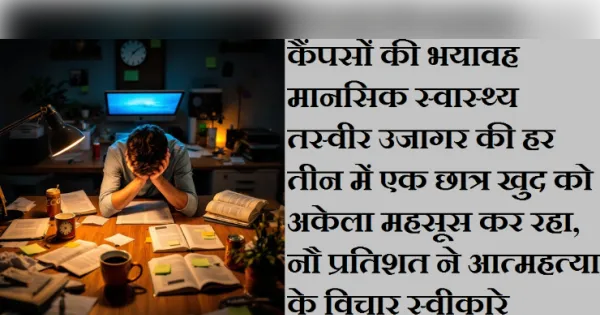

- NTF report reveals dire mental health picture on campuses One in three students feeling alone, nine percent admitting suicidal thoughts
Lucknow/ New Delhi. The country’s prestigious universities and colleges, where future scientists, doctors, engineers, administrative officers and researchers are prepared, today thousands of students are struggling with mental pressure and loneliness. The interim report of the National Task Force (NTF) formed on the instructions of the Supreme Court shows that student suicides are not the result of any single reason, but are the combined result of many serious flaws in the education system.
The report clearly indicates that if reforms are not made in time, the degree awarding institutions will prove unsuccessful in saving the lives of the students. On March 24, 2025, in view of the increasing incidents of suicide of students in higher educational institutions, the Supreme Court, headed by retired judge Justice S. National Task Force was formed under the chairmanship of Ravindra Bhat. The mandate of the task force is to identify the major causes of student suicides, review existing laws and institutional arrangements and recommend reforms to ensure effective prevention and accountability.
In its order dated May 27, 2026, the court has given time to the task force to submit its final report by October 31, 2026. The task force inspected 30 higher educational institutions in 10 states of the country from May 2025 till now and interacted with more than 2.43 lakh students. The report revealed that 34 percent students feel isolated in their own campus. 15 percent of the students are suffering from chronic stress, depression and anxiety, while nine percent of the students admitted that they had suicidal thoughts several times in the last one year.
The most worrying aspect of the report is that the institutions which are responsible for providing mental support to the students, do not even have basic arrangements in place. More than 70 percent of the institutions surveyed did not have full-time mental health specialists. Only 20 per cent of the institutions have formal tie-up with experts and only four per cent of the institutions have a clear action plan (SOP) to deal with emergencies like suicide.
The problems that students pose to the workforce are not limited to studies. Rigid attendance rules, ever-increasing academic pressure, caste and gender discrimination, delayed scholarships, shortage of teachers, poor hostels, dysfunctional grievance redressal mechanism and lack of counseling services are breaking students from within. Many students also said that when they complain, they are ignored instead of getting solutions.
The National Task Force has acknowledged that it would be a big mistake to consider student suicide as merely an individual mental weakness. It is also a result of institutional culture, social discrimination, economic pressure and administrative apathy. Therefore, the report recommends appointing trained counselors in every higher educational institution, setting up effective mental health support centres, making the grievance redressal system accountable, increasing student-teacher communication and taking strict action against discrimination.
This report is a warning for the government, university administration and society. The youth population of the country can become a national power only when along with their dreams, their mental health is also safe. If universities remain limited only to results and placements and the emotional security of students continues to be ignored, this crisis may deepen in the years to come. Now the need is not just for new policies, but to create such sensitive campuses where every student feels that he is not alone.

Comments are closed.