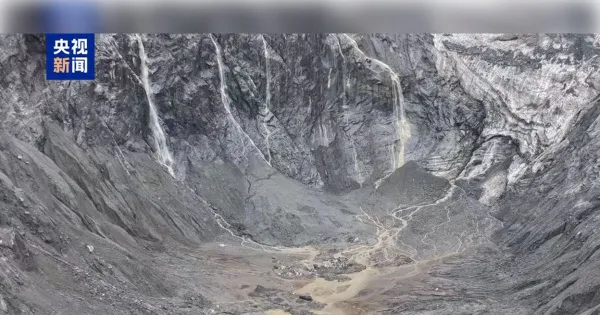
The magnitude of the glacier collapse, which is believed to be the cause of the devastating floods in Nepal’s Rasuwagadhi, can be gauged from the fact that about 25 million cubic meters of snow and icebergs fell about 2,000 meters below. According to experts, this incident generated huge energy in the surrounding area, whose effect was like a bomb explosion.
According to Dr. Ranjan Kumar Dahal, Professor, Central Department of Geology, Tribhuvan University, who is studying avalanches and floods north of Langtang Lerung, the huge pile of snow not only fell down, but also caused an explosion causing widespread damage in the surrounding area.
Dr. Dahal said that on the basis of analysis of satellite data and very low estimates, it is confirmed that about 25 million cubic meters of snow has fallen.
According to him, the effect of the energy generated by this icy pile while falling about 2,000 meters would have been like a bomb explosion. The tremors produced by this event were also recorded as an earthquake of 5.2 on the Richter scale.
Dr. Dahal, an engineering geologist from Tribhuvan University, along with professors from Tongji University in Shanghai, China, University of Cambridge and King’s College London, Britain, and University of Padua, Italy, started studying the activities taking place in the Himalayas and Himalayan regions about a year ago.
During the study, it was revealed that small water reservoirs and ponds recently formed on the supraglacial lake i.e. glacier of Purepu Himtal located in the upper Tibetan region of Rasuwagadhi had burst. Due to this, there was flood in Bhotekoshi river last year also.
After this, the team of geologists and scientists started studying the movements and activities taking place in the glaciers of the Himalayan region. Amidst this study, a sudden devastating flood occurred last Wednesday, after which some members of the team got involved in the study of avalanches and floods.
According to Professor Dahal, analysis of satellite data obtained shows that the length of the avalanche was about 1.3 kilometers. It cleared an area of about 500 to 800 meters downstream.
However, scientists have not yet been able to clearly determine the actual thickness of the ice pack. Based on the available details, they estimate that the fallen snow pile would have been about 60 to 70 meters thick.
On this basis, if the volume of snow and iceberg is estimated, there is a possibility of about 40 million cubic meters of material falling down.
However, Professor Dahal, even on the basis of very low estimates, says that at least 25 million cubic meters of snow may have fallen. At the same time, some other experts have initially estimated snowfall up to 100 million cubic meters.
How huge the volume of 25 million cubic meters of ice is can be estimated from the fact that it can fill London’s Wembley Stadium approximately 22 times. This quantity is said to be about 10 times more than the famous pyramid of Egypt.
Experts doing scientific study of the volume of snow say that the actual amount of snow that has fallen may be much more than these initial estimates.