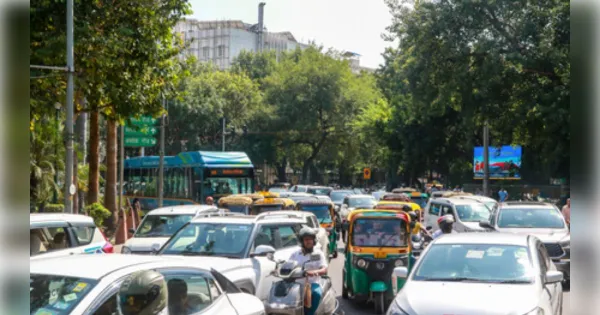
New Delhi. The Cabinet Committee on Economic Affairs (CCEA), chaired by Prime Minister Narendra Modi, on Wednesday approved the Rs 1,789.52 crore Intelligent Traffic Management (ITMS) project for Delhi. It aims to improve traffic flow, road safety and urban mobility in Delhi.
The project, to be implemented by Delhi Police, will include 42 identified traffic corridors and will be rolled out in three phases over a period of 24 months.
The initiative is part of broader efforts by the Center and the Delhi government to improve traffic management and transport infrastructure in the city. ITMS will use real-time traffic data, adaptive traffic signals, automated enforcement systems and integrated command-and-control systems to better manage Delhi’s road network.
This step has been taken at a time when the traffic pressure in the city is increasing and about 71 lakh active registered vehicles are currently running on the roads. According to the government, the increase in the number of vehicles in Delhi has been much higher than the expansion of road infrastructure, while traffic management is still largely dependent on fixed signal timings and manual intervention.
This new system is designed to make better use of the road capacity, so that the traffic control system can make immediate changes according to real-time conditions.
A special feature of this project is the implementation of ‘Adaptive Traffic Control System’. The system will automatically adjust signal timings based on traffic flow and coordinate signals on key routes to reduce congestion and delays.
This system will also facilitate priority movement for ambulances and other emergency vehicles by creating ‘green corridors’ on congested roads.
The government says that with this technology, traffic jams, accidents and other incidents happening on the road will be detected quickly, so that Delhi Police will be able to take appropriate action and manage traffic diversion better.
Commuters will get real-time information about traffic conditions, diversions and parking availability through ‘variable message sign boards’ and digital platforms. Traffic updates can also be shared with navigation service providers to help travelers choose better routes.
The project will help in automatically detecting traffic violations like red-light jumping, speeding, driving in the wrong direction, illegal parking, not wearing helmet and seat belt and using mobile phones while driving.
Analytics based on Artificial Intelligence (AI) will also help in identifying stolen, blacklisted and hot-listed vehicles, repeat rule breakers and vehicles linked to hit-and-run cases.