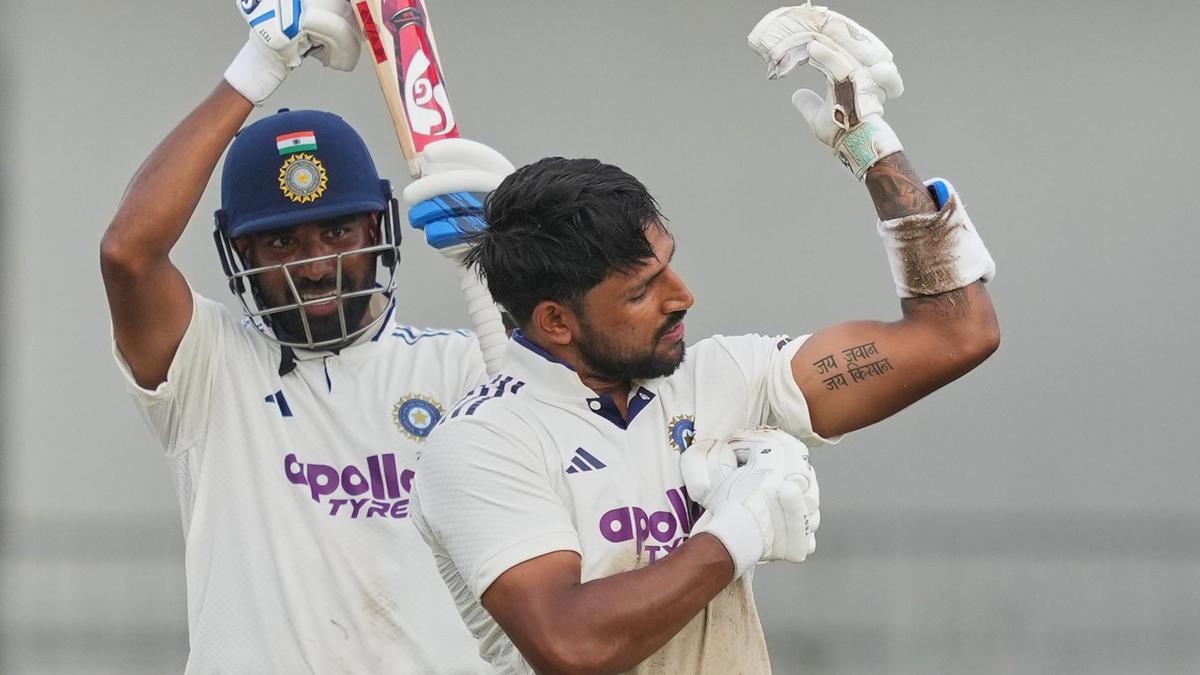
Dhruv Jurel raised his bat after reaching his second Test century, against Sri Lanka at the Sinhalese Sports Club on Monday, and, for a moment, the focus shifted from the score to the tattoo on his arm.
“ Jai Jawan, Jai Kisan.”
The words, made famous by former Prime Minister Lal Bahadur Shastri in 1965, mean something deeply personal to Jurel. His father, Nem Singh, is a Kargil war veteran. His grandfather was a farmer.
“My grandfather was a farmer and my father a soldier. I don’t want to forget my roots,” Jurel said.
But there is more to it.
In one corner of the Jurel family home in Agra is a wall-mounted glass cabinet filled with trophies and medals. Each has a story from his cricketing journey. Cricket was hardly the career his family had envisaged for him.
Jurel grew up in a fauji family. His father had served in the Army and expected his son to follow the same path and join the National Defence Academy.
But Jurel had fallen for cricket.
After the family moved to Agra in 2008, following his father’s heart attack, he initially took up swimming. Cricket soon became more than a hobby. He started going to a local academy and playing tournaments.
He just did not tell his family.
Jurel knew his father would not approve, so he quietly went about playing wherever he could. For a while, he managed to keep his cricket away from home.
ALSO READ |England drops Carse after investigation into club incident; Baker named replacement
Then a newspaper gave him away.
Nem Singh was an avid newspaper reader. One day, he spotted his son’s name in the sports pages after Jurel had scored heavily in a local tournament.
He asked Dhruv if he was the same boy mentioned in the report.
There was no point denying it.
Jurel admitted that he had been playing cricket at a local academy without telling the family. His father was furious.
For a few days, things remained tense at home. But Jurel knew he could not walk away from the game. Eventually, he found the courage to tell his father that he wanted to pursue cricket as a career.
It took some time, but Nem Singh came around. His mother once sold her jewellery to buy him a cricket kit.
From there came age-group cricket, domestic cricket, the Rajasthan Royals and, eventually, India.
Jurel’s first Test century came against the West Indies in Ahmedabad last October. In Colombo, he brought up his second, staying long enough to show the patience and composure that have become increasingly important to his batting.
He has also made a habit of learning from those around him.
At the Rajasthan Royals, Jurel spent time with Joe Root, picking the England great’s brain about batting and dealing with different situations. Their conversations continued during India’s England tour.
Jurel also draws inspiration from Kobe Bryant. A fan of the late basketball star, he believes in preparing for situations before they arrive. Even when he is not playing, he visualises walking out to bat, taking guard and facing different scenarios.
He wants the moment to feel familiar when it arrives.
He has had to wait for his chances, but when they have come, he has made them count. After his first Test hundred last year, Jurel saluted, a gesture meant to honour his father and the Indian Army.
In Colombo, there was no salute.
He simply raised his bat and showed the tattoo. For a brief moment, one caught a fleeting glimpse of the boy, who was so passionate about the sport that he had even locked himself in the bathroom for an entire day just so his father could allow him to play.
The tattoo was a quiet reminder of his roots.