
At least 10 airports ground flights as Typhoon Bavi the width of France closes on China’s east coast

In Hong Kong, Cathay Pacific, HK Express, Hong Kong Airlines and Greater Bay Airlines scrapped more than 40 flights and waived change fees, the South China Morning Post reported.
The cancellations hit routes to Taipei, Kaohsiung, Okinawa, Ishigaki and Zhoushan.
Singapore Airlines and its budget arm Scoot canceled at least 18 flights spanning Taipei, Tokyo, Seoul and Sapporo.
On the mainland, at least 10 airports halted departures. Zhoushan airport in eastern Zhejiang said 14 flights were grounded on July 10, and Wenzhou canceled 17 inbound flights.
Air China, China Southern Airlines, China Eastern Airlines and Hainan Airlines opened assistance channels and offered fee-free rebooking. Air China cleared free changes or refunds for passengers routed through Quanzhou, Hangzhou or Xiamen over two days.
China’s national observatory renewed an orange typhoon alert on July 10, the second-highest in its four-tier warning system, Xinhua reported.
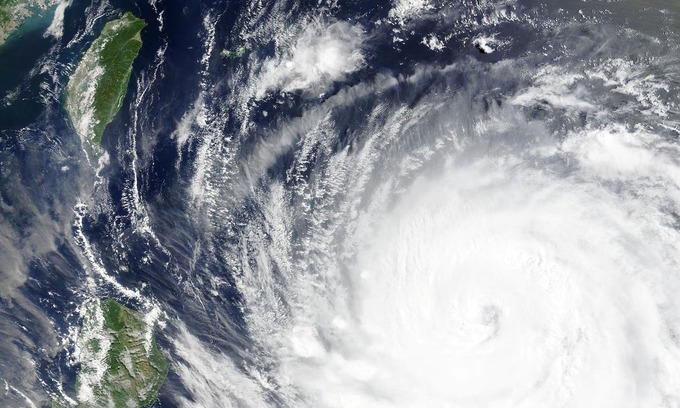
A satellite image shows Typhoon Bavi as it churns in the Pacific Ocean, July 9, 2026. Photo by Reuters |
At 8 a.m. on July 10 Bavi’s center lay about 1,020 km southeast of the Fujian-Zhejiang boundary, with maximum sustained winds of 42 meters per second (151 kph), the National Meteorological Center said.
Bavi peaked at 285 kph near the Northern Mariana Islands on July 6, where it hit the U.S. island of Rota, before an eyewall replacement cycle collapsed its inner core and eased its winds.
It still spans about 1,000 km at its widest, roughly the width of France, with cloud cover of about 940,000 sq.km, nine times the size of Zhejiang Province, according to Weather Chinaa service of the China Meteorological Administration.
Taiwan’s Central Weather Administration called it the largest storm by size to affect the island since 1987.
Bavi is forecast to skirt northern Taiwan before coming ashore between Xiapu in Fujian and Wenling in Zhejiang on the night of July 11, then weaken inland.
Taiwan warned of up to 900 mm of rain in its northern mountains through July 12. Southern Zhejiang and northeastern Fujian could see 250 to 400 mm on July 11, with the rain band pushing inland toward Hubei, Anhui, Henan and Shandong afterward.
China’s National Meteorological Center ordered coastal governments to bring fishing vessels back to port, suspend island and outdoor tourism, secure infrastructure and keep the elderly and children indoors. Zhejiang activated a Level IV flood emergency response.
In Shanghai, near the northern edge of the projected path, July 10 dawned bright but unusually hot and humid, residents told the South China Morning Post.
In Taizhou, Zhejiang, fish farmers reinforced their pens and readied pumps while crab farmers strung more than 3,000 meters of netting around their ponds to stop stock escaping, state broadcaster CCTV reported.
Shanghai farms raced to harvest vegetables before the storm.
Comments are closed.