Speaking at the Australian Financial Review Higher Education Summit in Sydney last week, Clare acknowledged that recent visa fee increases had been unpopular among universities, but said the revenue was helping fund measures recommended by the Australian Universities Accord, according to the transcript of his speech published by the Ministers’ Media Center.
He highlighted the government’s decision to increase the visa fee for international students, saying the change was sometimes overlooked in discussions about the decline in overseas student applications.
While acknowledging that the policy had been “not very popular,” he said the higher charge had “some impact on reducing the number of applications.” He also recognized that the new fee, which he described as “a lot of money,” and had drawn criticism from some people.
Australia in July raised visa fees for international students, with the application fee for higher education reaching A$2,500 (US$1,723), making it the highest among the “Big Four” study destinations, including the U.S., the U.K. and Canada.
The cost was raised for both student and post-study work visas, with the increase neither announced in advance nor accompanied by a public explanation.
According to the latest update from the Department of Home Affairs, the subclass 500 student visa fee for higher education and vocational education and training (VET) has risen from $2,000 to $2,500. Students from ASEAN countries are subject to a slightly lower fee of $2,050.
The visa application fee for English-language studies (ELICOS) has increased from $2,000 to $2,050, while the Temporary Graduate Visa (subclass 485) for post-study work has surged from $4,600 to $5,750.
The cost of studying in Australia has risen steadily over the past several years. The student visa fee climbed from $710 to $1,600 in 2024, before reaching $2,000 in July 2025.
|
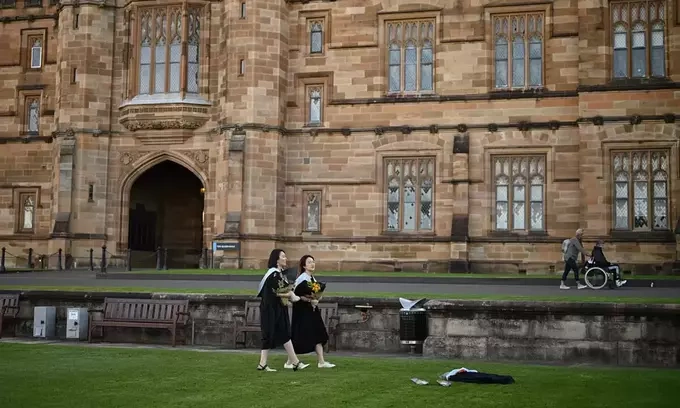
International students wear graduation gowns as they take pictures around the University of Sydney’s campus in Sydney, Australia, July 4, 2020. Photo by Reuters |
Although the government does not formally earmark visa revenue for specific programs, Clare said the fees provide an important source of funding for higher education reforms.
“How do you think we’re funding the Accord? Whilst we don’t strictly hypothecate the money, when you make the argument to colleagues about funding with the system, you’ve got to find ways to do it, and whether it’s extra CSPs to meet the growing demand, or whether it’s paying prac, or whether it’s the billion dollars that we’re putting into extra bridging courses to help young people that aren’t ready to start a degree they’ve started, all of those things are helped by that set of investment,” he said.
In simpler terms, his point is that the higher international student visa fee helps contribute to broader investment in Australia’s higher education system, including expanding subsidized university places for domestic students.
He pointed to several areas that require significant investment, including expanding the number of Commonwealth Supported Places (CSPs) as demand for university education grows, providing financial support for students undertaking mandatory practical placements, and investing in additional bridging courses.
The bridging courses are intended to help young people who are not yet academically prepared to begin a university degree, giving them an alternative pathway into higher education. He argued that all of these initiatives require additional government funding, and that the increased visa fee contributes to the broader pool of resources available for such investments.
The Commonwealth Prac Payment offers A$338.60 per week to eligible students while they are undertaking a mandatory placement in a Bachelor’s or Master’s degree in teaching, nursing, midwifery or social work, according to the Department of Education.
Australia earned around A$583 million from application fees paid by foreign students who were awarded visas last financial year, and another A$157 million from those whose applications were rejected. Since then, the fees have risen a further 25%, according to Times Higher Education.
Shortly after the announcement of the visa fee increase, the International Students Representative Council of Australia (ISRC) in July urged prospective international students to think carefully before choosing Australia as a study destination.
ISRC president Weihong Liang said the hike should not be viewed as an “isolated change,” but rather as part of a broader trend toward “increasingly restrictive” and unpredictable policies that are not always clearly communicated, as quoted by The Guardian.
He said international students were increasingly being viewed less as valued members of Australian universities and communities and more as a “source of government revenue.”
The number of international students in Australia totaled 845,933 for the 2025 calendar year, according to Department of Education data, down 1% from 2024. China remained the top sending market, followed by India, Nepal, Vietnam, and the Philippines.
For the January-February 2026 period, government data shows 622,043 international students enrolled in the country. The top nationalities for this period were China, India, Nepal, Vietnam, and Bangladesh.