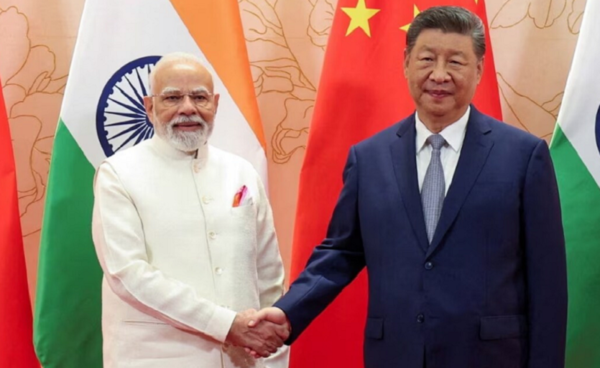
New Delhi . Before the 18th BRICS Summit to be held on September 12-13 in New Delhi, talks between India and China on economic and trade issues are going to be important. Chinese President Xi Jinping is expected to attend the conference and a large business delegation may also accompany him. In such a situation, the issue of problems being faced by India in importing high-tech goods from China and restrictions related to investment of Indian companies in China can be raised.
The Ministry of Commerce and Industry has initiated discussions with Indian industry organizations regarding this matter. The China Desk of the Ministry has studied the restrictions imposed by Chinese Customs on major technical items. According to a government official, these restrictions are having an impact on Indian manufacturing. In the talks, the issue of reciprocity i.e. equal level of facilities from both the countries can be raised for relief in procedural barriers and rules related to sourcing.
According to a senior official in the renewable energy sector, increasing restrictions on the export of important technology and raw materials from China in many sectors have become one of the major priorities of the government. According to an industry official, China has imposed export restrictions on ingot and wafer technology, battery cells and battery cell technology, equipment related to high voltage direct current (HVDC) and some special transmission components.
HVDC technology is important in delivering electricity over long distances, as it can reduce power losses during transmission. It is also considered necessary for connecting renewable energy to the grid and for the stability of the grid.
Industry officials said that these Chinese restrictions could impact India's efforts to develop domestic manufacturing capacity. If the problems are not resolved then the process of backward integration in India may also be affected. Most of these restrictions have been imposed in the last 12-15 months. China's restrictions on exports of critical technology and specialized components also expose strategic vulnerabilities in global supply chains.
However, official trade data shows a different picture of trade with China. India's exports to China increased by more than 28 percent to $5.55 billion in the April-June period of the current financial year compared to the same period last year. This increase came at a time when Indian fish exports were affected due to US tariffs. Increased exports to China helped offset that loss to some extent.
In recent times, there has been some softening in India-China trade relations. The major changes are some relaxation in FDI norms from countries sharing land borders, resumption of border trade through Nathu La, resumption of direct flights between the two countries and increased people-to-people contacts.
Meanwhile, a senior official of the Commerce Ministry was expected to go to Beijing this week, but due to border talks between India and China, it has been reported that this trip has been postponed. The question sent to the Commerce Ministry had not received a reply till the time of writing.
On September 1, Chinese Ambassador Xu Feihong met Commerce Secretary Rajesh Aggarwal. Both sides exchanged views on economic and trade relations as well as other issues of mutual interest. According to the Chinese Embassy, the pace of improvement and development in relations has been maintained under the strategic guidance of the leaders of the two countries.
Earlier in April this year, Commerce and Industry Minister Piyush Goyal had held bilateral talks with his Chinese counterpart Wang Wentao during the 14th WTO Ministerial Meeting in Cameroon. The talks were held for the first time after India walked out of the China-led RCEP talks in 2019.
Amidst the uncertainty over US tariffs, India has also relaxed rules in some areas of economic relations with China. In March, the government allowed BHEL to purchase 21 critical items from China for five years. In June, four Chinese power equipment manufacturers TBEA Energy, Nanjing Electric India, New Northeast Electric India and Taikai Electric India were allowed to participate in government tenders related to important power projects.
After the violent clash between India and China troops on the LAC in 2020, rules related to government procurement were tightened for Chinese companies. Registration with the relevant Indian authority was made mandatory for companies from countries sharing a land border. Political and security clearance from the Ministry of External Affairs and the Ministry of Home Affairs were also mandatory for Chinese bidders.
Now there seems to be some relaxation in the rules with some power purchase cases and four Chinese power equipment companies getting permission in government tenders. In such a situation, the BRICS conference of 12-13 September can become an important platform for high-level talks between India and China on economic and trade issues.