
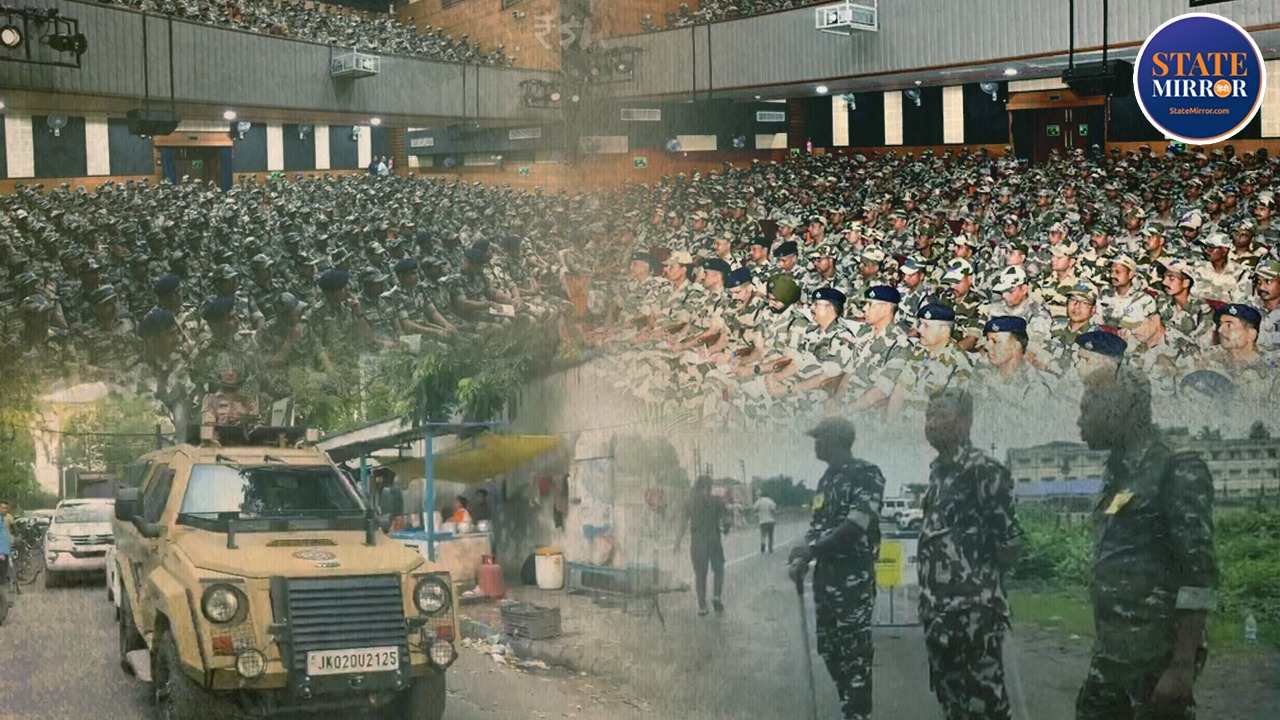
Bengal Elections 2026: Ban on bikes at night, deployment of marksman, what is going on in West Bengal before voting?

Campaigning for West Bengal Assembly elections ended today. Voting will be held on 252 seats out of 294 on April 23. Meanwhile, in order to conduct peaceful and fearless voting in Bengal, the Election Commission has shown unprecedented strictness regarding security. Such strictness was seen in the Bihar Assembly elections 2005, when TN Seshan and KJ Rao had made strict security arrangements to ensure fair voting so that ‘even Parinda could not be killed’. In Bengal too, the Election Commission’s ban on bike movement at night, limits on pillion riding, heavy deployment in sensitive areas and the presence of “marksmen” have made the election environment extraordinary.
Ruling TMC MP Mahua Moitracalling it a “military-style takeover”. Whereas the Election Commission and security agencies are calling it a necessary step for fair and peaceful voting. Understand the whole matter in seven points?
1. What is a Marksman and why is it deployed in elections?
“Marksmen” are specially trained security personnel who are adept at taking precise shots at long ranges. They are deployed to control high-risk situations, such as potential firing, booth capturing or crowd riots. Their role in elections is more of “deterrence” than aggressive action. That is, their very presence works to stop violence. Their deployment around sensitive booths, strong rooms and counting centers adds an additional security layer, thereby creating psychological pressure on anti-social elements.
2. Why is TMC saying “military-style takeover”?
Mamata Banerjee’s party TMC alleges that the heavy deployment of central forces and their method of operation is different from the normal electoral process. According to the party, the security level in the state has been made like a “military zone”. TMC also says that the role of local police has been limited and central forces have been given more control, which is against the federal structure. Opposition parties reject this allegation and say that strictness is necessary in view of the history of election violence in Bengal.
3. What happened in the “unprecedented” meeting of CAPF?
A major meeting of all units of the Central Armed Police Forces (CAPF) was held in Kolkata’s Science City, which officials described as “unprecedented”. Top officers of CRPF, BSF, CISF, ITBP and SSB participated in it. According to reports, a joint meeting of this level had not been held before in the election-bound state. For this reason, TMC called it a preparation for “military-style occupation”. Whereas security agencies say that this was just a security review meeting so that the elections could be conducted peacefully.
4. How much deployment of central forces is there in Bengal?
This time around 2.4 lakh CAPF personnel (about 2400 companies) have been deployed in West Bengal, which is considered to be the largest deployment so far during elections in any one state. On an average, there are 80 to 100 jawans in a company, which means the deployment ratio is approximately one jawan for every 140 voters. It should also be mentioned here that in the first phase, 3.4 crore voters will cast their votes on 152 seats. Earlier, 290 companies were deployed during the violence in Manipur.
Earlier, 900 companies were deployed for the 2024 Jammu and Kashmir elections. Apart from this, bulletproof anti-riot vehicles have also been brought to Bengal from Jammu and Kashmir, which eases operations in violence-hit areas.
5. What is the role of state police?
Despite this, it is also important to know that West Bengal Police plays an important role in the elections, even if the central forces are more visible. State police responders gather local intelligence during elections. Identify sensitive areas. Fulfill the responsibility of maintaining law and order. Not only this, they also handle the arrest and legal process. Whereas, CAPF is deployed for area domination, booth security and flag march. Coordination between the two is very important for the success of elections.
6. What are the bike bans and other restrictions?
The Election Commission has issued strict instructions for two-wheelers apart from four-wheelers. These include ban on riding bikes/scooters from 6 pm to 6 am, complete ban on bike rallies, ban on pillion riding during the day. Only family members can sit behind on the day of voting.
Exemptions have been given in some important situations like medical emergency, family function or school, but for this, prior police permission is necessary. The purpose of these restrictions is to stop the movement of cash, liquor or weapons and to end efforts to intimidate voters.
7. What is the reason for such a huge security deployment?
According to media reports, in the last six years, incidents of election violence in West Bengal have been more than other states. There were 300 violent incidents in the 2021 elections and 58 people died. According to ACLED data, the role of political parties came to light in many incidents after 2020. In this background, the Election Commission has adopted a “zero tolerance” policy this time, so that any kind of violence can be prevented in advance.
What did Mahua Moitra say?
TMC MP Mahua Moitra has given a sharp reaction to this preparation of the Election Commission. He alleged that the central government and the Election Commission were together planning a “military-style occupation”. He further said that CAPF is being removed from sensitive areas like Kashmir and Manipur and brought to Bengal. Such heavy deployment is being done to scare the voters. This can affect the democratic process. He said on social media that this is a “mockery of national security” and an attempt is being made to “crush Bengal under the boots of external forces”.
Security or politics?
The atmosphere before the West Bengal elections shows how complex the balance of security and politics can be. On one hand the Election Commission and security agencies are calling it a necessary step for fair elections, while on the other hand TMC is calling it political pressure and “over-security”.
Force at every nook and corner, Bengal on high alert
Jitendra Chauhan, deputy editor of Read, who is covering the Bengal elections from ground zero, says that the Election Commission has fully geared up to conduct peaceful voting. Security forces are deployed at every nook and corner. Officers and soldiers of CAF, CRPF, BSF and other agencies are deployed. EC is trying to create an environment of voting without fear. He said that in view of the sensitivity of the matter, security forces have not been deployed in the area of Murshidabad where Humayun Kabir had announced the construction of Babri Masjid. The atmosphere in this area is calm.
When Jitendra Chauhan was asked about the deployment of security forces by the EC, TMC MP Mahua Moitra made a scathing comment. He has termed this action of EC as military take over. On this he said that whatever he says is his political matter. But the truth is that the EC is preparing for the elections and has worked to provide all possible security to the voters. He said, if TMC’s hooliganism is true, then this time looking at the tight security arrangements, it seems that they will not be able to do what they have been doing till now.

Comments are closed.