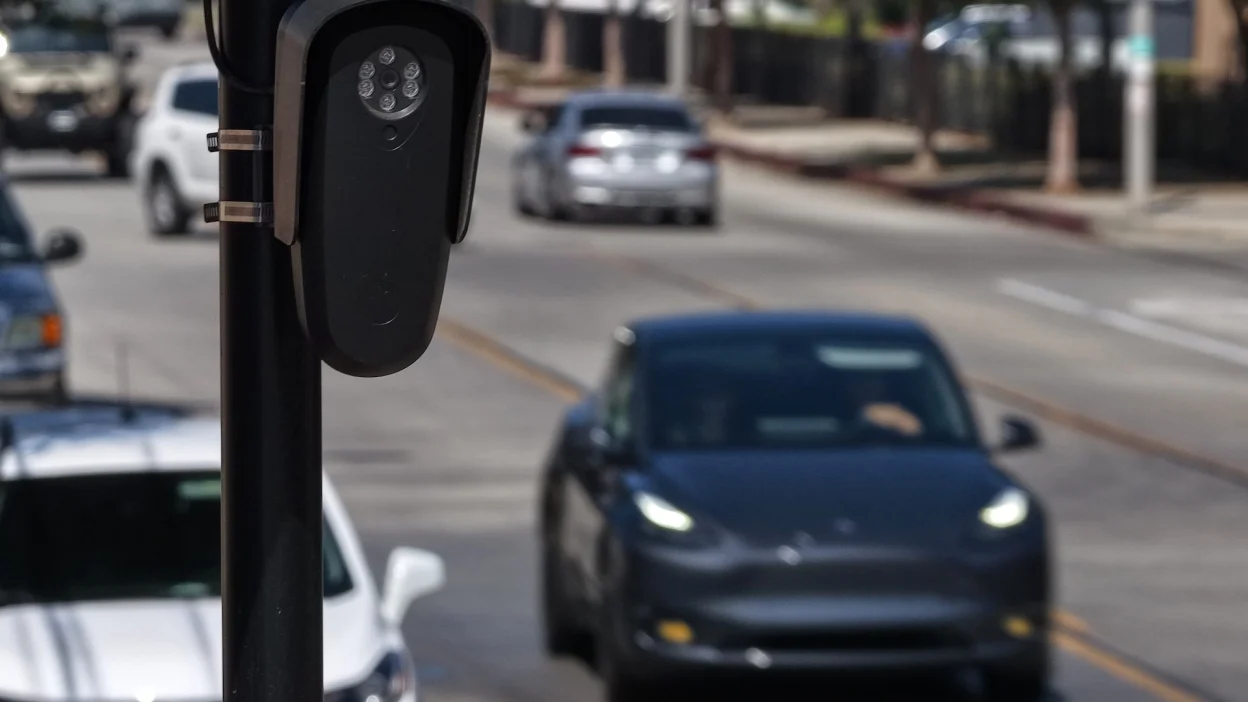
Senator Bernie Sanders has introduced legislation that could significantly restrict how federal agencies use automatic license plate readers (ALPRs), putting renewed scrutiny on Flock Safety and the rapidly expanding network of surveillance cameras used by law enforcement agencies across the US.
The Vermont Democrat introduced the Ban Flock Act on Friday, proposing to prohibit federal agencies from using ALPR technology or accessing vehicle-location data collected by systems operated by local police departments and private companies.
Despite its name, the bill does not specifically mention Flock Safety. Instead, it would apply broadly to all ALPR systems, meaning the legislation could affect any company or government agency operating the technology.
Credits: Politico
What Does the Ban Flock Act Propose?
Under the proposed legislation, federal agencies would generally be prohibited from operating automatic license plate readers or accessing information gathered by ALPR networks run by state and local authorities or private companies.
The bill provides limited exceptions for toll collection. Congress could also authorize other uses through future legislation, but any such legislation would have to limit the retention of ALPR data to no more than 48 hours.
The proposal would also put pressure on state and local governments to restrict the technology. Beginning in the first fiscal year after enactment, governments that fail to comply could lose federal grants from five departments, including the Justice Department and Department of Homeland Security.
The legislation would additionally allow individuals to sue the federal government for violations, while state attorneys general would receive enforcement powers.
However, the bill faces significant hurdles before it could become law.
Flock Safety Faces Growing Scrutiny
The legislation comes as Flock Safety faces increasing opposition over the scale of its surveillance network and how collected vehicle data can be accessed.
Flock is the largest ALPR provider in the US, according to Sanders, with more than 120,000 cameras deployed across the country. The company’s network processes more than 20 billion vehicle reads every monthaccording to figures released by the company earlier this year.
The technology works by capturing information about passing vehicles, including license plates, and can allow authorized users to search historical vehicle movements. Supporters of ALPR systems have argued that the technology can assist law enforcement investigations, while critics have raised concerns about privacy, data retention and potential misuse.
Those concerns have increasingly translated into public and political pressure. Some communities have protested the cameras, while others have suspended or ended contracts with Flock.

Credits: UPI
Flock Tightens Rules as Pressure Mounts
Flock has responded to growing scrutiny by changing some of its policies governing access to its platform.
In August, CEO Garrett Langley announced that the company’s default data retention period would be reduced from 30 days to seven days. Customers are also required to use an auditing system designed to identify unusual searches and temporarily prevent officers from accessing the platform while those searches undergo review.
The changes follow cases highlighting the risks of unauthorized use.
In one prominent incident, a former Milwaukee police officer pleaded guilty to misconduct after repeatedly using Flock’s system to search for his then-partner and her former partner. The officer reportedly conducted 179 searchesidentifying the activity as an investigation.
The incident has fueled calls for stronger safeguards around who can access vehicle-location information and how searches are approved.
One proposal discussed publicly has been a “double-key” system requiring two people to authorize a search. Langley has indicated that such an approach is being considered.
For Sanders, however, tighter company policies do not address the broader issue of government access to mass vehicle surveillance data. The Ban Flock Act instead seeks to place federal restrictions on the technology itself, potentially setting up a wider debate over privacy, law enforcement and the growing role of private surveillance networks in public policing.