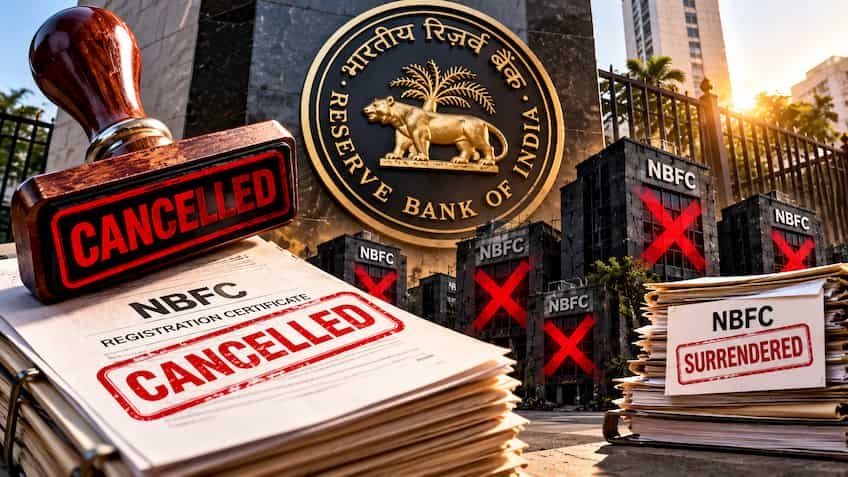
To keep the Indian financial system safe, transparent and compliant, the Reserve Bank of India (RBI) has cracked down on non-banking financial companies (NBFCs). Taking strict action, the Central Bank has canceled the Certificate of Registration (CoR) of 13 NBFCs with immediate effect. Additionally, 10 other financial institutions have voluntarily surrendered their registration certificates to RBI due to closure of their business or regulatory restructuring. After the official notification issued by the Reserve Bank on October 9, there has been a stir in the financial and banking sector of the country. RBI has made it clear that any institution ignoring financial discipline, capital adequacy and interests of consumers will not be allowed to operate in the banking structure of the country.
The Reserve Bank has taken this punitive action using the powers granted under Section 45-IA (6) of the Reserve Bank of India Act, 1934. According to the official release of the central bank, out of the 13 NBFCs whose licenses have been cancelled, 11 companies were operating from West Bengal alone (especially Kolkata). These companies were found to have serious violations like not filing financial returns on time, ignoring RBI's prudential norms and losing existence as a legal entity. Some of these companies like Vandana Grih Nirman Limited and Ramsisaria Builders Limited had already lost their legal existence due to merger, dissolution or strike-off by the Ministry of Corporate Affairs. After the cancellation of the license, now all these 13 companies are completely banned from carrying out any kind of financial transaction, loan distribution or accepting deposits from the public as a non-banking institution.
In a separate official statement, the Reserve Bank said that 10 other NBFCs have themselves returned their registration certificates. There were several operational and strategic reasons behind the surrender of licenses by these companies. Some companies decided to exit the non-banking financial business altogether, while many reorganized themselves into categories exempted from mandatory registration requirements. Major companies that surrendered include entities like Pragati Fincap Ltd, Rajlakshmi Commerce Pvt Ltd, Vivarti Capital Ltd, MSJ Colonizing and Leasing Company Pvt Ltd, PKSL Investments Pvt Ltd and HCL Corporation Pvt Ltd. After reviewing the applications and legal formalities of these companies, RBI has formally canceled their certificates.
The biggest objective of this clean-up campaign being run by RBI against non-compliant NBFCs is to protect the hard-earned money of the general public. Often, in the name of unauthorized or defunct NBFCs, a network of illegal loan apps, loan recovery at high interest rates and fake investment schemes are spread in the market. When the central bank revokes such licenses, it serves as a clear warning to the common citizens not to enter into any new financial deals with these companies. Customers who already have any outstanding or legal transactions with these companies will be settled through the existing contracts and relevant tribunals, but a complete ban on new business activities will remain in place.
As the digital loan market has grown rapidly across the country through fintech and NBFCs, complaints of default and fraud have also increased in proportion. The activities of non-banking financial companies are widespread in the country's financial capital Mumbai, Delhi-NCR as well as in fast-growing business centers like Lucknow, Kanpur and Patna, the capital of Uttar Pradesh. RBI has given strict instructions to all regional offices to continuously review the books of accounts, audit reports, conduct of recovery agents and consumer grievance redressal mechanisms of NBFCs operating in their respective jurisdictions. Financial experts believe that with this strict screening by the central bank, only those companies will be able to survive in the market which are working with transparent governance and strong balance sheet.