
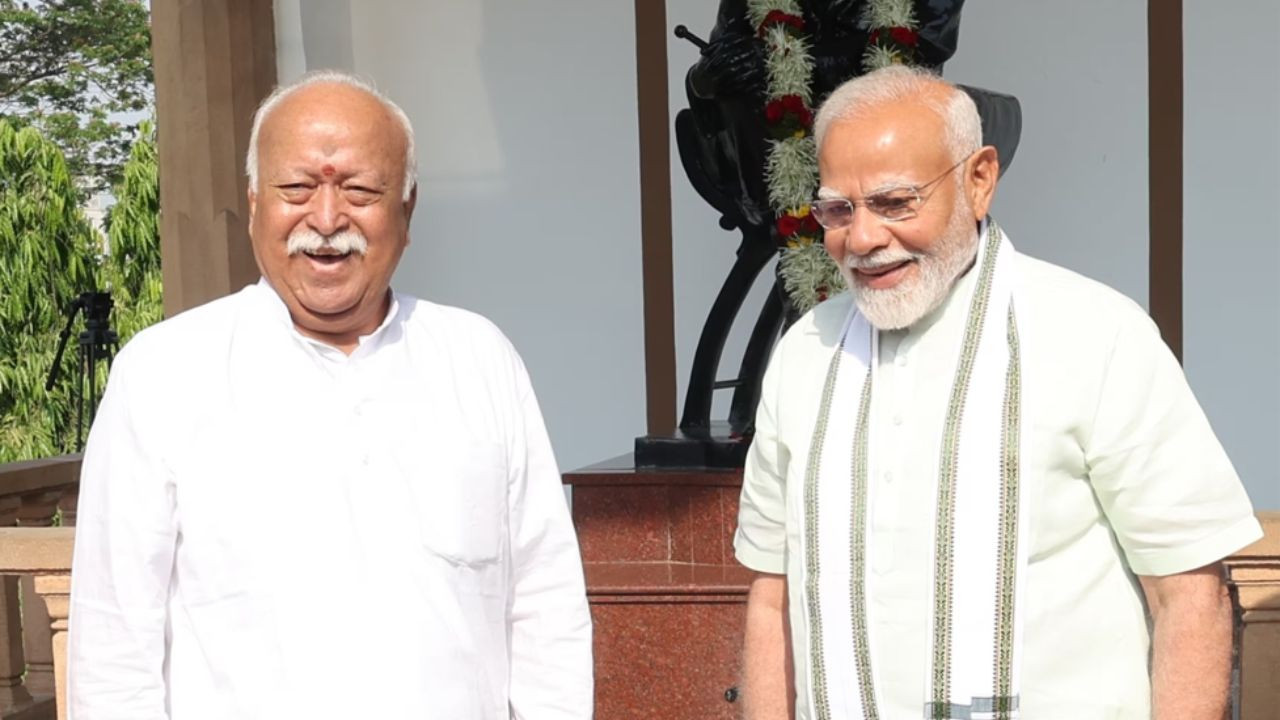

Maharaja Sayajirao University, located in Vadodara, Gujarat, has made a new and popular change in its sociology curriculum. The university has started a new module named ‘Sociology of Patriotism’ at the postgraduate level, in which the leadership of Prime Minister Narendra Modi has been made the subject of study in the form of ‘Modi element’. Along with this, the history and social impact of Rashtriya Swayamsevak Sangh has also been included in the curriculum.
What did Dr. Virendra, head of the sociology department, say?
According to Dr. Virendra Singh, Head of the Department of Sociology, the objective of this course is to understand leadership, nationalism and social changes in contemporary Indian society from a scientific perspective. He said that through ‘Modi element’, students will get an opportunity to analyze how a leader’s personality, policies and communication style have a deep impact on the society.
Dr. Singh said that this course is not the propagation of any ideology, but an academic study. He says that the concept of charismatic leadership has been discussed in sociology for a long time, which was defined by the German sociologist Max Weber. It is in this context that leaders like Mahatma Gandhi and Martin Luther King Jr. are studied. Now in the same way an attempt will be made to understand the leadership style of Prime Minister Modi.
This course covers not only personality analysis but also many contemporary issues. Under ‘Modi element’, topics like role of media, digital nationalism, questions related to citizenship, politics of dissent, globalization and identity will also be discussed in detail. Its objective is to understand how social and political discourse is developing in modern India.
According to Dr. Singh, through this course students will try to know what social and political factors work behind the popularity of Prime Minister Modi. Besides, it will also be studied what impact his policies like demonetization, digital initiatives and administrative reforms had on the society and how they became accepted among the people.
The new module was divided
This new module is divided into four separate papers, with approximately 15 hours of teaching scheduled for each. The concept of this course was developed when university students were conducting surveys in rural areas under a project related to NITI Aayog. There he got information about the activism and social impact of some organizations, after which he felt the need for in-depth study on this topic.
Apart from this, the curriculum also covers topics like cultural nationalism, the concept of nation-state and India’s identity in the global context. Also, the contributions of historical social reformers like Chhatrapati Shivaji Maharaj and Sayajirao Gaekwad III will also be highlighted, so that students can understand the evolution of Indian society in a broader perspective.

Comments are closed.