
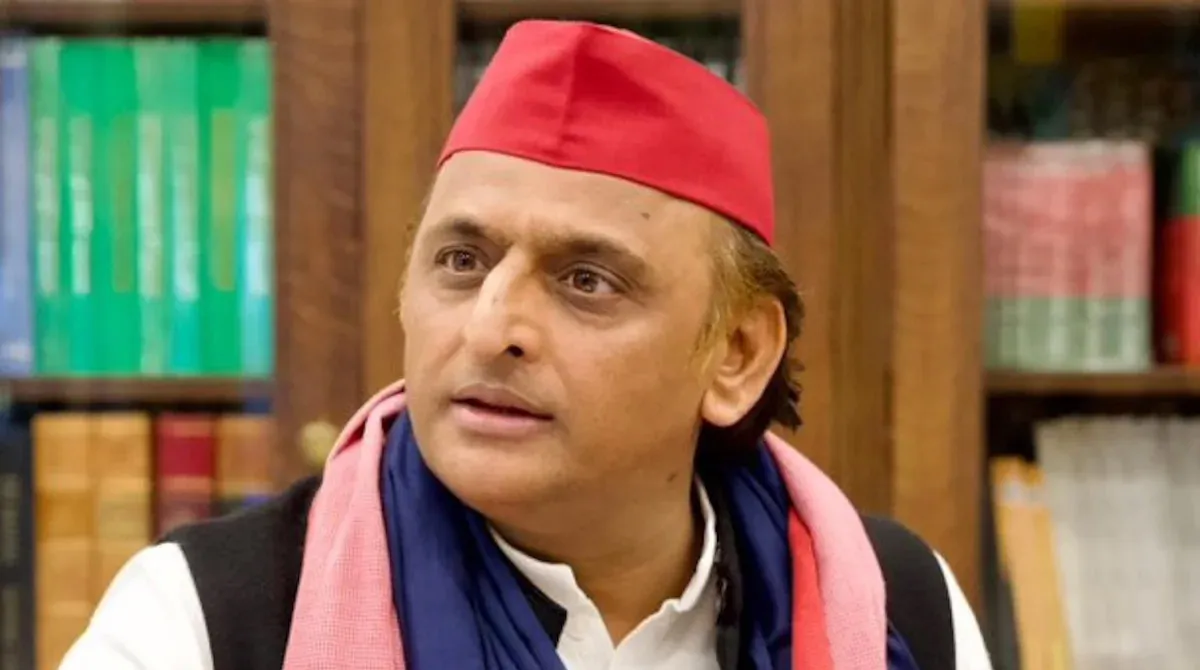
Big game going on in NDA! Chandrababu Naidu has revealed the plan of delimitation, but will Akhilesh Yadav turn the tables?

New Delhi: There is a tremendous stir in the country’s politics at this time. Amid reports of a major rift within the Trinamool Congress (TMC), TDP chief and NDA’s most important ally Chandrababu Naidu has openly told what kind of trouble is currently brewing within the country’s ruling alliance. Chandrababu Naidu has made a big claim and said that the NDA alliance led by Prime Minister Narendra Modi is once again fully prepared to present the ‘Delimitation Bill’ in the Parliament.
Naidu said that in today’s time the country is in dire need of this law and we want it to be passed by the Parliament as soon as possible, so that the women of the country can immediately get the benefit of 33 percent reservation in Parliament and Assemblies. Along with this, he targeted the opposition and said that the opposition parties are spreading wrong information on this issue in the country and creating unnecessary uproar. But the biggest question is whether the Modi government will be able to pass this historic bill this time? Does the government have the magic numbers to pass it in Parliament?
Lok Sabha seats will become 850, understand what is the whole plan
To pass the delimitation bill in Parliament, the government will have to make the 131st amendment to the Constitution. The real objective of this very important bill is to directly increase the number of Lok Sabha seats in the country from 543 to 850. If this bill is passed, then new delimitation will be implemented in the country on the basis of 2011 census and the number of Lok Sabha seats will increase to 850, which means there will be a huge increase in the number of MPs in the country. With this increased figure, the way for giving 33 percent reservation to women will also be cleared. BJP wants to pass this bill at all costs, but the catch is that to amend the Constitution, the government will need a two-thirds (2/3) majority in the House, numbers which currently the NDA does not seem to have on its own.
How many MPs are needed for two-thirds majority?
If we understand the current mathematics, at present there are three seats vacant in the Lok Sabha, which makes the total number of members 540. If all members of Parliament participate in the voting, the government will need at least 360 votes to prove a two-thirds majority, which is currently far from the NDA’s own figure. If we talk about the Upper House i.e. Rajya Sabha, the total number of members there is 245, where two-thirds majority i.e. 164 votes will be required to pass this major constitutional amendment.
Parliament’s numbers game: Know who has how much power
If we look at the current figures of Lok Sabha, BJP has 240 MPs of its own. If among the allies, 16 MPs from TDP, 12 from JDU, 7 from Shiv Sena (Shinde faction) and 5 from Chirag Paswan’s LJP are included, then the total number of NDA currently reaches 293.
Now if we look at the game of speculations and political manipulation, even if the 20 MPs contending from the rebel group of TMC are added to the NDA, still this figure would increase to 313 only. This number is still far behind the magic figure of two-thirds majority (360).
The real game starts from here because it is believed that DMK is angry with Congress on some issues these days. In such a situation, there is discussion that DMK can either support this bill by making one or half amendments of its choice or can walk out of the House at the time of voting. DMK currently has 22 MPs. If they come together with the government, NDA’s tally will reach 335. After this, it is also being claimed about 7 MPs of Uddhav Thackeray’s party that they can join Shinde faction. If these 7 MPs also vote for the government on the bill, the number will increase to 342. If we add to this the 5 other MPs who supported the NDA when the bill was introduced in April, the total number will reach 347. But even after all these multiplications, the government remains a few steps away from the two-thirds majority mark.
Rajya Sabha equation also stuck
At present, NDA has about 149 MPs in the Upper House i.e. Rajya Sabha, while the two-thirds majority figure is 164 seats. However, elections are going to be held for 25 Rajya Sabha seats in 10 states of the country on June 18, after which there is every expectation of a significant increase in the number of members of NDA. Despite this, looking at the current circumstances, the NDA may still be about 15 MPs away from the two-thirds majority mark. This means that even after a bumper victory in the Rajya Sabha elections, the government will have to rely on some additional regional parties or independent MPs to pass this big bill.
…So does Akhilesh Yadav have the key to this mega bill?
Here the whole story hinges on Uttar Pradesh and Samajwadi Party chief Akhilesh Yadav. At present, Samajwadi Party has a total of 37 MPs in the Lok Sabha. If these 37 MPs of Akhilesh Yadav are also added to the possible 347 numbers of NDA, then this number directly reaches 384, which will easily cross the two-third majority (360) mark.
But the problem is that last time Akhilesh Yadav had strongly opposed this bill from the streets to the Parliament and had even termed it anti-women. In such a situation, it is not going to be politically easy for them to directly support the Modi government on this bill. However, there is talk in the diplomatic circles that a new game plan can be made behind the scenes, under which SP MPs create ruckus in the House and walk out during voting. If Akhilesh does this, his ally Congress may be very angry with him, because Congress is opposing this bill on the front foot.
The biggest thing is that assembly elections are to be held in Uttar Pradesh next year i.e. in 2027. Akhilesh Yadav would like to avoid any controversy or step just before the elections, which may anger any of his core voters. In today’s era, women voters prove to be silent killers, hence the eyes of political pundits across the country are fixed on what stand Akhilesh Yadav takes on this bill.

Comments are closed.