
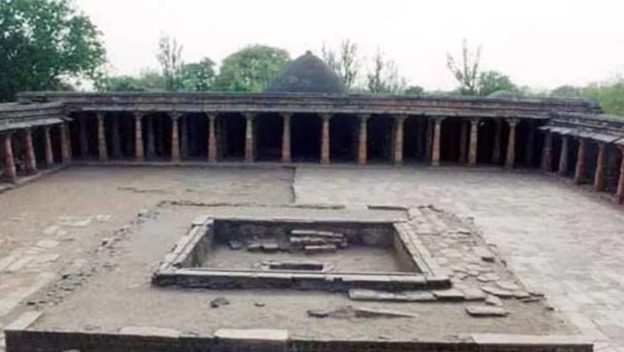
Big victory for Hindu side in Dhar Bhojshala dispute, High Court considered Bhojshala as a temple.

Dhar: The Hindu side has got a big legal victory in the historical Bhojshala dispute located in Dhar, Madhya Pradesh. The Indore bench of the High Court, in its important decision on Friday, declared Bhojshala as a temple and granted the right of worship to the Hindu community. The court said that the tradition of Hindu worship at this site never completely ended.
Dhar Bhojshala Dispute In the case, the court considered the report of the Archaeological Survey of India (ASI) and historical evidence as important basis. The Court said that the available historical literature and archaeological evidence establish that the disputed site was a Sanskrit learning center associated with King Bhoj of the Paramara dynasty in the form of “Bhojshala”.
The main question before the court was whether the site was a Hindu temple (Vagdevi Temple) or the Kamal Maula Mosque of the Muslim community. Expressing confidence in the scientific investigation and report of ASI, the court said that archeology is an evidence-based subject and the findings of the survey report are reliable.
The High Court clarified that this is a protected monument and ASI will have full rights for its conservation and monitoring. Also, the court told the Muslim side that they can apply separately for the mosque land.
The decision came at a time when prayers were being offered by the Muslim community in the Bhojshala premises as it was Friday. The administration had made extensive security arrangements before the decision. Additional police force was deployed in Dhar city and social media was also being monitored so that no untoward situation arises.
On the orders of the High Court, ASI had conducted a detailed scientific survey of the Bhojshala complex in the year 2024. This survey lasted for about 98 days. ASI had presented a report of about 2000 pages in the court. The report claimed that the present structure was built using the remains and pillars of a pre-existing temple. Sculptures, carved stones and inscriptions of the Parmar period were also found during the survey.
This dispute is several decades old, but in the year 2022, the legal battle intensified after the petition of Hindu Front for Justice. At present, according to the 2003 order of ASI, the Hindu community is allowed to offer prayers on Tuesday and the Muslim community is allowed to offer namaz on Friday.
Hindu, Muslim and Jain parties had presented their respective arguments in the case. The Hindu side called it Saraswati Temple and Gurukul built by Raja Bhoj, while the Muslim side considered it Kamal Maula Mosque. The Jain community also claimed that it was originally a Jain Gurukul and temple.
This decision of the High Court is being considered an important decision in the famous religious and historical controversies of the country.

Comments are closed.