
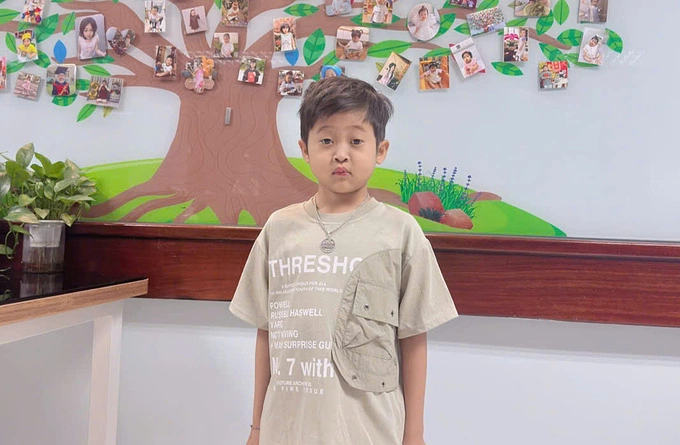
Two months after the transplant, Hieu’s health has improved. His jaundice has faded, his appetite has returned, his swollen abdomen has decreased and he is more active.
His mother, Le Thi Huong, 33, said she could see her son living more like other children.
“He smiles more, wants to play, and asks for foods he couldn’t eat before. We’re deeply grateful to the donor. Because of that sacrifice, my son now has the chance to grow up healthy like other children,” she said.
|
Pham Duc Hieu receives treatment at the hospital. Photo courtesy of Hieu’s family |
Hieu was born in 2019 and developed jaundice, yellow eyes, pale stools, dark urine and an enlarged abdomen when he was one month and 10 days old. Doctors at Thanh Hoa Pediatric Hospital diagnosed him with biliary atresia, a rare condition in which bile ducts are blocked, causing bile to accumulate and potentially leading to cirrhosis.
He was later treated at the National Children’s Hospital. At two months and 10 days old, he underwent surgery to remove his gallbladder and part of the scarred liver.
The procedure did not prevent further complications. Hieu was repeatedly hospitalized for infections, high fever, swelling, abdominal distension, weakness and poor appetite.
Doctors eventually told Huong that treatment was no longer effective and that a liver transplant was the only option to save her son’s life.
“I went numb when I heard that,” Huong recalled.
The estimated cost of the transplant was around VND500 million (US$20,000), beyond what the family could afford. Huong, who was separated from her husband, earned about VND5 million a month while caring for Hieu. Her elderly father was also frequently ill.
 |
|
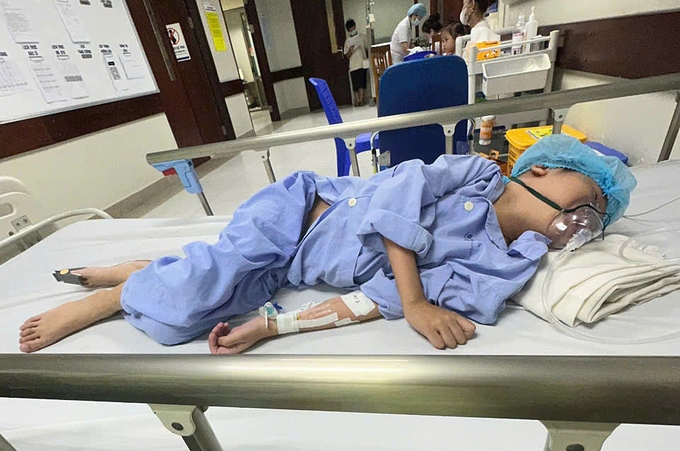
Pham Duc Hieu during his hospital stay. Photo courtesy of Hieu’s family |
Without sufficient funds for a transplant, Hieu continued living with the disease for seven years, often being hospitalized every one or two months.
During flare-ups, Huong had to take him more than 100 kilometers to hospital. Each admission lasted 10 days to two weeks. As his liver function deteriorated, his abdomen became increasingly swollen and walking became difficult.
In June 2026, the Sun of Hope program, run by Hope Foundation and Read, helped cover part of the transplant costs. A suitable liver from a brain-dead donor became available and was transported to the National Children’s Hospital.
The transplant lasted 11 hours, from 10 a.m. to 9 p.m. After doctors confirmed that the procedure had succeeded, Huong cried with relief.
Doctors later said the transplanted liver was functioning steadily. Hieu was discharged and continues to receive follow-up care.
 |
|
Pham Duc Hieu has been healthy after the liver transplant. Photo courtesy of Hieu’s family |
Liver transplantation is a complex procedure used to treat patients with end-stage liver disease. In 2022, more than 37,000 liver transplants were performed worldwide, most involving organs from deceased donors.
In Vietnam and some other Asian countries, living-donor transplantation is more common. Experts estimate that the five-year survival rate for liver transplant recipients in Vietnam is about 75%, comparable with international figures.
Cost remains a barrier to transplantation, doctors said. Children with end-stage chronic liver disease may require frequent hospitalizations and medical checks, placing a significant financial burden on families.
A typical 40-day hospital stay can cost around VND300 million, while post-transplant follow-up, dietary requirements and hygiene measures can cost an estimated VND5-10 million a month. Annual expenses can reach around VND200 million during the first two years.
For Huong, Hieu’s discharge marked a turning point after years of treatment.
“I was so overjoyed I didn’t know what to say. After all those days of only wishing for him to be healthy, that day finally came,” she said.
Hieu will still require long-term monitoring and care, but his mother now hopes he can return to school and grow up like other children.
Readers can support children like Hieu via the Sun of Hope.