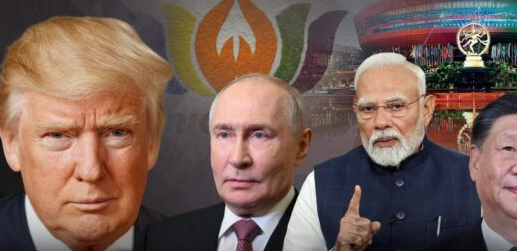
Amidst the BRICS Summit 2026 in Delhi, there is now a strong discussion that the efforts to challenge the supremacy of the US dollar is not limited to just news headlines. BRICS countries are moving towards increasing trade in local currency, increasing gold reserves and creating alternative payment systems. This is why America’s concern about possible changes in the world’s financial system is also increasing. Economist Sharad Kohli believes that this strategy of BRICS can become a big challenge for the dollar in the coming years.
However, considering the global foreign exchange reserves and the dollar’s strong hold in international trade, it will not be easy to end its reign.
Is BRICS in a position to compete with America?
The challenge of BRICS before America is no longer just diplomatic rhetoric. In 2026, BRICS has expanded to 11 countries and covers almost half the world’s population. Along with China, India, Russia, Brazil, Iran, United Arab Emirates and South Africa, Egypt, Ethiopia, Indonesia and Saudi Arabia are also within its scope. But the big question is, can such a large population and economy really challenge America’s economic, military and financial strength? The answer is simple – BRICS is not a united anti-American military alliance, but it is definitely becoming a force to reduce American dominance.
Is the economy of BRICS bigger than America?
The answer to this question depends on whether the economy is being measured on the basis of market exchange rates or purchasing power. At the market exchange rate, America’s economy will be worth about 32.4 trillion dollars i.e. 32.4 trillion dollars in 2026.
China is about 20 trillion dollars, India is about 4.5 trillion dollars, Brazil is about 2.3 trillion dollars, Russia is about 2.2 trillion dollars, United Arab Emirates is about 60 thousand crore dollars, South Africa is about 45 thousand crore dollars and Iran is about 40 thousand crore dollars.
Adding only these seven countries, the total economy is around 30-31 trillion dollars. That is, almost equal to America, but still a little smaller than America alone.
But the picture changes depending on purchasing power. On this scale, the weight of large-populated and relatively low-cost economies like China, India and Russia increases significantly. The share of the entire BRICS in the global economy has reached around 40 percent.
What is the strength of China, India, Russia and other countries?
China is the biggest economic power of BRICS. Its manufacturing, exports, shipbuilding, electronics, solar energy, batteries and industrial production make it America’s most serious economic rival. China’s economic size alone is central to the entire BRICS strategy.
India is the second big power. Rapid economic growth, huge domestic market, young population, information technology, pharmaceutical industry, space program and digital payment system give India different strengths. However, it would not be correct to call India an anti-US member of BRICS, because it also has deep strategic and economic relations with America.
Russia’s economic strength is not as great as that of China or India, but its strategic weight due to energy, nuclear weapons, missiles, space, natural resources and military technology is much greater than its economy.
Brazil is a major powerhouse of agriculture, food, iron ore, oil and natural resources. Iran is important because of its energy and missile capabilities. The United Arab Emirates is a center of finance, energy, ports and trade, while South Africa is among Africa’s leading industrial economies.
Can BRICS compete with America in military strength?
America is still far ahead here. America will spend about $954 billion on military in 2025. China stood second and third with about $336 billion and Russia with about $190 billion. India spent about 92 billion dollars.
Even if the military might of China, Russia and India is added, America cannot match America only in expenditure. America has a huge network of military bases around the world, aircraft carriers, long-range strike capability, advanced air force, satellite system and a large alliance system.
On the other hand, BRICS has nuclear superpowers like China and Russia and India is also a nuclear power. But BRICS does not have any joint army, joint military command or collective defense treaty against America. Therefore, military comparison of BRICS versus America is not possible at present. Efforts are being made to increase trade in local currencies, connect cross-border payment systems and reduce dependence on the dollar. The possibilities of linking India’s UPI, Brazil’s PICS and China’s digital payments system are not like actual war alliances.
Could the dollar’s dominance end?
This is the area where BRICS can pose a long-term challenge to America. BRICS countries are trying to increase trade in local currencies, link cross-border payment systems and reduce dependence on the dollar. Work is also being done on the possibilities of connecting India’s UPI, Brazil’s PIX and China’s digital payment system.
But right now the position of the dollar is very strong. The dollar’s share in the world’s official foreign exchange reserves in the first quarter of 2026 was 57.13 percent, while China’s weakness is mutual differences. There is border dispute and strategic competition between China and India. India is also a strategic partner of America. The interests of UAE and Iran have not turned out to be similar on every issue and are also getting closer on the basis of market value. Its collective weight in the military field is huge, but it does not have combined military power. In terms of dollar it is still far behind, the share of the currency was around 2 percent.
Therefore, BRICS is not in a position to replace the dollar in the near future. He can more realistically try to reduce the monopoly of the dollar.
So how far can we compete with America?
The most important thing is that BRICS cannot be seen as one country. China is America’s economic and strategic rival, India is a rapidly rising independent power, Russia is a military and energy power, while the remaining members add energy, resources, trade and regional influence.
The biggest strengths of BRICS are population, resources, energy, manufacturing and growing economy. His biggest weakness is mutual differences. There is border dispute and strategic competition between China and India. India is also a strategic partner of America. The interests of UAE and Iran are not the same on every issue.
Therefore, the conclusion is that BRICS today is not a power to directly replace America, but a power to limit American dominance. In the economy, it has gone far ahead of America on the basis of purchasing power and is also getting closer on the basis of market price. Its collective weight in the military field is huge, but it does not have combined military power. It is still far behind in terms of dollars.
In the coming decade, if BRICS strengthens local currency trade, shared payment system and mutual investment, then the biggest challenge to America may not come from any new BRICS currency, but from many countries of the world gradually becoming less dependent on the dollar.
Will BRICS break the reign of the dollar?
famous in the country Economist and financial advisor Sharad Kohli Recently while talking to Read, BRICS countries are making serious efforts to reduce the dominance of dollar. However, due to its 60 percent share in global foreign exchange reserves and its strong presence of about 88 percent in international trade, it is not easy to immediately challenge the supremacy of the US dollar.
According to Sharad Kohli, the rapid increase of gold reserves by some BRICS countries including China and Russia and experiments related to the use of local digital currencies can become a big challenge for the dollar in the future. This can give impetus to efforts to reduce dependence on the dollar in the global trade and payment system.
He also said that US President Donald Trump’s threat to impose 100 percent tariffs on BRICS countries can be seen as a sign of broader economic conflict. According to Kohli, this step indicates that America is seriously concerned about the emerging possibilities of the dollar as an alternative.