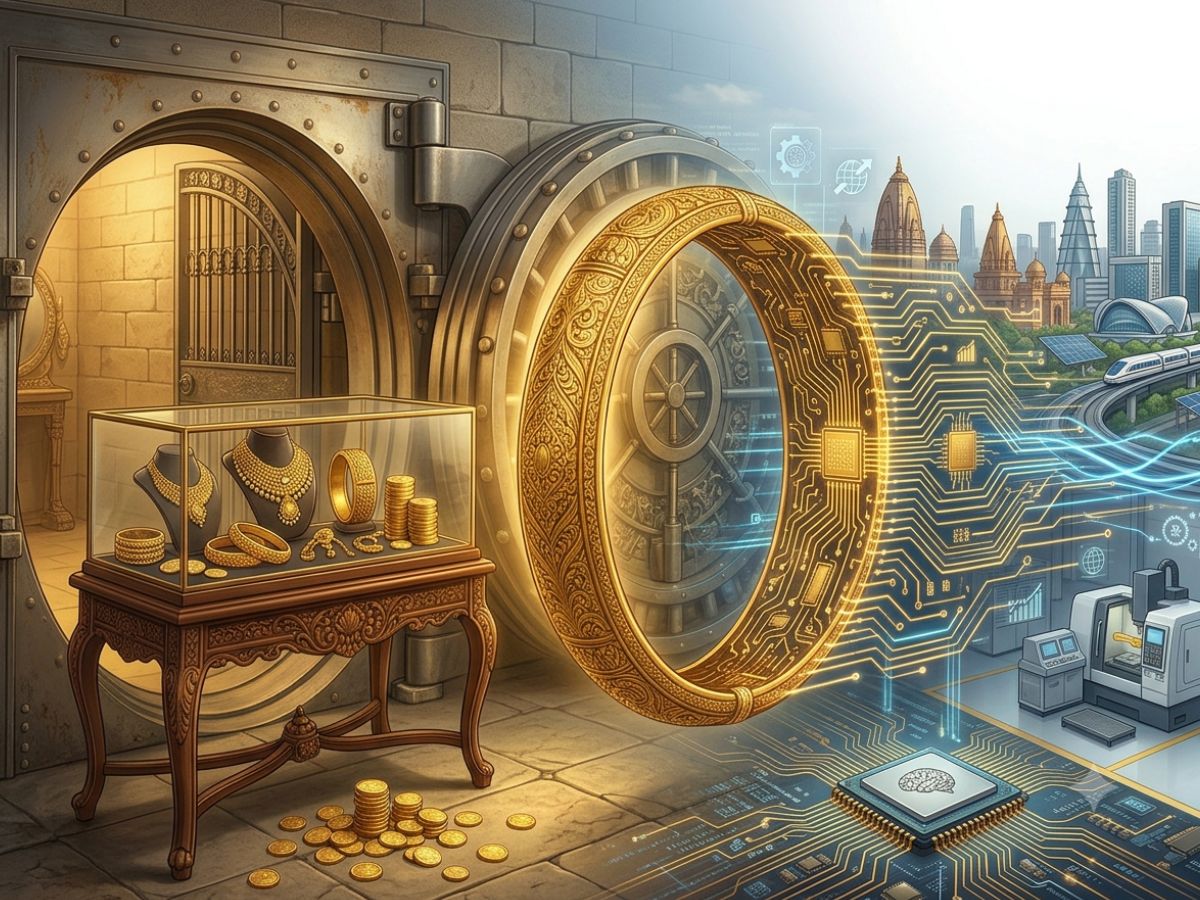
For generations, gold in India has represented security, tradition and prosperity. It has been gifted at weddings, passed down through families and stored as a symbol of financial protection.
Now, the World Gold Council wants India to look at gold differently.
Its new vision document, “Swarnim Udaan 2047: Unlocking the Full Potential of Gold Towards Viksit Bharat 2047,” argues that gold can become more than a household asset. It can become a strategic contributor to India’s economic growth.
The timing is important.
India is aiming to become a developed economy by 2047. At the same time, global supply chains are changing, manufacturing is moving toward new centres, and countries are focusing more on resource security.
The central question is simple:
Can India convert its relationship with gold from one of consumption and savings into one of productivity and growth?
The world’s largest gold paradox
India is among the world’s largest consumers of gold. But most of the gold used in India comes from imports.
The country has enormous demand, deep cultural attachment and a large jewellery industry. Yet it has limited domestic mining and a relatively small role in the global gold value chain.
This creates a unique paradox.
India owns a significant amount of gold wealth, but much of that wealth remains outside the formal economy.
The World Gold Council estimates that Indian households hold around 31,000 tonnes of gold, valued at approximately ₹314.9 lakh crore (around US$3.4 trillion).
The opportunity, according to the report, is to bring a part of this wealth into productive economic channels.
From locked wealth to financial strength
One of the biggest ideas in Swarnim Udaan 2047 is the financialisation of gold.
The report suggests that mobilising even a small portion of household gold could reduce dependence on imports and create new financial opportunities.
However, this is not only an economic challenge. It is also an emotional one.
For many Indian families, gold is not just an asset. It is memory, security and tradition.
Previous attempts to encourage gold monetisation have faced difficulties because people are often reluctant to part with physical jewellery.
Any future effort will need trust, simplicity and products that respect how Indians view gold.
Building a global jewellery powerhouse
Another major ambition is to make India the world’s largest gold jewellery exporter by 2047.
India already has skilled artisans and a strong jewellery tradition. But becoming a global leader will require more than craftsmanship.
The industry will need modern manufacturing, better technology, stronger branding and access to new international markets.
The next generation of consumers will also play a role.
India’s growing young population is changing how jewellery is purchased. Digital experiences, modern designs, transparency and responsible sourcing are becoming increasingly important.
Can India mine its own gold?
The report proposes that India should meet 10–15% of its annual gold demand through domestic mining by 2047.
This would improve resource security and reduce import dependence.
But achieving this target will require significant progress.
India needs better exploration, faster approvals, improved geological data and stronger private sector participation.
Mining is a long-term activity. Discovering deposits, obtaining approvals and developing mines can take years.
Therefore, policy support and execution will determine whether this ambition becomes reality.
Gold beyond jewellery
It also emphasises the industrial importance of gold.
Gold is used in electronics because it has unique properties such as being reliable and corrosion resistant.
India is scaling up in sectors like semiconductors, advanced manufacturing and technology, gold could be part of a wider industrial ecosystem.
That’s a change of mindset.
Gold is no longer simply something that is stored in lockers or worn as jewelry. More and more, it is discussed as a resource that is connected to finance, manufacturing, and innovation.
The road ahead
To achieve this vision, the report proposes stronger coordination through institutions such as a National Gold Board and a Gold Innovation Centre.
These bodies would help align policy, encourage research and support technology adoption across the gold value chain.
But the biggest challenge will be execution.
India’s gold story has always been powerful because of its cultural connection. The next chapter will depend on whether that connection can be combined with modern financial systems, global manufacturing capabilities and technological innovation.
The real opportunity is not simply to own more gold.
It is to unlock more value from the gold India already has.
(Disclaimer: This article is for informational purposes only and should not be considered investment advice. The views, opinions, and recommendations expressed herein are those of the respective experts. Readers are advised to consult a qualified financial advisor before making any investment decisions.)
Also Read: Gold, Silver Prices Today (August 5, 2026): Check City-Wise 18K, 22K, 24K Gold and Silver Rates in Delhi, Mumbai, Chennai and More
Prabhat Gupta is Senior Copy Editor of Business Segment. He has worked across broadcast and digital newsrooms, editing and producing stories on politics, business, regulation and current affairs. His work has included writing on global markets and regulatory developments, along with long-form editorial content on business and governance.
He holds a master’s degree in Political Science from the University of Delhi and qualified UGC-NET in the subject, bringing an academic grounding to public affairs and policy coverage.
The post Can India Unlock Its Rs 315 Lakh Crore Gold Vault? WGC’s 2047 Plan Explained appeared first on NewsX.