Carney Backs EU-Canada Associate Membership Plan as Trump Calls it a ‘Hostile Act’/ TezzBuzz/ WASHINGTON/ J. Mansour/ Canadian Prime Minister Mark Carney welcomed a proposal to make Canada the European Union’s first associate member amid worsening relations with Washington. Carney proposed deeper cooperation with Europe on trade, defense, energy, critical minerals, artificial intelligence and financial services.
The undefined status would require negotiation and Canadian parliamentary approval, while Carney stressed that Ottawa is not seeking full EU membership.


Quick Look
- Carney endorsed the concept during an address to the European Parliament.
- EU associate membership does not currently exist under the bloc’s treaties.
- Canada is not pursuing full membership of the European Union.
- Proposed cooperation would include trade, defense, energy, AI, space and research.
- Approximately 70% of Canadian exports currently go to the United States.
- Trump called the proposed EU arrangement potentially hostile.
- Carney rejected outside attempts to dictate Canada’s international agreements.
- Canada has already joined the EU’s SAFE defense procurement program.
- A Canada-EU summit is scheduled for Oct. 29-30 in Montreal.
- Any enhanced partnership would be debated and voted on by Canada’s Parliament.


Deep Look
Carney welcomes closer EU relationship
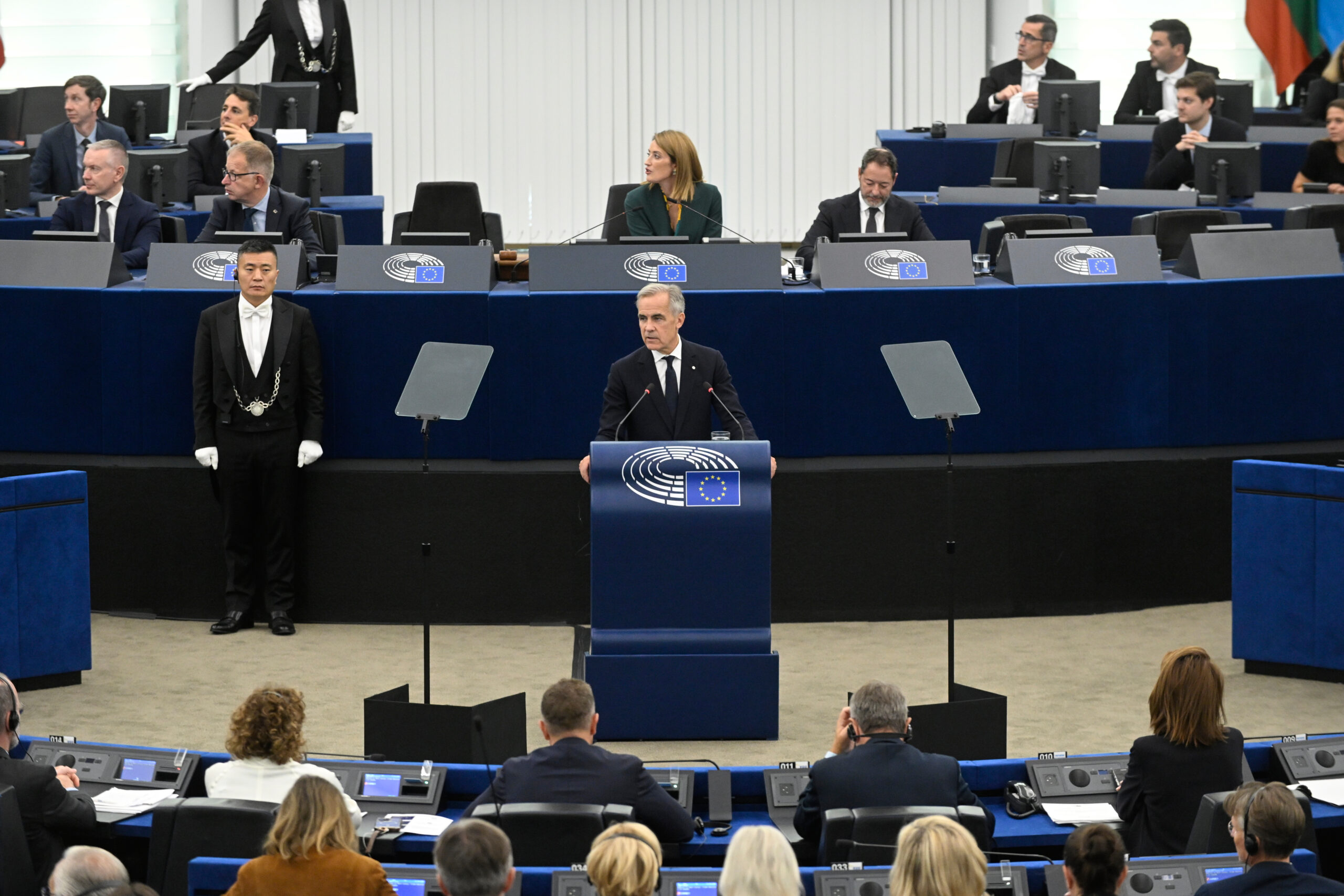
Prime Minister Mark Carney endorsed the possibility of Canada becoming the European Union’s first associate member during a speech Thursday to the European Parliament in Strasbourg, France.
Carney said closer cooperation with Europe could help protect Canada from economic coercion while reducing its dependence on any single trading partner.
The prime minister welcomed the proposal announced Wednesday by European Commission President Ursula von der Leyen. He acknowledged, however, that the meaning of “associate membership” has not been determined.
The status does not currently exist in EU treaties and would have to be created through negotiations involving Canada and the European Union.
Carney later clarified that his government is not seeking full EU membership. The developing proposal was reported by the Associated Press and discussed during the European Parliament’s plenary session in Strasbourg.
Canada seeks economic resilience
Carney proposed extensive integration between Canada and Europe in sectors that influence economic security and national sovereignty.
The potential partnership would include:
- Trade and digital commerce
- Defense and military procurement
- Critical minerals
- Artificial intelligence
- Energy security
- Space technology
- Scientific research
- Financial services
Carney said the objective would be to make Canada and Europe less vulnerable to economic and geopolitical pressure from larger powers.
“We do not seek power to dominate others,” he said. “On the contrary, we are pursuing resilience so that no one can control our open markets, impair our sovereignty, threaten our territorial integrity, or undermine our freedoms, our democracies, our rule of law.”
The prime minister presented closer European ties as a way for Canada to diversify rather than abandon its relationship with the United States.
Trump policies influence Canada’s shift
Canada’s economic relationship with the United States has traditionally been central to its trade policy.
Approximately 70% of Canadian exports go to the U.S., leaving the country highly exposed to American tariffs, policy changes and fluctuations in cross-border demand.
Relations have deteriorated under President Donald Trump because of tariffs, demands for economic concessions and his repeated statements about making Canada the 51st U.S. state.
The Canadian government has rejected those suggestions and retaliated against American tariffs. Carney has said some U.S. demands threaten Canada’s sovereignty.
The dispute has increased pressure on Ottawa to diversify its trade relationships and establish stronger political, defense and economic ties with Europe.
Carney receives enthusiastic reception
European lawmakers gave Carney an enthusiastic welcome when he entered the parliamentary chamber in Strasbourg.
Several approached him for handshakes and photographs, while one member wore a Canadian hockey jersey.
Carney received a standing ovation following his speech, demonstrating broad enthusiasm among the lawmakers present for deeper Canada-EU cooperation.
The reception contrasted with the increasingly tense exchanges between Ottawa and Washington.
However, the positive parliamentary response does not by itself create associate membership. The proposal would still need a legal structure, agreement among relevant European institutions and approval through Canadian political processes.
Von der Leyen proposes a new status
Von der Leyen introduced the associate membership idea during an address Wednesday, saying Europe wanted to elevate its relationship with Canada to “the highest level possible.”
Carney, who was seated in the front row, stood and embraced von der Leyen after she announced the proposal.
The European Commission president called for Canada and the EU to move beyond their existing free-trade agreement.
She proposed an “Alliance for the Future” that would include a “common prosperity and economic security space.”
The proposal could involve deeper economic integration while stopping short of Canada becoming a conventional EU member state.
Canada and EU leaders are expected to discuss the concept at a summit in Montreal scheduled for Oct. 29 and 30.
Europe and Canada took different approaches to Trump tariffs
Canada and the European Union have responded differently to the Trump administration’s trade policies.
Ottawa retaliated against American tariffs and rejected economic demands that Carney considered a threat to Canadian independence.
The EU avoided a comparable escalation. European officials shelved planned retaliation and accepted tariffs of up to 15% on most exports to the United States.
Despite that different approach, both Canada and Europe have an interest in limiting their vulnerability to sudden U.S. trade actions.
A deeper partnership could provide Canadian exporters with greater access to European markets while giving European businesses access to Canada’s energy, minerals and technology sectors.
Trump calls proposal potentially hostile
Trump reacted critically to the proposed relationship, suggesting that Canada’s associate membership could constitute a “hostile act.”
He also threatened to impose heavy tariffs on Europe if he concluded that the arrangement was designed to work against American interests.
Carney responded by asserting Canada’s right to determine its domestic culture and international relationships.
“Canadians are united that nobody is going to tell us what language we speak. No one is going to dictate our culture or with whom we can strike agreements internationally,” Carney said.
The exchange raised the diplomatic and economic stakes surrounding the proposal before Carney addressed the European Parliament. Trump’s comments and tariff warning were separately reported by the Associated Press.
Carney organizes cooperation among middle powers
Carney has called on countries he describes as middle powers to cooperate when facing economic pressure from larger states.
During the World Economic Forum in Davos in January, he warned that countries negotiating individually with a dominant power could be placed at a disadvantage.
“We negotiate from weakness. We accept what is offered.”
Trump criticized Carney following that speech.
Jonathan Wilkinson, Canada’s ambassador-designate to the EU, said Ottawa wants “to get as close as we possibly can” to Europe while building greater Canadian independence.
The associate membership proposal aligns with Carney’s broader argument that middle powers can protect their sovereignty more effectively through cooperation.
Canada joins European defense program
Canada has already completed one major step toward deeper integration with Europe.
Earlier this year, it became the first non-European country to participate in the EU’s 150-billion-euro SAFE defense procurement program, valued at approximately $173 billion.
The program gives Canadian companies access to joint procurement opportunities as European countries increase military spending and strengthen defense production.
Participation also allows Canada and European governments to cooperate more closely on equipment, supply chains and defense-industry capacity.
The two sides have held additional discussions about energy, critical minerals, artificial intelligence and digital trade.
These existing initiatives could provide the foundation for the broader relationship proposed by von der Leyen and Carney.
Canadian Parliament would have final vote
Carney said any enhanced EU partnership would be debated in Canada’s Parliament and submitted for a final vote.
That process would give Canadian lawmakers an opportunity to examine the proposal’s economic, legal and sovereignty implications.
Negotiators would first need to define the rights and obligations associated with the unprecedented status.
Important unresolved issues include market access, regulatory alignment, defense commitments, institutional participation and whether the agreement would require changes to existing EU treaties.
Until those details are negotiated and approved, associate membership remains a political proposal rather than an established legal arrangement.
Analysts see a changing Western alliance
Daniel Béland, a political science professor at McGill Universitysaid the Trump administration’s approach was prompting both Canada and Europe to prepare for reduced American leadership.
“The policies and rhetoric of the Trump administration are clearly pushing both Canada and the EU to imagine a world without strong U.S. leadership and to act accordingly,” Béland said.
Nelson Wisemana professor emeritus at the University of Toronto, said European officials have traditionally valued Canada’s detailed understanding of the United States.
He argued that Carney’s resistance to Trump’s demands has drawn additional European attention.
“Carney’s shrewdness in dealing with Trump has captured Europe’s attention,” Wiseman said.
For more world news