

152
New Delhi: In large parts of West Bengal, the coming election is being reduced to a simple household calculation. What is already coming into bank accounts every month versus what could come if power changes hands.
The ruling All India Trinamool Congress is relying on its flagship Lakshmir Bhandar scheme, which now pays about Rs 1,500 a month to general and OBC category women and around Rs 1,700 to SC and ST beneficiaries following a revision in the 2026-27 budget. The opposition Bharatiya Janata Party has raised the stakes with a promise of Rs 3,000 per month to women if it forms the government, positioning it as a guaranteed entitlement.
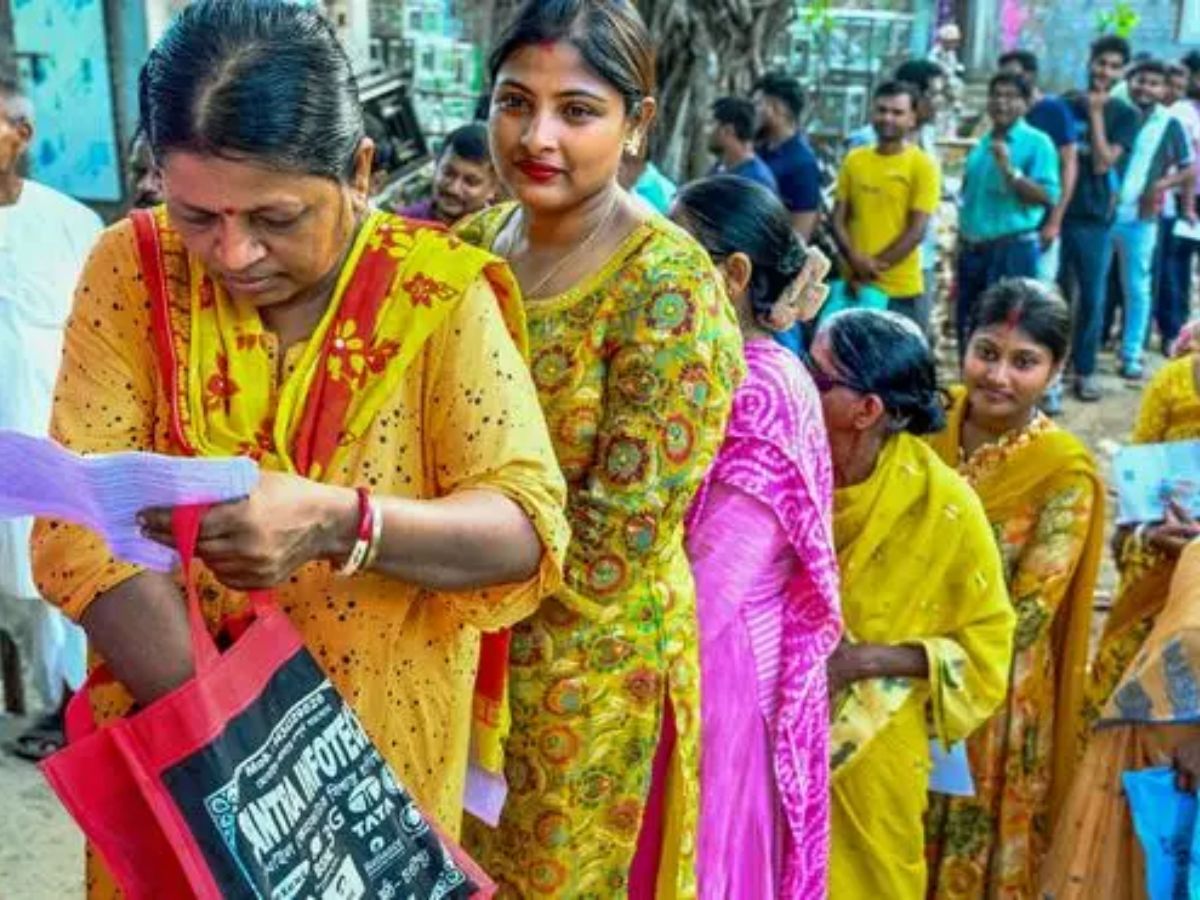
On the ground, the contrast is shaping voter conversations more than any other issue. Observers in districts such as North 24 Parganas, Purba Medinipur and Malda say the scheme has become a default reference point in household discussions, particularly among lower and lower-middle income families where the transfer directly affects consumption.
Administrative estimates indicate Lakshmir Bhandar now covers around 2.4 crore women across West Bengal after enrolment expansion through Duare Sarkar camps. With the state’s female population estimated at roughly 4.5 to 5 crore, the scheme reaches a substantial share of adult women.
Sources within the Trinamool Congress say the scale and regularity of payments have created what they describe as habit-based trust.
A senior functionary said predictable monthly transfers are now embedded in household budgeting.
BJP leaders, however, argue that the higher proposed transfer is intended to reset expectations. Party sources say the Rs 3,000 promise is designed to neutralise incumbency by offering a materially larger income stream.
Field feedback suggests a split response. In rural areas, where DBT-linked welfare has stabilised income flows, there is a visible preference for continuity. In peri-urban and urban clusters, there is greater openness to a higher payout if credibility is established.
Political observers say the contest has effectively turned into a certainty versus upside trade-off. The Trinamool Congress is betting on delivery credibility and behavioural lock-in. The BJP is attempting to convert the election into a referendum on income expansion.
What is unfolding in Bengal reflects a wider structural shift. Over the past five years, recurring direct cash transfers to women have become a central electoral instrument across states.
In Madhya Pradesh, the Ladli Behna scheme pays about Rs 1,500 per month to over 1.2 crore women, with the beneficiary base stabilising after eligibility filtering. Karnataka runs the Gruha Lakshmi programme with Rs 2,000 per month to roughly 1.3 crore women.
In Maharashtra, the Majhi Ladki Bahin scheme pays Rs 1,500 per month and covers well over 2 crore women, with the active base fluctuating due to verification cycles. Tamil Nadu operates the Kalaignar Magalir Urimai scheme at Rs 1,000 per month, while Chhattisgarh has introduced the Mahtari Vandan Yojana offering Rs 1,000 monthly support to married women. Jharkhand and Assam run similar recurring transfers, in some cases structured at the household level with women as primary recipients.
Across these states, beneficiary bases range from tens of lakhs to over two crore women, turning these programmes into high-frequency, high-visibility welfare instruments. Monthly transfers, direct credit into bank accounts and broad eligibility ensure immediate impact and clear attribution.
Observers say the spread of such schemes reflects electoral convergence rather than ideology. Once introduced and seen to influence outcomes, competing parties have moved to replicate or outbid, driving an escalation in both coverage and payout size.
In West Bengal, that convergence has produced a direct comparison. A functioning scheme with about 2.4 crore beneficiaries is up against a significantly higher promised payout. With women voters forming a decisive bloc, the outcome may hinge on a single calculation repeated across households.
Whether a guaranteed Rs 1,500 to Rs 1,700 each month carries more weight than a promised Rs 3,000.

Comments are closed.