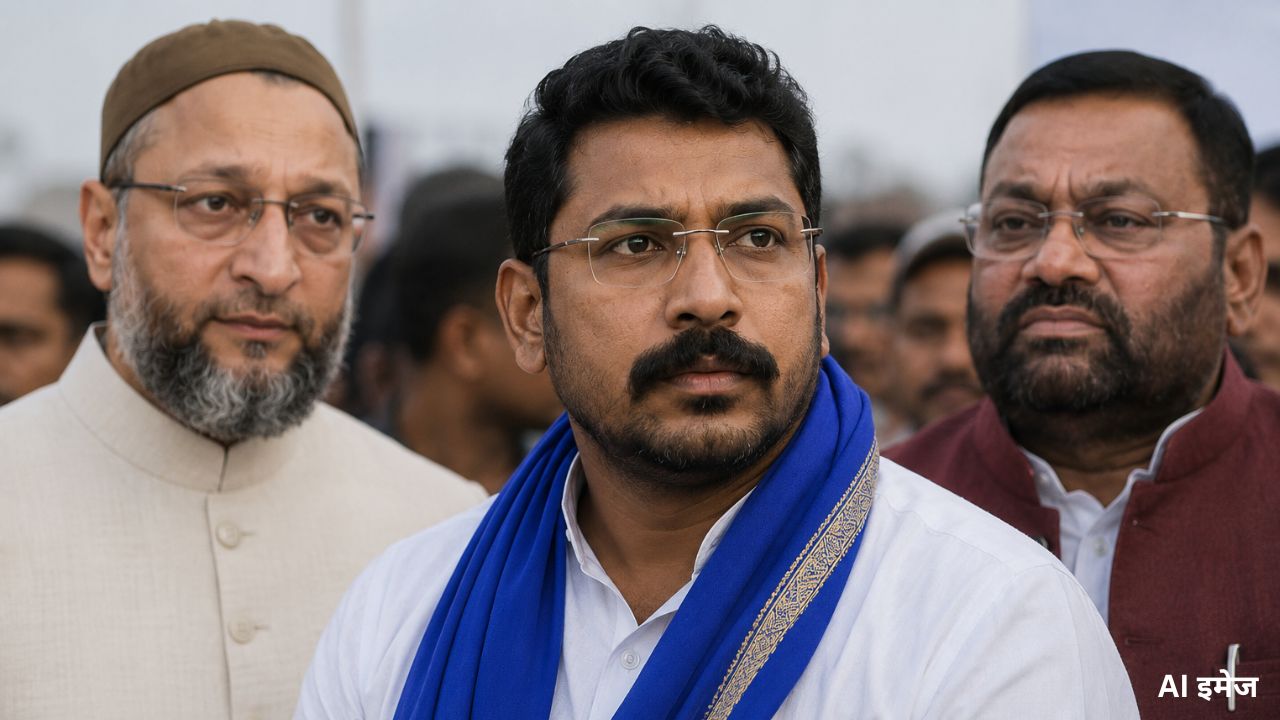
Discussion of new political equations has intensified in Uttar Pradesh politics ahead of the 2027 assembly elections. The presence of Azad Samaj Party (Kanshi Ram) chief and MP Chandrashekhar Azad, All India Majlis-e-Ittehadul Muslimeen (AIMIM) chief Asaduddin Owaisi, and Aam Aadmi Party MP Sanjay Singh together during a protest in Delhi is concerning.
Chandrashekhar Azad’s recent meeting with Rashtriya Shoshit Samaj Party president Swami Prasad Maurya has fueled speculation about a third front. While no formal alliance has been announced yet, these political activities have drawn the attention of both the Bharatiya Janata Party and the Samajwadi Party.
Is the foundation of a third front being laid?
Following the joint forum in Delhi and the political meetings that preceded it, there is a growing discussion about whether parties pursuing social justice politics are attempting to come together before 2027. If this happens, many seats in Uttar Pradesh could become directly contested in a triangular or even quadrangular contest.
These votes are under close scrutiny
The biggest pillar of the potential equation could be Dalits, Muslims, and non-Yadav OBCs. Dalits constitute approximately 21 percent of the population in Uttar Pradesh, Muslims approximately 19 percent, and non-Yadav OBCs are considered a major social group. This group includes Maurya, Kushwaha, Shakya, Saini, Nishad, Pal, Kashyap, Lodh, and several other communities.
Chandrashekhar Azad is considered influential among Dalit youth, especially the Jatav community. Swami Prasad Maurya has long been a prominent figure in non-Yadav OBC politics, while Owaisi enjoys recognition among a segment of Muslim voters. Aam Aadmi Party MP Sanjay Singh is also an active figure in Uttar Pradesh politics.
Which areas could have an impact?
Dalit, Muslim, and non-Yadav OBC voters are in a position to influence election results in several assembly seats in Western Uttar Pradesh, Rohilkhand, Awadh, and Purvanchal. If some segment of these communities shifts to a new political platform, the margin of victory and defeat in many seats could change.
Why could the challenge for the BJP and SP increase?
The BJP has built a strong base among non-Yadav OBCs and non-Jatav Dalits in the last two assembly elections. Meanwhile, the Samajwadi Party is working to align these same communities through the PDA (Backward, Dalit, Minority) strategy. If a third party gains influence among these social groups, the electoral strategy for both parties could become even more challenging. However, its true impact will only be evident when a formal alliance and seat-sharing are announced.
More hints at present, no announcements
There has been no official announcement of an electoral alliance between the Azad Samaj Party (Kanshi Ram), AIMIM, Rashtriya Shoshit Samaj Party, and Aam Aadmi Party. However, the growing political closeness, shared platforms, and meetings certainly indicate that all parties are keenly watching for new alliances to emerge in Uttar Pradesh politics before 2027. If this political chemistry translates into an electoral alliance, the electoral contest in Uttar Pradesh could become more interesting than ever.