Durian shipments fetched more than US$3.45 billion during the period, a 25% year-on-year jump, according to preliminary statistics from the customs department.
Mainland China accounted for nearly $3.3 billion, a 27.6% increase and a market share that went up from 93.6% last year.
Papua New Guinea was a distant second at $37.7 million, followed by Hong Kong at $36.7 million, and the U.S. at nearly $20.5 million.
|
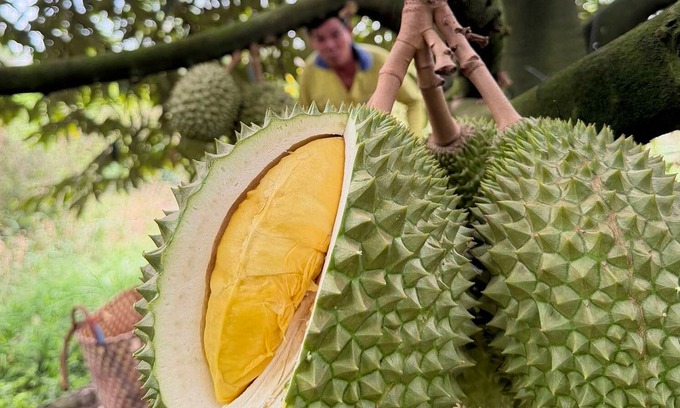
Durians at an orchard in Can Tho City, Vietnam. Photo by VnExpress/Manh Khuong |
Dang Phuc Nguyen, secretary general of the Vietnam Fruit and Vegetable Association, said mainland China was a particularly important market because consumers there favored fresh durian whereas many other markets primarily consumed frozen and processed products.
But this concentration would leave durian exports vulnerable if China tightened quality requirements or simply reduced imports.
Durian was a high-value fruit but ripened quickly and was difficult to store for extended periods without deep freezing.
When shipments were unable to clear customs on schedule, the risk of backlogs at packing facilities in the Mekong Delta and Central Highlands increased, putting pressure on sellers to offload at steep discounts.
Markets such as the U.S., EU, Japan, South Korea, and Australia had potential but could not absorb large volumes of fresh durian diverted at short notice.
These markets mainly consumed frozen products or cater to Asian customers, making them unable to replace China in terms of sales volume.
The risks also extended to growers’ bargaining power. During the peak harvest season, when supply surged and sales depended largely on customs clearance of shipments to China, farmers often found themselves in a weak position.
If exports stalled, traders could reduce purchases or force prices down, while growers lacked cold storage facilities to hold their produce until the market recovered.
Durian exports had grown more slowly than expected this year and selling prices were lower during the peak season, as growing areas in the Mekong Delta faced problems with high cadmium levels, while erratic rains and sunny weather in the Central Highlands affected quality and output.
To reduce the risks of dependence, the industry’s immediate priority should be to maintain stable access to China by controlling quality at growing areas, particularly cadmium and pesticide residues, and ensuring traceability.
Local authorities needed to expand testing capacity and strengthen oversight of growing-area codes and packing facilities to limit shipments that fail to meet standards.
Over the longer term, businesses needed to invest in cold storage, freezing, and further processing, including frozen durian flesh, ice cream, cakes, and durian powder, to extend shelf life and facilitate transport to distant markets.
Companies should also expand their presence in markets covered by trade agreements such as the Regional Comprehensive Economic Partnership and the EU-Vietnam Free Trade Agreement, targeting premium segments, supermarket chains, and Asian customers in the U.S., Japan, and E.U. while meeting GlobalG.A.P. or organic standards.
The industry also needed stronger cooperation between the government, scientists, businesses, and farmers.
Companies should sign long-term purchase agreements with cooperatives, coordinate harvest plans and invest in cold storage and logistics in growing areas to secure supply and reduce pressure to sell quickly during the peak season or when exports were disrupted.
Vietnam’s durian exports could rise by 20% this year to $4.5-4.7 billion.