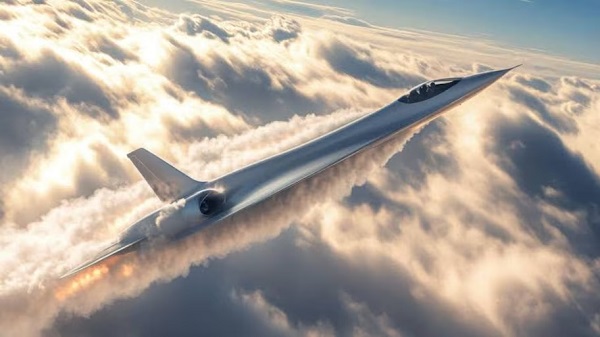
Beijing. China is busy developing new technology in the field of supersonic passenger aircraft. The TMS-10 test aircraft being developed in China may be capable of flying at almost twice the speed of sound. Its maximum speed is said to be Mach 2 i.e. about 2,470 kilometers per hour. This technology aims to significantly reduce long distance air travel time in the future.
Plan to build aircraft for 10 to 15 passengers
The TMS-10 is currently being developed as a test aircraft. Going forward, there is a plan to develop a supersonic passenger aircraft with a capacity of 10 to 15 passengers on the basis of this technology. China's aim is to create such technology that the two-hour air journey from Beijing to Shanghai can be completed in about 30 minutes.
Tianmushan Laboratory and Beihang University are developing
TMS-10 is being jointly developed by China's aerospace research organization Tianmushan Laboratory and Beihang University. The assembly work of the aircraft is said to be in the final stages and preparations are being made for its testing. The project also focuses on reducing the problem of sonic boom arising during supersonic flight along with the high speed of the aircraft.
When an aircraft flies faster than the speed of sound, shock waves are formed in the air. When they reach the ground, a loud bang-like sound can be heard. This is why sonic boom has long been a major challenge in the development of supersonic passenger aircraft.
Attempt to reduce the shock wave by spreading it
In the design of TMS-10, the nose and wings of the aircraft are being prepared in such a way that the shock wave formed around them does not come together to form an extremely strong wave. The design of the rear of the aircraft will also help in spreading these waves in different directions and reducing their strength.
Speed can reach Mach 2
The maximum speed of TMS-10 is said to be Mach 2, which is equivalent to about 2,470 kilometers per hour. In normal i.e. subsonic flight, its speed can be up to Mach 0.95 i.e. about 1,173 kilometers per hour.
Aerodynamic wind tunnel tests of the aircraft have been completed. Information has also been given that work related to its flight control design and airframe has been completed. Earlier its smaller model was tested at low speed. This model has flown at speeds less than Mach 0.2.
In the next phase the aircraft will be tested at supersonic speed. During this time, scientists will assess how much sonic boom is generated during flight and how other technical capabilities of the aircraft work.
NASA is also working on low noise supersonic aircraft
China is not alone in the race to develop supersonic passenger aircraft. American space agency NASA is also working on a test aircraft named X-59. Its maximum speed has been kept at Mach 1.4. NASA's objective is to reduce the loud sonic boom and convert it into a relatively soft sound i.e. 'sonic thump'.
Both the TMS-10 and X-59 projects focus on reducing noise from supersonic flight, although the design and technical approaches are different. China's TMS-10 is working on a way to reduce the intensity of shock waves by spreading them in different directions, while NASA's X-59 is being designed to produce a low-intensity sonic boom.