
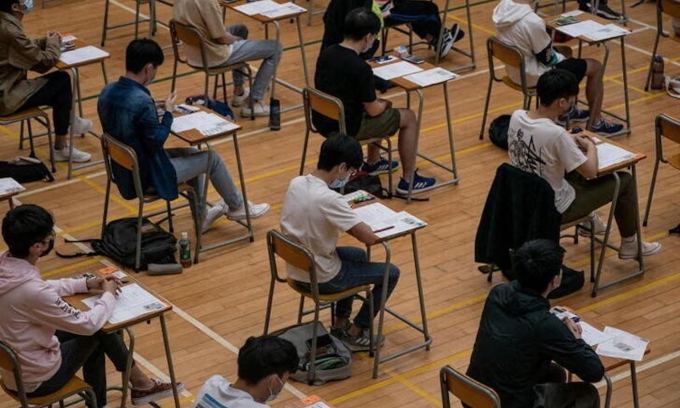

A search for “TOPIK preparation” on the Chinese social media platform Xiaohongshu returned more than 87.5 million posts, the majority advertising test-malpractice services in Mandarin slang loosely meaning “carpooling,” “score guarantee” and “immediate pass,” The Korea Herald reported.
After contacting one broker as a buyer, the paper received a promotional booklet listing three services: proxy test-taking with a money-back guarantee, advance answers claimed to be 90% accurate, and one-on-one assistance during the exam through what the broker called a 1-millimeter earpiece.
Pricing started at 20,000 yuan ($2,900) for the earpiece service and ran from 25,000 to 35,000 yuan for advance access to questions, depending on whether they were delivered six, eight or 12 hours before the exam. The combined top tier reached the headline figure of $5,100. The broker told the Korea Herald the questions came from a staff member inside a test center in South Korea.
TOPIK, short for The Test of Proficiency in Korean, is administered by the National Institute for International Education under South Korea’s Ministry of Education. It is widely required for foreign-student admission to Korean universities, for graduation from many Korean degree programs, and for visas, employment and immigration. The exam was held in 17 countries in 2025 with about 550,000 sitters by September.
The leak appears to ride on a structural weakness. Candidates in Europe, Australia, Africa and the U.S. typically take TOPIK on Saturday, while Asia sits the exam on Sunday, NIIED said.
The Korea Herald found that earlier test-takers memorized questions and resold them to brokers, who then pushed the material to candidates in later time zones before they entered the hall. A student who sat the 105th TOPIK on Sunday, April 12, told the paper that some answer keys posted on Xiaohongshu before the exam matched the actual questions.
Chosun Ilbo reported that a Chinese student was caught with a sheet of answers during the same April 12 exam at a test center in South Korea. Police were called, and NIIED said it would file a complaint against the student for obstruction of business.
“We are aware of what is happening on social media,” an NIIED TOPIK Center official told the Korea Heraldattributing the surge in malpractice to rising test-taker numbers and growing institutional acceptance of TOPIK scores. “We are coming up with many different responses, but the reality is we aren’t able to prevent 100% of it.”
The Education Ministry said it was working “at full capacity” with NIIED to close the gap. From the July sitting, the ministry will reduce similarities between exam papers across regions, and NIIED is reviewing whether to move all regions to a single test day.
Demand for TOPIK has surged alongside Korean cultural exports and Seoul’s foreign-student recruitment drive. Sitters rose from 360,000 in 2022 to 420,000 in 2023, 490,000 in 2024 and more than 500,000 in 2025, the local daily Herald Business reported. Chinese candidates account for more than 12% of total applicants, with about 70,000 taking the test inside mainland China last year.
The broader prize is South Korea’s international student market. The country reached its Study Korea 300K target of 300,000 foreign students in August 2025, two years ahead of schedule, with the figure climbing to 314,397 by February 2026, according to Korea Immigration Service data.
Vietnam overtook China to become South Korea’s largest source country in 2025, with 107,807 students enrolled, the Korea Times reported.
Comments are closed.