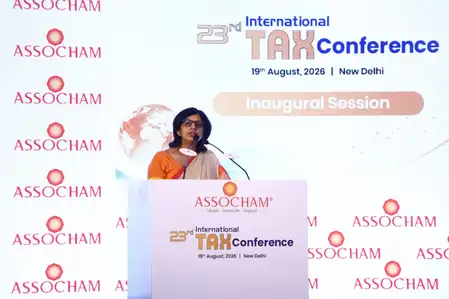
New Delhi, August 19 (IANS). India's international tax regime is at a critical juncture and the country must strike a balance between protecting its tax base as well as providing a stable, transparent and predictable policy environment to global investors. Principal Chief Commissioner of Income Tax (International Tax) Monica Bhatia of the Income Tax Department said this on Wednesday.
Addressing the 23rd International Tax Conference organized by ASSOCHAM, Monica Bhatia said that the Supreme Court judgment in the Tiger Global case, the new Income Tax Act, evolving dispute resolution mechanisms and rapidly growing technology are rapidly changing the international taxation landscape.
“Policy stability is the foundation of investor confidence,” he said. Monica Bhatia also said that after the Supreme Court's judgment in the Tiger Global case, the government has taken several steps to provide more clarity and confidence to genuine and old investors.
Monica Bhatia also mentioned India's achievements in the field of Advance Pricing Agreements (APAs). He said India has so far entered into more than 1,000 APA agreements, including more than 220 bilateral agreements. He said that this has helped multinational companies in reducing tax related uncertainties.
He said that in the coming years, Artificial Intelligence is not only changing the business models but also giving a new direction to the tax administration. This is raising new questions on issues such as permanent establishment, allocation of profits and the actual location of value creation.
Bhatia stressed that current tax rules change relatively slowly compared to the speed at which technology is developing. In such a situation, the importance of international cooperation and rules based on global consensus will continue to increase.
Speaking at the conference, Rakesh Nangia, Chairman of ASSOCHAM's International Tax Task Force, said that international taxation has now entered not only a period of rapid change but also a period of comprehensive structural change. According to him, the Tiger Global decision, new income tax law, global minimum tax regime and AI will shape the tax system of the future.
At the same time, Sandeep Chaufla, Chairman of the National Direct Taxes Council of ASSOCHAM, said that governments want to protect their tax base, while taxpayers expect clarity and certainty.
“The need of the hour is to strike a balance between the legislative framework and its effective implementation,” he said. He also highlighted the growing role of AI in tax administration.
Important topics such as post-Tiger Global tax landscape, AI and international tax policy, BEPS 2.0, evolution of tax treaties, new Income Tax Act, advance pricing agreements, safe tax provisions and cross-border tax dispute resolution were also discussed during the conference.
–IANS
DBP