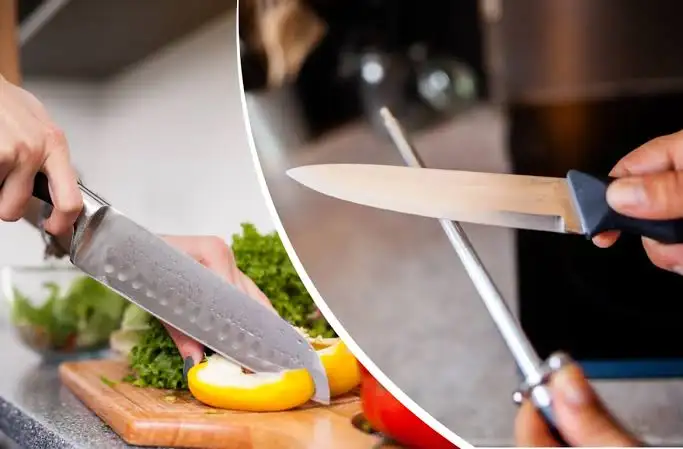
While cutting vegetables, fruits and other things in the kitchen every day, the sharpness of the knife gradually reduces. In the beginning it is not felt much, but after some time even cutting common things like tomatoes and onions starts becoming difficult. In such a situation, many people buy a new knife or take it out to get it sharpened. However, it is not necessary to do this every time. By adopting the right method, the sharpness of a knife can be improved to a great extent even at home.
There is a common belief that a blunt knife is safer, but this is not necessary. A knife with a less sharp edge may require more pressure to cut something. During this time, the risk of injury to hands or fingers may increase if the blade suddenly slips. Therefore, keeping the knife sharp is important not only to make the work easier but also from the safety point of view.
After all, why does the edge of a knife get spoiled?
Due to continuous use, the blade of the knife wears out and its sharpness gradually starts decreasing. However, excessive use alone is not the reason. Using the wrong cutting board can also damage the blade.
If you cut vegetables on a hard surface like glass, stone or marble, the knife's edge can wear off faster. Additionally, storing the knife in a drawer with other utensils without a cover or protection can also result in scratches on the blade and damage to the edge.
Washing a knife in a dishwasher is also not considered good for its sharpness. The sharpness of the blade can be affected due to hot water, strong movements and collision with other utensils.
Sharpen a knife with a whetstone
If the knife has become too blunt, whetstone i.e. sharpening stone Can be used. Before using it, soak it in water according to the manufacturer's instructions.
After this, bring the knife blade closer to the stone. 15 to 20 degree angle Keep it on. Now move the blade forward on the stone in a light and controlled manner. Repeat the same process on the other side of the blade.
This method requires some practice and patience. Especially beginners should pay attention to keeping the angle of the blade the same and keeping the hand steady.
Ceramic mug can also be useful
If you don't have a sharpening stone, if needed ceramic mug can be used. For this, keep the mug upside down and look at the unglazed rough part at its bottom.
The edge of the knife can be gently moved on this rough surface. However, it should not be considered a substitute for regular sharpening tools. This is a home remedy to be used only in emergencies.
Align the edge with the honing rod
A honing rod is commonly used to sharpen knives, but its function is slightly different from that of a sharpening stone. This helps restore the existing edge rather than creating a new edge by removing large amounts of metal.
If the knife is not too blunt and the edge is slightly bent, a honing rod may be useful. Holding it steady, run the knife at an equal angle on both sides with light pressure.
Fine sandpaper can also be an option
Fine sharpening if correct sharpening tool is not available 1000 to 2000 grit sandpaper Can also help to some extent. Place the sandpaper on a flat surface and gently move the blade at an even angle.
However, this should not be considered the routine or best way to sharpen a knife. It is more advisable to use the right sharpening tool for better results.
Keep these things in mind to keep your knife sharp for a long time
Once the knife is sharpened, it is important to take proper care of it. By changing a few small habits, you can keep your blade's edge in better condition for a longer period of time.
- Do not use glass, marble or stone surface for cutting vegetables.
- Use a wooden or good quality plastic cutting board.
- Do not keep knives open in a drawer with other utensils.
- Use a safe place such as a knife block, cover or magnetic strip.
- Wash the knife by hand and dry it thoroughly immediately.
- Avoid putting knives in the dishwasher, especially if maintaining the blade's sharpness is a priority.
With these precautions, the knife's edge can be kept good for a long time and the need for frequent replacement or sharpening can also be reduced.
Take care of safety: When sharpening a knife, always keep the blade facing away from your body, keep your hands away from the edge and do not rush.