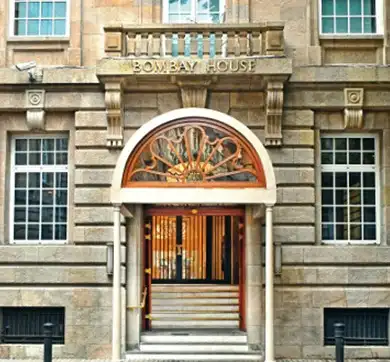
New Delhi, September 12 (IANS). The Reserve Bank of India (RBI) has rejected Tata Group's holding company Tata Sons' demand to deregister it as a Core Investment Company (CIC). According to a report, after this decision, the regulatory requirements related to being listed on the stock market are likely to remain applicable to the company.
Tata Sons was classified as an upper-layer non-banking financial company (NBFC) in the year 2022 and has also been retained in the RBI upper-layer NBFC list for the year 2026-27, NDTV Profit quoted sources as saying. Companies falling in this category are subject to more stringent regulatory oversight than banks.
Tata Sons had earlier requested RBI to terminate the CIC registration saying that the company is now debt-free and hence it is no longer required to remain registered as a Core Investment Company. However, the central bank did not accept this argument.
The report said that RBI had earlier also informed Tata Sons about the need to be listed by September 2025. Since the company is still considered an upper-layer NBFC under the regulatory framework, listing rules remain important for it.
According to the report, the RBI has also not accepted industry demands suggesting increasing the asset limit for classification of large NBFCs or retaining the complex risk-based methodology already in place.
Instead the central bank has decided to adopt a more simplified framework, with the main focus being the size of the balance sheet. Under the revised norms, NBFCs with independent assets of Rs 1 lakh crore or more will have to face tighter regulatory oversight like banks. These may also include the need to be listed on a stock exchange in the future.
According to the report, Tata Sons has been opposing public listing for a long time. The Company believes that there will be a significant increase in disclosures, compliance processes and regulatory requirements following listing.
The potential listing of Tata Sons, being the principal holding company of the Tata Group, may also have an impact on the group's ownership structure and shareholders. Therefore, this issue is considered important for both investors and the industry.
This development has come at a time when Tata Sons is also going through the process of leadership change. Company Chairman N. Chandrasekaran has decided not to seek another term, following which the search for a successor has begun.
Recently, the Annual General Meeting (AGM) of Tata Sons also had to be postponed due to lack of sufficient quorum. According to reports, this was the first time in the history of Tata Sons that the AGM had to be postponed. This situation was said to have arisen due to an embargo related to the Sir Ratan Tata Trust.
–IANS
DBP