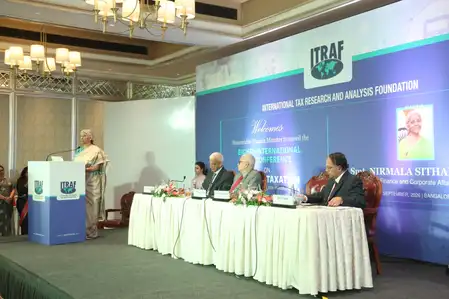
Bengaluru, September 16 (IANS). Union Finance Minister Nirmala Sitharaman on Wednesday said the impact on India, other countries and future investments should be carefully studied while taking decisions related to taxation on the digital economy.
Addressing an event organized by the International Tax Research and Analysis Foundation (ITRAF) in Bengaluru, the Union Finance Minister said that in cases related to cloud services, digital products and consumption of digital services, it is not easy to decide where to tax and on whom.
“This complexity should be studied calmly. Its impact on India, its impact on other countries and most importantly, its impact on future investments in India should also be studied in depth,” he said.
Sitharaman also mentioned India's experience in global two-pillar tax negotiations. He said that during these talks, India had withdrawn two taxes imposed on digital companies, so as to build confidence in the emerging global agreement.
However, he said the issue should not be viewed only from the perspective of potential loss in India's tax revenue, as taxation on digital businesses is part of broader global negotiations.
The Finance Minister said that in the future tax policy discussion, topics like Significant Economic Presence, Virtual Permanent Establishment, Artificial Intelligence (AI), Robotics, Gig Economy, Global Mobility, Virtual Digital Assets, Global Capability Center and classification of goods and services in digital transactions will be prominent.
He said the government is ready to put in place an institutional mechanism that can provide clarity on whether digital transactions are considered a good or a service under GST and income tax laws. In this regard, he urged the industry to send suggestions and proposals.
Sitharaman said distinguishing between goods and services in digital transactions has become more complex than before as businesses are now operating across borders.
He asked tax experts, industry organizations and researchers to not just limit themselves to demanding lower tax rates, exemptions and concessions, but also contribute in identifying such provisions which are no longer useful to the tax system.
He said industry organizations should also suggest provisions that should be removed even if they are currently benefiting them.
The Finance Minister said, “Consultation should not just mean giving everyone an opportunity to present their side. It should be a genuine process based on facts, experiences and views.”
He informed that the next meeting of the GST Council will be held on October 7, in which procedural reforms under GST 2.0 will be discussed. These will also include issues related to e-invoicing.
Sitharaman said the last GST Council meeting focused on rationalization of rates, while process reforms were postponed till the next meeting.
He also invited the industry to send specific suggestions to the government regarding any anomalies existing in the GST framework.
The Finance Minister also said that the government has continuously expanded foreign direct investment (FDI) limits since 2014 and most of the investments are now coming through the automatic route. Restrictions are applicable only in certain security related areas.
He said global investors are trying to diversify their supply chains under the “China Plus One” strategy and India's strong macroeconomic position is attracting them.
Sitharaman also mentioned the role of GIFT City and said that it is playing an important role in channeling offshore capital to India. He underlined its growing contribution in sectors such as maintenance, repair and overhaul (MRO), shipbuilding, ship repair and fintech.
–IANS
DBP