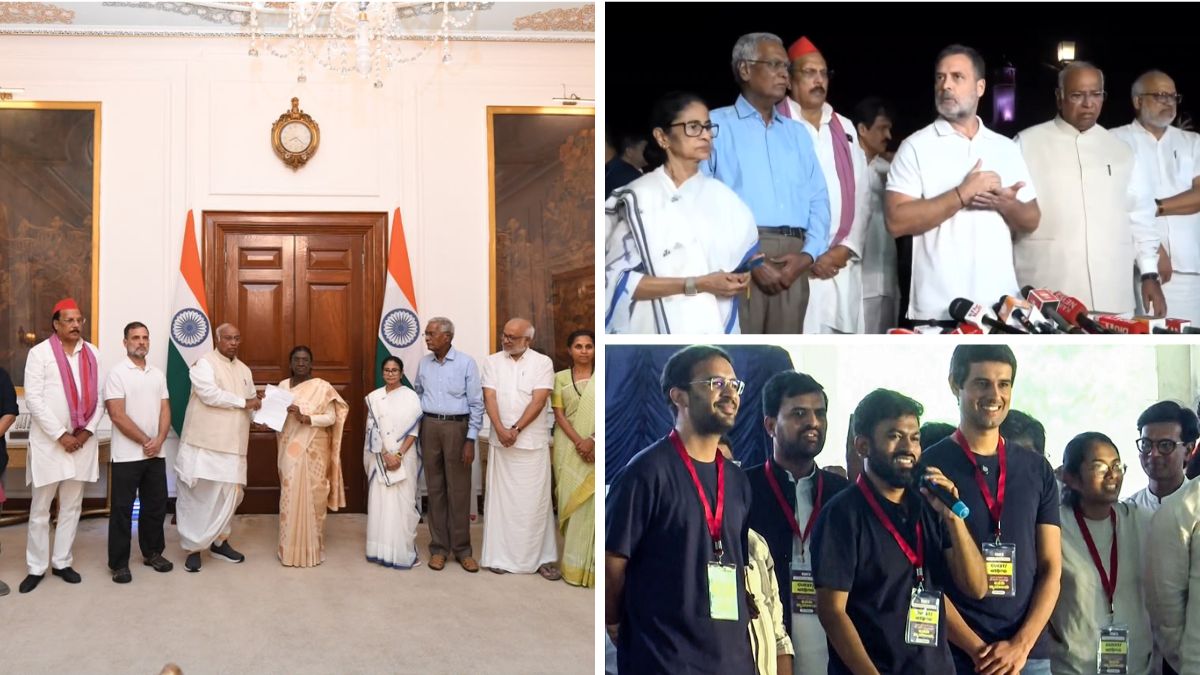
The conflict between the central government, the Election Commission and the opposition regarding the electoral process and voter list has intensified in Delhi. On Friday, October 9, leaders of the INDIA alliance met President Draupadi Murmu and raised demands for the removal of Chief Election Commissioner Gyanesh Kumar, ban on Special Intensive Revision (SIR) of voter lists and restoration of names of allegedly removed voters. On the other hand, ahead of the proposed CJP protest at Jantar Mantar on October 10, security was increased in the capital, restrictions were imposed at metro stations and some rail services were also affected.
Meanwhile, the Supreme Court raised questions regarding the widespread ban on public transport. The court said that there is a difference between security arrangements and stopping the entire service. Restrictions should be proportionate to the situation. On this issue, Congress MP Priyanka Gandhi Vadra, while reacting to the metro restrictions, said, “This is what you call fear”.
After meeting the President, Rahul Gandhi claimed that the President did not reject the opposition’s allegations, but asked them for evidence of alleged election irregularities. However, the opposition’s allegations cannot be considered proven facts; It is important to understand the President’s reaction and the Election Commission’s stand separately.
10 big things about Delhi protests and ‘vote theft’ controversy
1. Four-point memorandum submitted to President Murmu
Leaders of INDIA alliance met President Draupadi Murmu and demanded action against Chief Election Commissioner Gyanesh Kumar. The memorandum includes issues like stopping SIR, restoring names allegedly removed from the voter list and return of ballot paper in the elections.
2. Rahul Gandhi said- President asked for evidence
After meeting the President, Rahul Gandhi said that he accused Prime Minister Narendra Modi, Home Minister Amit Shah and Chief Election Commissioner Gyanesh Kumar of a conspiracy to harm democracy. According to Rahul, instead of rejecting the allegations, the President asked him for evidence of election irregularities. This is Rahul Gandhi’s statement about the meeting; This should not be understood as acceptance of the allegations by the President.
3. Opposition demands- ballot paper instead of EVM
Congress President Mallikarjun Kharge said that the opposition has demanded voting through ballot paper instead of EVM in the elections. The alliance has also raised the demand for repeal of the 2023 law giving legal protection to the Chief Election Commissioner and other election commissioners. The final decision on these demands can be taken only under the relevant constitutional and legal procedures.
4. Controversy over SIR and names of crores of voters
The opposition alleges that during the special intensive revision of the voter list, the names of a large number of people were removed. In the memorandum, the demand for restoration of names of 13.30 crore voters has been stated. It is necessary to present this number and the alleged illegal name reduction as a claim of the opposition. This in itself cannot be considered as evidence of proven electoral irregularities.
5.Big allegation of Abhijeet Dipke
Abhijeet Dipke claimed that the government blocked a video he posted on X. In this video, he had appealed to people for the last time to join the CJP protest to be held at Jantar Mantar from Saturday. Sharing a screenshot of the video, Deepke wrote, “They blocked the video I just posted.” However, the same video is still available on his Instagram account.
6. Supreme Court raised questions on comprehensive restrictions
A bench of Chief Justice Surya Kant and Justice Joymalya Bagchi and Justice V. Mohan said that metro and rail services can be controlled according to the circumstances instead of stopping them completely. The court stressed that security measures should not unnecessarily hamper the movement of ordinary citizens. He also clarified that the right to protest is subject to the law and the conditions of the permission.
7. Order of ban on 57 metro stations changed
Earlier DMRC had announced to close the entry and exit gates of 57 metro stations from 9 pm on October 9. The restrictions were amended following the Supreme Court’s comments and as per available reports, 45 stations were to be affected. Entry, exit and interchange conditions may vary at the affected stations, hence passengers should check the latest official information from DMRC before travelling.
8. News of restrictions on rail services, roads and internet also
Before the protest, there were reports of changes and cancellations in some train services related to New Delhi and Hazrat Nizamuddin railway stations. Additionally, a temporary suspension of mobile internet services around the Janpath-Kartavya Path area came to light under police orders. The actual scope of these measures and the period for which they will remain in force should be verified from the orders of the departments concerned.
9. CJP’s Jantar Mantar march on 10 October
Cockroach Janata Party (CJP) has called for a demonstration at Jantar Mantar on October 10 demanding the resignation of Chief Election Commissioner Gyanesh Kumar. According to reports, Delhi Police did not allow the demonstration and a large number of police and central forces were deployed in the capital. The organizers have raised questions over the restrictions and the alleged detention of their supporters.
10. Opposition movement from Rashtrapati Bhavan to Supreme Court
Rahul Gandhi said that opposition leaders will try to meet the Chief Justice on Monday and submit a copy of the memorandum. This indicates that the INDIA alliance wants to raise this issue before the constitutional institutions instead of limiting it only to political demonstrations.
Now the further direction will depend on what evidence the opposition presents in support of its allegations and what action the concerned institutions take on them.