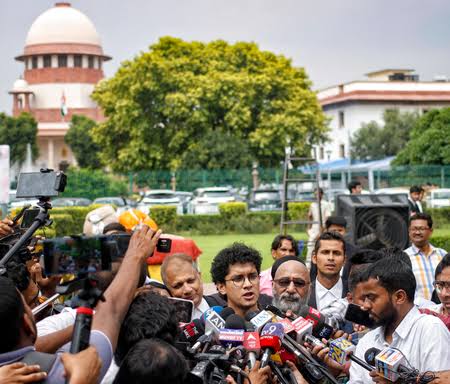
The Cockroach Janta Party (CJP) has withdrawn its call for a September 5 march from India Gate to Delhi Police Headquarters after the Centre gave assurances before the Supreme Court regarding its pending commitments.
CJP spokesperson and co-convener Saurav Das told the Supreme Court on Tuesday that the organisation had decided to withdraw the protest in view of the government’s assurances and the order being passed by the court.
“As co-convener of the CJP, I want to state that in view of the positive assurances of the Government of India and the judicial sanctity bestowed upon them today, and in view of the order being passed by this Court, the CJP deems it appropriate to withdraw the call for the march on September 5 and looks forward to compliance with today’s order,” Das told the court.
Why did CJP call the September 5 march?
The CJP had announced the peaceful march on August 24, saying it would travel from India Gate to Delhi Police Headquarters over what the organisation described as the government’s failure to honour commitments made on July 25.
The protest was linked to demands arising from the CJP-led NEET protests in July, including compensation for families of NEET aspirants who died by suicide and the withdrawal of cases registered against protesters.
The proposed mobilisation had attracted attention after the Supreme Court was approached over the planned march.
Centre assures compensation for families
During Tuesday’s hearing, Solicitor General Tushar Mehta, representing the Centre, told the Supreme Court that families of NEET aspirants who died by suicide would receive compensation within three months.
The Centre also urged the Supreme Court to exercise its powers under Article 142 to close FIRs registered against NEET protesters between July 20 and July 25 across the country.
The development came a day after Delhi Police told the Supreme Court that it “no longer wishes to pursue” 13 FIRs related to the CJP-led NEET protests in July.
Supreme Court had declined to stop September 5 protest
The CJP’s decision to withdraw the march came a day after the Supreme Court declined to intervene in the proposed September 5 mobilisation.
The court said decisions concerning law-and-order arrangements were for the Centre and Delhi government to take. It also stressed that all stakeholders should maintain peace and operate within the legal framework.
A bench comprising Chief Justice of India Surya Kant and Justices Joymalya Bagchi and V Mohana said there were “no compelling circumstances” before it to presume that the proposed mobilisation would turn violent.
The court left it to the authorities to determine whether the march could take place and, if so, under what conditions.
What happens next?
With the CJP withdrawing its September 5 march, attention now turns to whether the Centre and other authorities will implement the assurances made before the Supreme Court.
The CJP has said it expects compliance with the court’s order, while the proceedings have brought renewed focus on compensation for affected families and the status of FIRs arising from the July NEET protests.