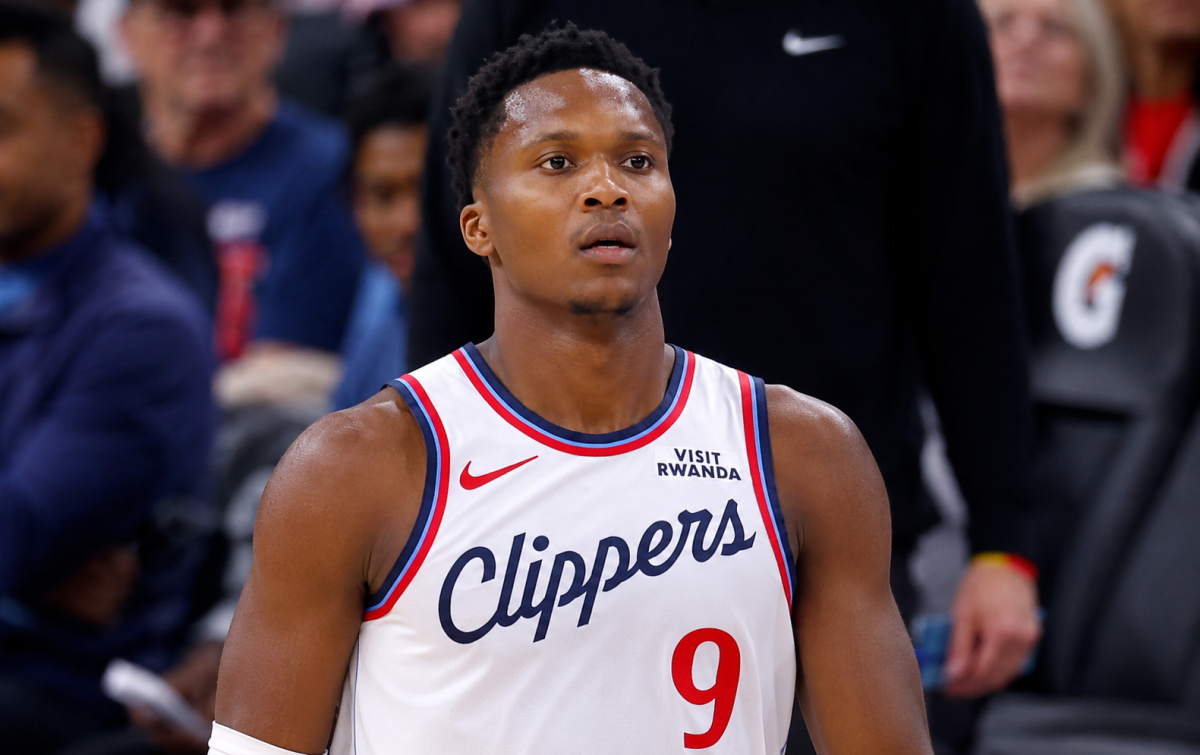
Bennedict Mathurin’s move to the New Orleans Pelicans has taken an unusual turn, with the Los Angeles Clippers reportedly looking for a way to gain compensation before allowing the former Indiana Pacers guard to leave.
Mathurin agreed to a two-year, $16 million contract with the Pelicans, including a player option for the second season. However, the deal was not immediately straightforward because the Clippers still held his $8.8 million qualifying offer and therefore retained his restricted free-agent rights.
Why Are the Clippers Still Involved?
Mathurin joined the Clippers in February after being traded by Indiana as part of the deal that sent Ivica Zubac to the Pacers.
After the season, Los Angeles issued Mathurin a qualifying offer, making him a restricted free agent. Under NBA rules, that gave the Clippers the right to match an offer from another team.
Mathurin and the Pelicans subsequently reached their agreement, but for New Orleans to sign him directly, the Clippers needed to withdraw the qualifying offer.
That is where the situation became complicated.
Clippers Don’t Want to Walk Away Empty-Handed
According to NBA insider Jake Fischer, the Clippers had not formally rescinded the qualifying offer as of September 2 and were exploring whether they could participate in a multi-team transaction that would help New Orleans create the necessary salary-cap room for Mathurin.
The important distinction is that Los Angeles cannot simply demand compensation in exchange for withdrawing the qualifying offer. Such an arrangement would violate NBA collective bargaining rules.
However, the Clippers could potentially become part of a larger transaction and receive an asset through the mechanics of that trade while simultaneously helping the Pelicans complete the Mathurin signing.
Why Would New Orleans Need a Bigger Transaction?
The Pelicans did not initially have an open roster spot for Mathurin, creating another complication.
A multi-team trade could potentially solve multiple problems at once—creating roster and salary-cap flexibility for New Orleans while giving the Clippers an opportunity to extract some value from a player whose restricted rights they currently control.
The arrangement would effectively allow all sides to get what they want without the Clippers simply surrendering their leverage for nothing.
Mathurin Was Productive With the Clippers
Mathurin’s brief stint in Los Angeles showed why New Orleans was interested.
The 24-year-old averaged 17.4 points, 5.5 rebounds and 2.5 assists in 26 games with the Clippers during the 2025-26 season. He also scored 38 points in his Clippers debut against Denver.
However, his three-point shooting dropped significantly after arriving in Los Angeles. Mathurin shot just 20.7% from three-point range with the Clippers, compared with 37% during his time with Indiana earlier in the season.
Across 54 games for Indiana and Los Angeles, he averaged 17.6 points, 5.4 rebounds and 2.4 assists.
Why Didn’t the Clippers Simply Keep Him?
There was a legitimate argument for bringing Mathurin back.
He is still only 24 and had demonstrated that he can provide scoring off the bench. But the Clippers’ roster changed significantly during the offseason.
Los Angeles added Max Strus, re-signed Bradley Beal and drafted Keaton Wagler, creating additional competition for perimeter minutes. The Clippers also have broader roster and salary-cap considerations to manage.
That made Mathurin less of a priority, even though the organization retained his restricted rights.
Pelicans Have Already Agreed to the Deal
For New Orleans, the appeal is straightforward.
The Pelicans are coming off a 26-56 season, and Mathurin gives new head coach Jamahl Mosley another young scoring option alongside players such as Zion Williamson, Trey Murphy III, Herb Jones and Derik Queen.
Mathurin’s two-year agreement also gives him a player option for the second season, providing him with the possibility of returning to free agency relatively quickly.
What Happens Next?
The simplest outcome would be for the Clippers and Mathurin to finalize the withdrawal of the qualifying offer, allowing him to join New Orleans as an unrestricted free agent.
But the more intriguing possibility is a multi-team transaction.
If the Clippers can help New Orleans create the necessary room while receiving an asset through a separate trade, Los Angeles could avoid losing Mathurin’s restricted rights for nothing.
For the Pelicans, the objective is to complete the signing. For Mathurin, it is about finally getting to New Orleans under the contract he agreed to.
And for the Clippers, the question is simple:
Can they turn a player they no longer appear committed to retaining into one more asset for their rebuilding plans?