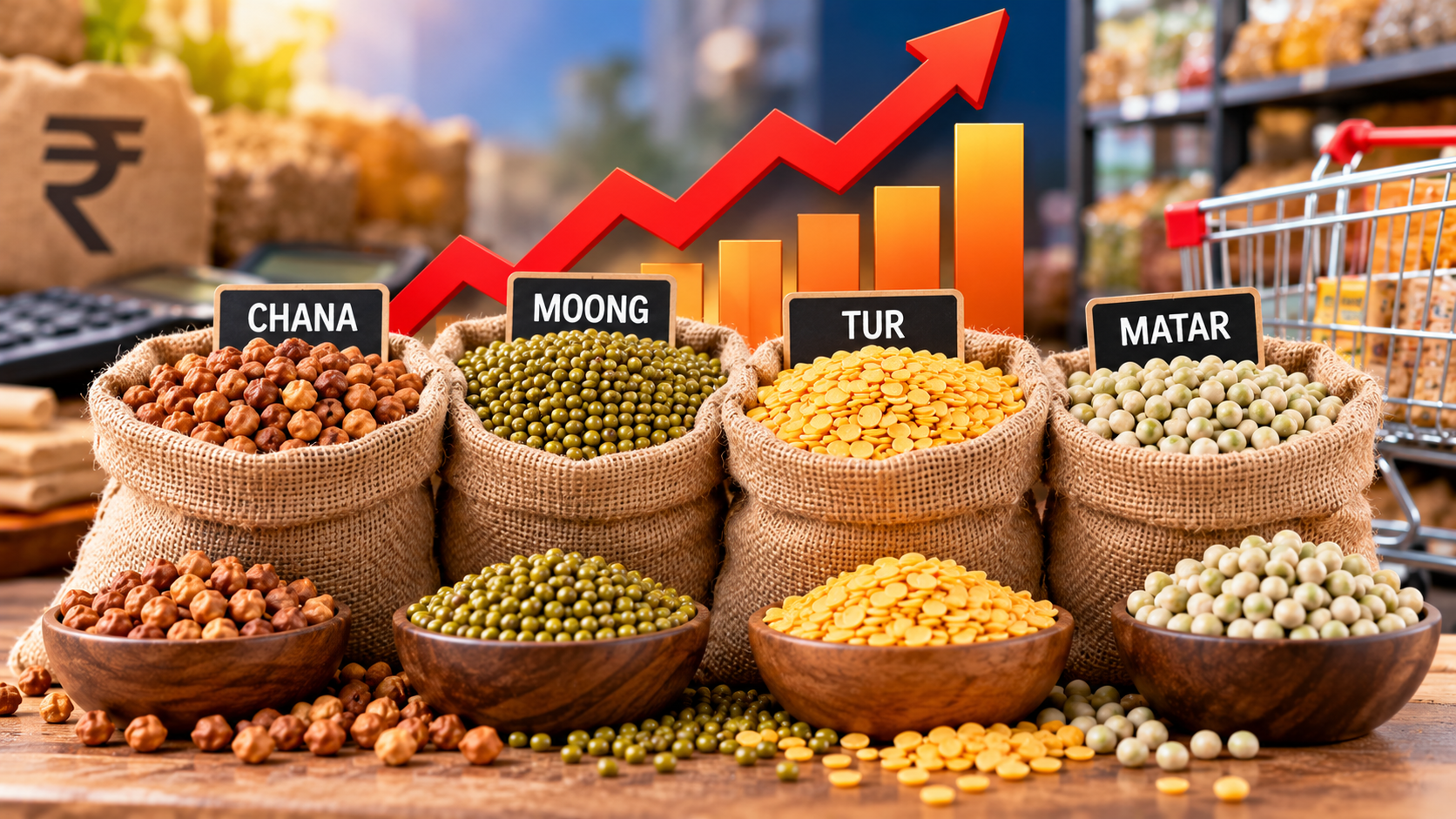
Dal prices could put additional pressure on household budgets as India heads into the festive season. Wholesale prices of several major pulses have increased significantly over the past month, with chana, moong, tur and matar all recording notable gains.
According to recent market data, some pulses have become up to 11 per cent more expensive in just one month. The price rise comes ahead of festivals such as Diwali, when household demand for groceries generally increases.
However, stronger festive demand is not the only factor affecting prices. Concerns over rainfall, soil moisture, crop conditions and future supplies are also influencing the pulse market. Uneven and deficient rainfall in parts of Maharashtra and Karnataka has added to concerns about upcoming crop production.
How Much Have Dal Prices Increased?
Data from the Indian Pulses and Grains Association (IPGA) shows that wholesale prices of several pulses have risen sharply over the past month.
Chana prices have increased by around 11 per cent, while moong has gained about 10.6 per cent. Tur has become approximately 6.5 per cent more expensive, while matar prices have risen around 6 per cent.
The increase has also accelerated recently, with prices of some major pulses rising between 3 per cent and 5 per cent in a single week.
Compared with the same period last year, the increase is even more significant. Chana prices are around 23 per cent higher, while matar has recorded a year-on-year increase of nearly 47 per cent. Urad prices are also about 24 per cent above last year’s levels.
Wholesale prices, however, do not necessarily translate into an immediate or equal increase in retail markets.
Government price-monitoring data showed that on September 28, the average retail price was around ₹88.72 per kg for gram dal, ₹125.72 per kg for tur dal and ₹112.14 per kg for moong dal.
Why Is Chana Becoming More Expensive?
Chana is among India’s most widely consumed pulses and is used in dal, besan and several other food products. Market concerns are currently focused partly on the upcoming rabi crop, as chana is primarily cultivated during the rabi season.
Adequate soil moisture at the time of sowing is important for the crop. However, rainfall has remained uneven across several agricultural regions this year. Parts of Maharashtra, particularly Marathwada, have faced significant rainfall shortages, raising concerns about water availability and rabi sowing conditions.
Imports are another factor affecting the market. India imported around 6.42 lakh tonnes of chana between January and July 2026, which was about 45 per cent lower than imports during the corresponding period last year. Australia supplied nearly 95 per cent of these imports.
A reduction in supplies from Australia could add further pressure to the domestic market.
Yellow peas are also relevant because they can be used as an alternative to chana in certain food products. Any increase in yellow pea prices could therefore help sustain demand for chana.
Tur and Moong Prices Under Pressure
Tur, also known as arhar or pigeon pea, is mainly grown as a kharif crop, making its supply outlook different from that of chana.
Tur-producing regions in Maharashtra and Karnataka are being closely monitored because of uneven rainfall. Several areas of Maharashtra have recorded substantial rainfall deficits this season, raising concerns about moisture availability and the eventual size of the tur crop.
India also relies on imports to meet domestic tur demand. During the first four months of 2026, tur imports increased significantly, with Mozambique, Tanzania and Myanmar among the major suppliers.
Moong prices have also moved higher. IPGA data shows that moong became around 10.6 per cent more expensive over the past month.
The rise is partly linked to concerns about kharif supplies and the impact of irregular rainfall on production. Since moong has a relatively short crop cycle, the timing and availability of rainfall can have a significant influence on its output.
Why Are Matar Prices Rising?
India is a major importer of yellow peas, which also play an important role in the domestic pulse market.
Between January and July 2026, India imported approximately 7.29 lakh tonnes of yellow peas, around 11 per cent more than during the same period a year earlier. Canada accounted for more than 79 per cent of these imports, while Russia was another significant supplier.
Despite the recent increase in prices, India’s overall pulse production remains strong.
Government estimates put total pulse production during 2025-26 at a record 274.09 lakh tonnes, compared with around 257 lakh tonnes in the previous year. Chana production was estimated at 125.14 lakh tonnes, representing an increase of about 12.6 per cent, while moong production reached approximately 44.92 lakh tonnes.
At the same time, India’s pulse imports declined from 72.56 lakh tonnes in 2024-25 to around 59.64 lakh tonnes in 2025-26, pointing towards improved domestic availability.
Therefore, the latest increase in dal prices does not necessarily indicate a nationwide shortage. Weather conditions, crop expectations, import trends and changing market demand are all playing a role in determining prices.
Disclaimer
This article is intended for general informational purposes only and should not be considered financial, investment, trading, commodity or consumer-price advice. Market and retail prices can change depending on supply, demand, weather conditions and other factors. Readers should verify the latest prices and official data before making any financial or purchasing decisions.