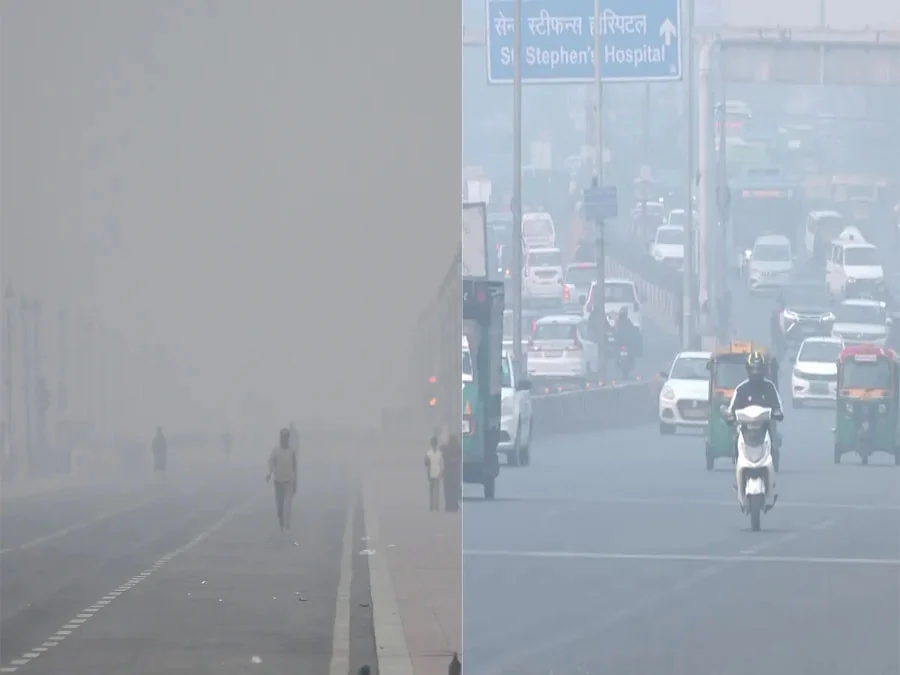
The situation of air pollution in Delhi-NCR has remained serious since Diwali. The increasing level of pollution has increased the problems of the people. According to the 'Sameer' app of the Central Pollution Control Board (CPCB), Delhi's Air Quality Index (AQI) was recorded at 403 on Friday morning, which falls in the very severe category. With this dangerous level of pollution, Delhi has overtaken Lahore, Pakistan to become the most polluted city in the world. The level of pollution in the air of the capital has increased so much that many areas of the city are covered with a thick blanket of smoke and fog.
Visibility on the roads reduced significantly in the morning, due to which drivers and pedestrians had to face a lot of trouble in transportation. At many places things in front were not clearly visible due to fog. Due to this the risk of road accidents has also increased. The continuously deteriorating air quality has increased the concern of the residents of Delhi-NCR. Due to polluted air, the risk of problems like breathing problems, eye irritation and sore throat can increase. Especially children, elderly and people suffering from respiratory diseases need to take extra precautions.
According to data from Swiss group IQAir, Delhi's air quality index (AQI) was recorded at 334 on Friday. With this level Delhi became the most polluted city in the world. At the same time, Delhi's AQI was recorded even higher at 403 on the 'Sameer' app of the Central Pollution Control Board (CPCB). The difference in data between the two agencies is due to their different methods of measuring air quality. The monitoring centers of IQAir and CPCB, the methods of data collection and AQI calculation are different, hence there is a difference in the results of both.
The Air Quality Index (AQI) has reached the serious category in many areas of the capital. According to Central Pollution Control Board (CPCB) data, Delhi's average AQI was recorded at 403 at 6.05 am on Friday. The pollution level remained the same even at 8 and 9 in the morning. Of the 58 monitoring centers in Delhi that provided data till 8 am, air quality was in the 'severe' category at 33 centres, while the AQI was recorded in the 'very poor' category at 24 centres. At the same time, the air quality at a monitoring center remained in the moderate category.
Worst situation in IIT Delhi
According to CPCB data, IIT Delhi recorded the highest AQI of 488. After this, 479 AQI was recorded in Chandni Chowk and 478 in North Campus of Delhi University.
The details of major polluted areas are as follows:
IIT Delhi – 488
Chandni Chowk – 479
Delhi University North Campus – 478
Burari Crossing – 456
ITO – 451
JNU – 451
Jahangirpuri – 430
Wazirpur – 427
Anand Vihar – 419
Rohini – 413
IGI Airport (T-3) – 403
Tikri Kalan – 402
At the same time, AQI 487 was recorded in IIT Delhi at 6.05 am. At the same time, it was 476 in North Campus and Chandni Chowk, 468 in Pusa and 461 in NSUT Jafarpur.
GRAP-3 implemented to control pollution
The Commission for Air Quality Management (CAQM) had implemented the third phase of the Graded Response Action Plan (GRAP) on 6 November. This decision was taken in view of the air quality reaching severe category in the National Capital Region. After the implementation of GRAP-3, restrictions have been imposed on many polluting activities in NCR. Under this, construction and demolition activities that generate dust have been banned. Apart from this, instructions have also been given to close stone breaking units and mining activities.
Ban imposed on these vehicles also
Under GRAP-3, plying of BS-3 petrol and BS-4 diesel or older light motor vehicles has been banned in high vehicle density districts like Gurugram, Faridabad, Sonipat, Ghaziabad and Gautam Buddha Nagar along with Delhi. Apart from this, entry of diesel goods vehicles of some categories of BS-4 and older in Delhi has also been banned. The aim of these restrictions is to reduce pollution caused by vehicles on the roads.
GRAP-4 will be implemented if AQI crosses 450
The fourth phase of GRAP can be implemented if the pollution situation becomes more serious. If Delhi's 24-hour average AQI reaches more than 450 and falls into the 'severe plus' category, GRAP-4, with the strictest restrictions for pollution control, is imposed. Meanwhile, a change was also seen in the weather of Delhi. The minimum temperature recorded at Safdarjung weather center was 16.2 degrees Celsius, which was 2.7 degrees above normal. The current conditions of weather and pollution have increased the problems of the people of the capital.
Follow the LALLURAM.COM MP channel on WhatsApp