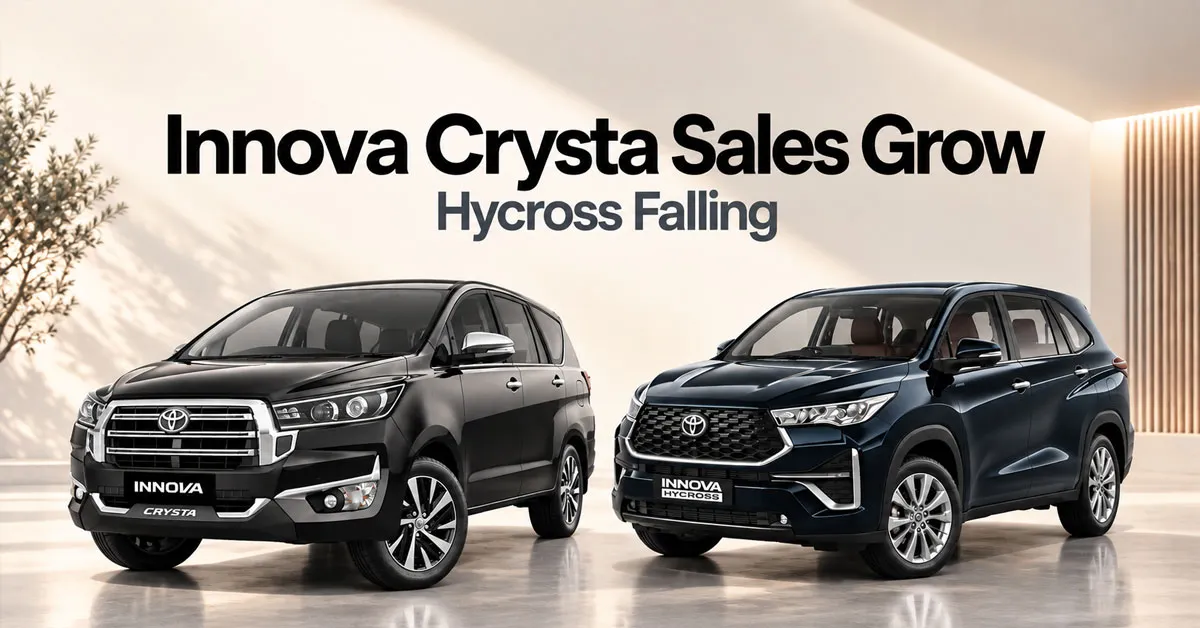
Toyota sold more Innova Hycrosses than Crystas in August, but the direction of travel was very different. Innova Crysta wholesales rose 10.7 percent year-on-year to 3,849 units, while the newer Hycross fell 12.2 percent to 5,114 units. Hycross sales were also down 15.6 percent from July.
This is not a reversal of the sales hierarchy. The Hycross still outsold the Crysta by 1,265 units in August, and the two Innovas together delivered 8,963 units, nearly a third of Toyota’s domestic volume. What is interesting is that the older diesel model is still growing when it was supposed to be the car that the newer Hycross would gradually replace.
The Crysta is the old-school Innova. It uses a ladder-frame chassis, rear-wheel drive and a 2.4-litre diesel making 150hp and 343Nm. The only gearbox is a five-speed manual. Prices currently run from about Rs 19.77 lakh to Rs 26.63 lakh ex-showroom.
The Hycross changed almost everything. It is a front-wheel-drive monocoque MPV with a 2.0-litre naturally aspirated petrol engine, and higher versions use Toyota’s strong-hybrid system. Every version is automatic. Prices begin at Rs 18.70 lakh for the regular petrol and rise to Rs 31.84 lakh for the top hybrid.
That creates two very different ownership cases. A private buyer wanting a quieter automatic, better fuel economy in urban use and a more feature-rich cabin has strong reasons to choose the Hycross. A high-mileage owner who specifically wants diesel, a manual gearbox and the older Innova’s commercial-duty layout still has only the Crysta inside Toyota’s range.
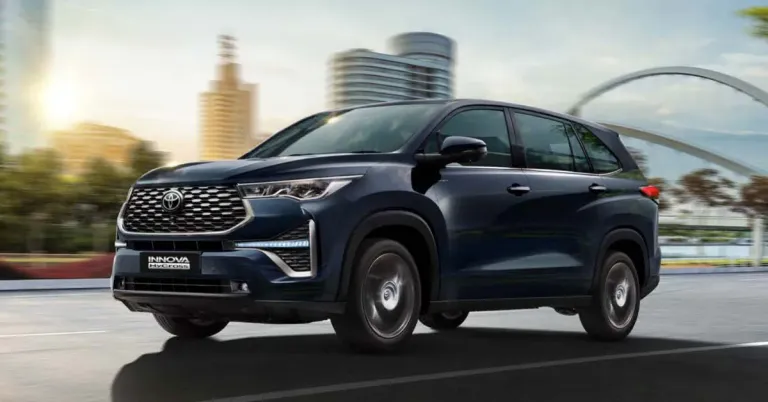
The entry prices make the split more interesting. A base Crysta costs only around Rs 1 lakh more than the cheapest petrol Hycross, while the first Hycross strong hybrid starts at Rs 26.76 lakh. That is almost exactly where the Crysta range ends.
So a buyer shopping around Rs 20-25 lakh is not simply choosing old versus new. The choice can be diesel manual Crysta versus petrol automatic Hycross. For fleet operators and owners covering large highway kilometres, fuel type and running pattern can matter more than having the newest dashboard or powertrain.
Toyota also continues to offer the Crysta to fleet customers. That gives the diesel MPV a demand base that does not overlap completely with the Hycross’s stronger private-buyer and premium-family positioning.
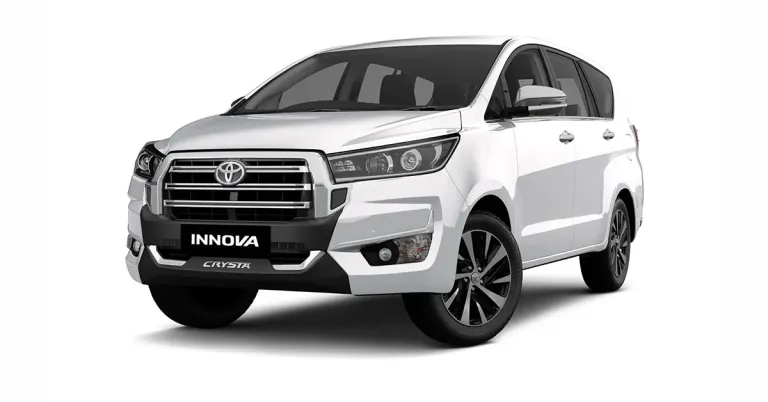
The August increase follows a strong July as well. Crysta sales reached 3,915 units in July, up 18.2 percent year-on-year. Hycross sold 6,061 that month and was still up 4.4 percent year-on-year, so August’s Hycross decline should not be treated as evidence of a permanent slide.
The more durable trend is that the Crysta refuses to disappear. Toyota updated it again in June with cosmetic changes even though the model is expected to be discontinued in 2027 as tighter CAFE-3 rules arrive. Mechanically, it remains largely the same diesel MPV buyers have known for years.
That approaching phase-out may actually sharpen the comparison over the next few months. If Crysta sales remain around 3,500-4,000 units while the Hycross continues above 5,000, Toyota will have succeeded in keeping two Innova customer groups alive at the same time rather than replacing one with the other.